
Packaged ice cream sold in supermarkets often contains problematic additives. An accumulation of substances – up to 15 in the same product – which can be easily avoided by checking the ingredient list on the label.
The nutritional profiles of shelf ice creams also deserve attention, as in some cases the levels of saturated fats and sugars are truly excessive. Too many, for those who pay even a minimum of attention to health. Our market survey on 20 ice creams.
Packaged ice cream, full of suspicious additives
The sample examined is a small representation of the hundreds of packaged ice creams available in supermarkets. But it is sufficient to note the widespread use of various additives.
Some ice cream brands precisely because of contaminated additives ended up in the ethylene oxide scandal, as we have seen.
Beyond this specific risk – and unfathomable without extensive checks as done in France – three substances deserve particular attention, although authorized, sometimes with usage limits.
E471, mono- and diglycerides of fatty acids
Mono- and diglycerides of fatty acids (E471) are emulsifiers widely used by the food industry. They appear in 13 of the 20 ice creams in the examined sample. The latest EFSA opinion (2017) does not indicate particular risks associated with their exposure. However, various scientific studies show the ability of mono- and diglycerides of fatty acids to alter the balance of the gut microbiota.
The imbalance of the microbiota linked to the intake of these and other emulsifiers in the cited scientific literature is associated with an increased risk of autoimmune diseases (e.g. Crohn's disease), allergies, inflammatory diseases, metabolic syndrome (increased adiposity), diabetes, and colon cancer (1,2,3,4). More generally, as seen, intestinal dysbiosis ‘disrupts’ the immune system.
E442, ammonium phosphatides
Ammonium phosphatides (E442) are other discouraged emulsifiers. The risk comes from the presence of erucic acid, whose frequent and prolonged intake may pose a health risk especially for children, as they are more exposed.
Animal testing associate its consumption with the onset of a cardiac syndrome (myocardial lipidosis). Moreover, as with many phosphate-based food additives, E442 is suspected to promote cardiovascular diseases.
The additive is subject to a usage limit of 10,000 mg/kg (1%) in cocoa and chocolate products. Based on the EFSA evaluation of an acceptable daily intake (ADI) of phosphates equal to 40 mg of phosphorus per kg of body weight. (5)
In the sample we found E442 in Algida croissant and Carte d’Or.
E407, carrageenan
Carrageenans derive from red algae and are widely used by the food industry as thickeners and gelling agents. However, following high temperature heating or in the presence of high acidity, carrageenans can release degraded carrageenans.
The scientific literature shows a link between the intake of degraded carrageenans and the onset of colon cancer. So much so that the International Agency for Research on Cancer (IARC) has classified them as possible carcinogens (group 2B). Other studies on rats have not confirmed carcinogenicity. Nonetheless, the European legislator allows their presence up to 5% in additive E407. (5)
Among the 20 ice creams examined, carrageenan is contained in 5 products, one of which (Ben & Jerry’s) has a recall package for children. In addition to two Carte d’Or ice creams, a Carrefour ice cream, and the iconic Motta Coppa del Nonno.
Excess saturated fats and sugars
The nutritional profile of the examined ice creams is sometimes very unbalanced. The products are quite similar, all based on industrial creams, with 'fewer calories' generally in fruit ice creams.
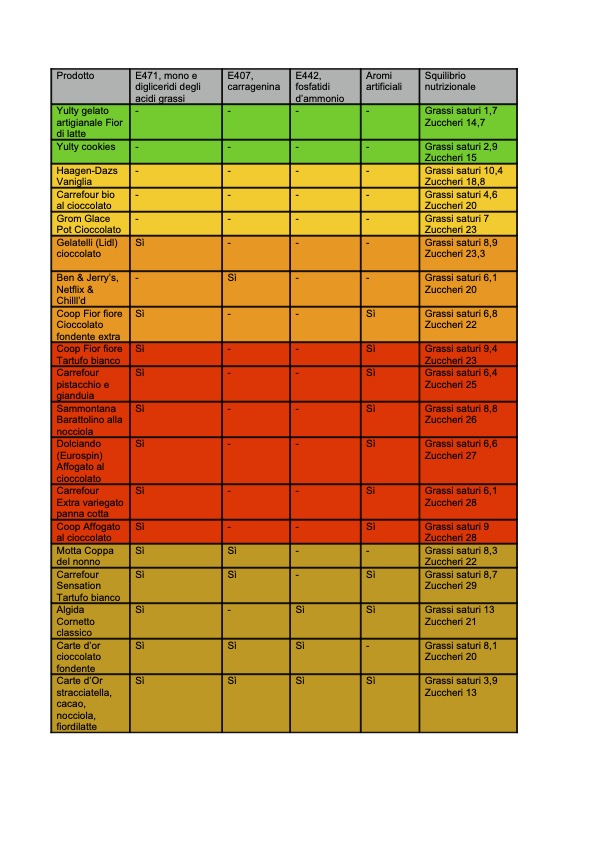
The variations are significant, as shown by the table of the 20 ice creams examined:
– saturated fats vary from 2.9% to 13%. More than four times.
– sugars range from 13% to 28%, more than double.
Ice cream, additives and natural flavors (or not)
Our analysis also considers the presence of natural or artificial flavors, whose use is sometimes necessary to attribute flavor to ultra-processed foods with low-quality raw materials.
The true artisanal ice cream Italian, it goes without saying, it’s a whole different thing. And that’s why our site GIFT (Great Italian Food Trade) has repeatedly called for the definition of a voluntary standard that allows certifying its authenticity. Without even needing a law, recently proposed, which Big Food will vigorously oppose.
Marta Strinati
Notes
(1) Chronic intestinal inflammation caused by mono- and diglycerides of fatty acids and other emulsifiers can also promote the onset of colon cancer. See Viennois E, Chassaing B. (2021). Consumption of Select Dietary Emulsifiers Exacerbates the Development of Spontaneous Intestinal Adenoma. Int J Mol Sci. 2021 Mar 5;22(5):2602. doi: 10.3390/ijms22052602.
https://pubmed.ncbi.nlm.nih.gov/33807577/
(2) Chassaing B, Koren O, Goodrich JK, Poole AC, Srinivasan S, Ley RE, Gewirtz AT. Dietary emulsifiers impact the mouse gut microbiota promoting colitis and metabolic syndrome. Nature. 2015 Mar 5;519(7541):92-6. doi: 10.1038/nature14232. https://pubmed.ncbi.nlm.nih.gov/25731162/
(3) Lerner A, Matthias T. Changes in intestinal tight junction permeability associated with industrial food additives explain the rising incidence of autoimmune disease. Autoimmun Rev. 2015 Jun;14(6):479-89. doi: 10.1016/j.autrev.2015.01.009. Epub 2015 Feb 9. PMID: 25676324. https://pubmed.ncbi.nlm.nih.gov/25676324/
(4) Naimi, S., Viennois, E., Gewirtz, A.T. et al. Direct impact of commonly used dietary emulsifiers on human gut microbiota. Microbiome 9, 66 (2021). https://doi.org/10.1186/s40168-020-00996-6
(5) Reg. EC 1333/08, regarding food additives. Annex II, Part B https://eur-lex.europa.eu/legal-content/IT/TXT/HTML/?uri=CELEX:02008R1333-20201223&from=IT#tocId2

Professional journalist since January 1995, she has worked for newspapers (Il Messaggero, Paese Sera, La Stampa) and magazines (NumeroUno, Il Salvagente). Author of journalistic investigations on food, she published the book 'Reading labels to know what we eat'.


