

Under the generic label ‘orange juice’ there are three very different categories of drinks. From freshly squeezed juices naturally rich in vitamin C to 100% fruit juices from concentrate, up to drinks almost always with little juice and a lot of sugar and additives (sometimes to avoid).
Shelf offerings are examined by comparing 50 products, divided into 17 freshly squeezed juices (6 blood oranges and 11 blond), 6 organic freshly squeezed juices, 7 juices from concentrate and 20 drinks with orange juice. Among the latter there is the ‘no added sugars’ variant (and without sweeteners), which raises some doubts.
As always, we examine the brands of leaders in the Brand Industry (IDM) and Private Label (MDD). For the latter, we compare the private labels of GDO (Coop, Esselunga, Carrefour, Conad), discount (Eurospin, Lidl and Todis) and their suppliers (Consilia).
It is worth noting that freshly squeezed juices are subject to VAT at 22%, while the less valuable juices from concentrate and sugared drinks with a bit of juice are subject to the lower tax of 10%. Italian farmers are thus penalized compared to the beverage industries.
Orange freshly squeezed juices
Freshly squeezed orange juice It is the top product. It contains only fresh orange juice. No juice from concentrate, nor added sugars, flavors, colorings or additives.
The commercial name Strictly speaking, it is improper, since industrial juice extraction does not occur by squeezing, as at home and in bars, but through needle devices that suck the juice from the fruit.
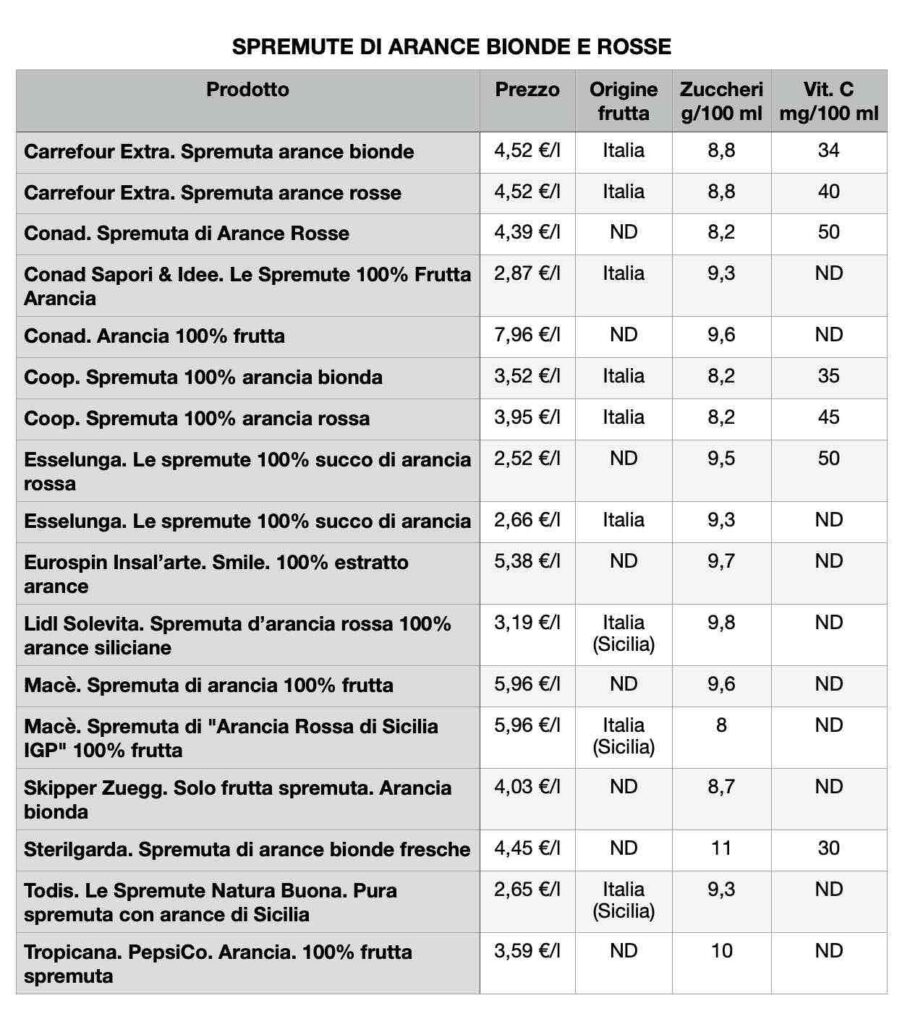
9 juices out of 17 They come from Italian oranges. It is peculiar the case of Lidl's red orange juice which contains pulp, more precisely 'added orange cells', from Sicilian fruits but is bottled in Germany, two thousand km away from the collection point. Eurospin instead declares its (expensive) blonde orange juice as 'Produced in Italy', without specifying the origin of the fruit.
Blood oranges and blond oranges
Taste aside, several aspects distinguish red orange juices from ‘blonde’ ones.
Vitamin C is more abundant in red oranges. Comparison is not simple as the Vitamin C content is indicated on the label in only 7 products out of 17. The few available data show the following:
– red orange juices report the amount of Vitamin C, varying from 40 to 50 mg/100 ml, in 4 cases out of 6. The two labels that omit the information are Lidl and Macè.
– in blonde orange juices, Vitamin C is indicated in only 3 products out of 11 and varies between 30 and 35 mg/100 ml.
The average price is about 4 €/l, with great variability within each category:
– from 2.52 to 5.96 €/liter, more than double, among red orange juices, from the cheapest Esselunga to the most expensive Macè, both with red oranges of unknown origin,
– from 2.65 to 7.96 €/liter, triple, for the blondes. Todis and Esselunga have the most convenient prices, Conad the highest. The price of Eurospin juice, 5.38 €/liter, not exactly ‘discount’, is noted.
Organic freshly squeezed juices, blood and blond
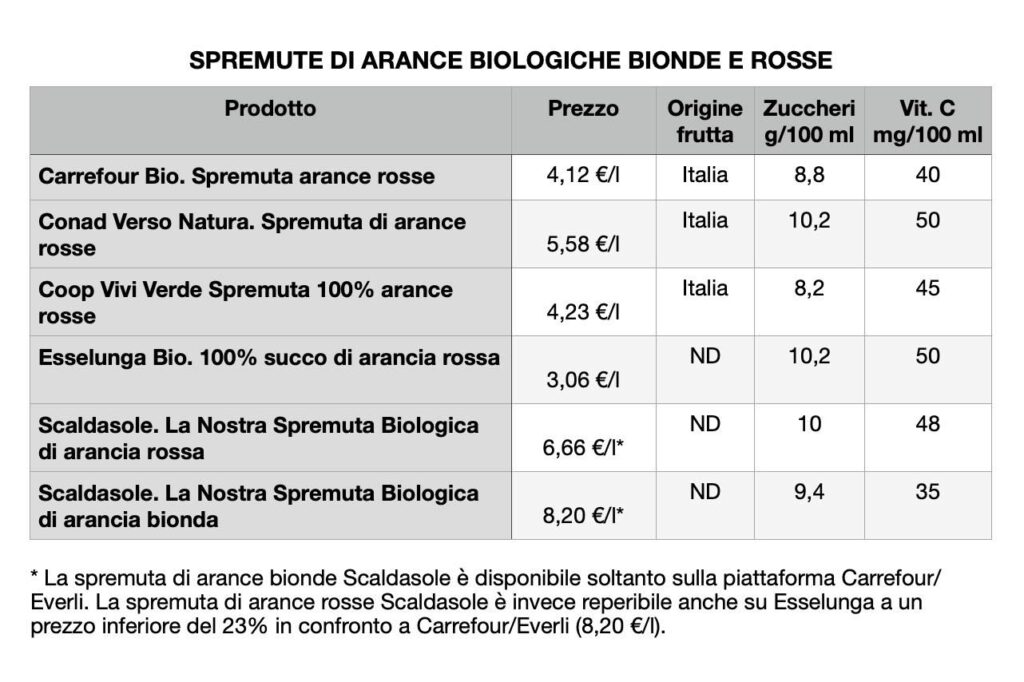
The most prized organic version of orange juice often has a similar cost, sometimes even lower than ‘conventional’ fruit products, that is treated with synthetic pesticides. Good food, respectful of the environment and health, is therefore in some cases an option for every budget.
The average price is 4.96 €/l, with a range between 3 €/l from Esselunga and double, about 6 €/l, from Conad and Scaldasole.
The Italian origin The fruit origin is mentioned only on three labels out of six: the blood orange juices from Carrefour, Conad and Coop.
Vitamin C is confirmed to be more abundant (from 45 to 50 mg/100 ml) in the red juices than in the only blonde one (35 mg/100 ml).
Concentrate juices of 'blond'
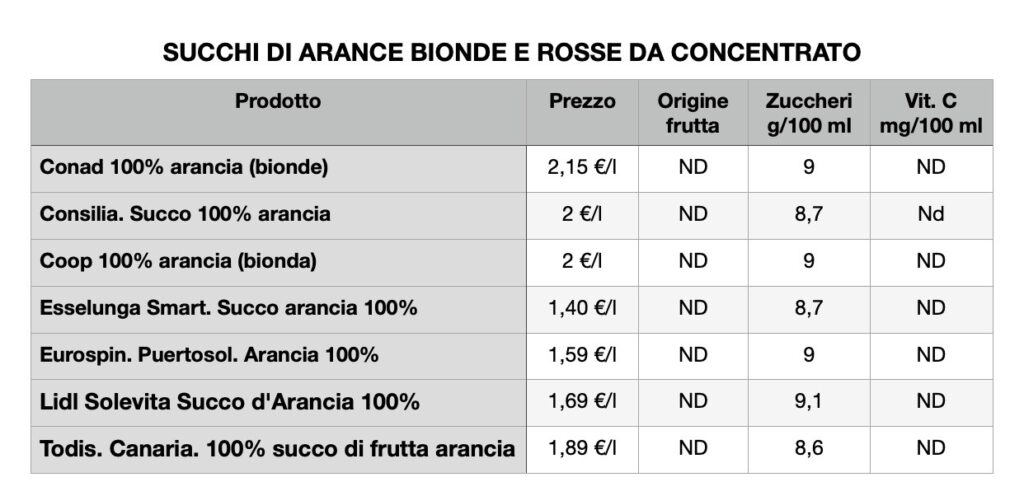
Less valuable of the juices are orange juices from concentrate, offered with the claim '100% fruit'. The average price of the seven products examined is €1.82/l, less than half of the fresh juices. It ranges from a minimum of €1.40/l for the Esselunga juice to a maximum of two euros (Conad, Coop, Esselunga).
Fruit origin and vitamin C content always unknown. The only ingredient is juice from concentrate, except for two cases (Conad and Todis) where the additive ascorbic acid is also present.
Drinks with orange juice, a difficult world
Rarely acceptable are finally the drinks with water and orange juice (from concentrate). Colorants, synthetic flavors, additives and sugars and/or artificial sweeteners are often added to the mixtures.
Out of 20 drinks examined, only two are correctly presented by reporting the content of 'blood orange and blonde orange'. Another five, although composed this way, are presented as 'blood orange'.
Fruit origin is always unknown. An exception is Hero Light, with Italian fruit.
The amount of juice of orange varies from 30 to 80%. But, as the table shows, this figure is not always the only indicator of good quality. Attention to sugars and additives.
Low-cost, low-quality
The average price of these drinks is €1.56/l, with a minimum of €0.86/l (Conad Vit blood orange) and a maximum of €2.89/l (Hero Light).
Vitamin C is displayed on the label only when added. This happens in 11 products with a vitamin content ranging from 6 to 40 mg/100 ml.
Among the ingredients we find substances that should be avoided. Especially in children's diets:
– synthetic flavors in 11 products, artificially mimicking the taste of fruit,
– E 120. This dye (carminic acid or cochineal) is obtained from squeezing insects cactus parasites. It is banned in organic products and subject to an acceptable daily intake of 2.5 mg/kg body weight. It is indeed allergenic and suspected to promote hyperactivity in children. It is found in 2 products (Consilia and Rauch),
– added sugars. 13 drinks contain sucrose, in four cases in addition to glucose-fructose syrup (GFS). The result is a sugar concentration of up to 12 g/100 ml. That is 7.5 teaspoons (level, 4g each) of sugar in a 250 ml glass. While EFSA recommends to minimize sugar consumption, a cause of cavities and chronic metabolic diseases,
– sweeteners. Rauch adds cyclamates (E 952) and saccharin (E 954) in one product and sugar mixed with sucralose (E 955) in another. Hero Light uses instead sucralose (E 955). These synthetic sweeteners are useless for weight loss and expose to diseases such as type 2 diabetes, cardiovascular diseases, and mortality, WHO has warned in the guide published a year ago.

Few clean recipes, just watered down juice
Only four products ‘Without added sugars’ are made with water, orange juice and natural flavors, without any sweetener or additive.
The alternative is unappealing. All things considered, if you need to save money, it is better to choose a tasty organic squeezed juice (naturally rich in vitamin C) and add water in the same ratio as the concentrated juice in soft drinks is diluted. More taste, fewer illusions.
Fruit origin, when?
‘The European Parliament outgoing has deliberately omitted to introduce the obligation to label the origin of fruit in juices, as in jams, in the recent revision of the breakfast directives,’ denounces lawyer Dario Dongo, candidate for the European elections to be held on June 8-9, 2024 in the North-East College, with the movement #PeaceEarthDignity.
‘Our battle so that the origin of the primary (>50%) and characteristic ingredients is mandated as compulsory on the labels of all food products continues in every context. Consumers have the full right to make informed purchasing choices, to enhance the products of local agriculture’.
Marta Strinati

Professional journalist since January 1995, she has worked for newspapers (Il Messaggero, Paese Sera, La Stampa) and magazines (NumeroUno, Il Salvagente). Author of journalistic investigations on food, she published the book 'Reading labels to know what we eat'.


