
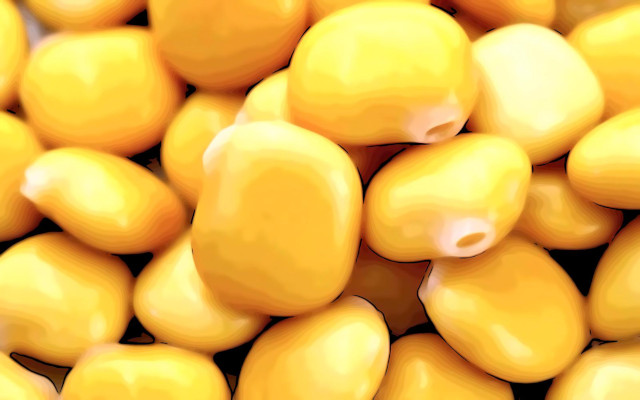
Lupins are an ancient legume, historically cultivated primarily for their soil-enhancing capacity. They were also present on our grandparents' tables, often eaten as snacks simply boiled. Today, thanks to their nutritional properties, they are gaining renewed interest, especially as an ingredient for meat substitute products. (1)
Lupins, a legume with an ancient history
The lupins, or ‘wolf beans’, are the fruits of a herbaceous plant belonging to the Leguminosae or Fabaceae family. It is a typical crop of the Mediterranean area and the Middle East, known since ancient times.
The first traces come from the Egyptians, who placed them in the tombs of the pharaohs. For the Greeks, they had propitiatory functions while the Romans cultivated and consumed them in large quantities as a substitute for meat, taking advantage of their high energy and protein value.
Three species cultivated in Italy
There are many species of lupin, but not all suitable for human consumption. Those cultivated in Italy – especially in Calabria, Puglia, Lazio and Campania – are three:
– white lupin (Lupinus albus),
– yellow lupin (Lupinus luteus) and
– blue or azure lupin (Lupinus angustifolius).
The plant is annual and can reach a height of 1.5 meters. It has a very elegant flowering, with large white flowers. After pollination, long flattened pods form containing seeds that are white and up to 15 millimeters in diameter.
Resistant to frost and drought
The lupine plant it adapts well to different types of soil. In fact, its nitrogen-fixing action – typical of legumes – is able to improve the structure and fertility of the soils, so much so that it was used as a rotation crop. (2)
Resistance to frost allows early sowing, already in autumn. The late flowering, between May and June, is ideal for pollinating insects. The pods are harvested at the end of summer, after the sun has dried the plant.
Water requirement is modest. Lupine roots can penetrate the soil up to a depth of 1.5 meters, making irrigation unnecessary except in extremely dry periods. This characteristic makes this crop resilient to climate change.
Excellent nutritional properties
Protein content of lupine seeds is similar to that of soybeans and higher than all other legumes: about 16 g per 100 g, 34-44% on dry weight. Furthermore, the quality of the proteins is very high due to the amino acid composition and their digestibility.
They contain 7.2 g/100 g of carbohydrates, but they are practically starch-free. The fat content is significantly low, about 2-3 g per 100 g of product. The seeds contain a considerable amount of oil rich in unsaturated and saturated fatty acids. Lupine seeds are also a rich source of vitamins – especially B group – and minerals such as calcium, phosphorus, magnesium, potassium, and manganese.
Selection of plants with fewer alkaloids
One of the causes that has led to the low consumption of lupines in our diet is the presence of some antinutritional substances, particularly alkaloids. These substances are produced by some plants as a defense against predators. Other examples are solanine in potatoes, nicotine in tobacco, or caffeine in coffee plants.
Alkaloids give a bitter taste to lupines, which can become toxic to humans and animals. Those contained in lupines belong to the quinolizidine family and are about 100 bitter components. To avoid health problems, over time sweet lupine varieties have been selected – for example, the 3 mentioned above – which have an average content of 130-150 mg of alkaloids per kilo (0.013-0.015%) compared to bitter lupines that contain 40-80 thousand mg per kilo (4 to 8%). (3)
Potential and future challenges
Thanks to its characteristics and properties, lupine is arousing new interest for its possible applications.
In agriculture
Besides being a plant that adapts well to the most difficult soils and climates, lupine is a natural fertilizer. In particular, bitter lupins have a greater ability to fix nitrogen. Moreover, the alkaloids contained in the plant can be used as natural pesticides.
In medicine
Proteins of lupine have beneficial effects on lipid and glucose metabolism as well as on blood pressure levels. Furthermore, they affect inflammatory processes and changes in the gut microbiome. The high content of polyunsaturated fatty acids relative to a low level of saturated fatty acids makes lupines useful in the prevention of numerous metabolic diseases, including cardiovascular diseases.
Alkaloids, moreover, can be usefully employed in pharmaceuticals. They have antimutagenic, antibacterial, antifungal, antitumor and anti-inflammatory properties. In particular, lupanine enhances insulin release induced by glucose, proving useful in the treatment of type II diabetes, while sparteine is an anticonvulsant. (4)
In the food and feed industry
The demand for proteins is growing exponentially, in line with the growth of the world population. Lupines can be a valid alternative to soy, which we mostly import today, to be used in human nutrition and feed.
The lupins are also gaining increasing interest from the alternative meat food industry aimed at vegans and vegetarians. Besides the classic recipe – boiled and salted lupine seeds – today you can find burgers, sauces, meatballs and cold cuts made from lupine flour. Being practically starch-free, they are also suitable for celiac diets. (5)
The challenges
One of the major problems related to lupine consumption, as we have seen, is the presence of alkaloids. Only a few countries have set maximum limits for the presence of such substances in food. These include France, Great Britain, Australia and New Zealand, where the maximum level is set at 200 mg/kg of alkaloids in seeds.
Lack of regulation At the European level. Today, for their commercialization, it is necessary to eliminate contaminants, as required by Council Regulation 315/93. The elimination of alkaloids can be carried out through leaching, which might however reduce the protein content. Alternatively, cultivating ‘sweet’ lupins that produce alkaloids in insignificant amounts.
Other contaminant A source of concern regarding human and animal consumption of lupins are the Phomopsins, a family of mycotoxins produced by the fungus Diaporthe toxica. Since data on the presence of phomopsins in food and feed are poorly documented, EFSA has not issued precise recommendations concerning maximum intake levels. However, considering that fumopsin was found to be hepatotoxic in all evaluated species and hepatocarcinogenic in rats, EFSA suggests to keep animal and human exposure to this mycotoxin as low as possible.
Provisional conclusions
Given the numerous positive aspects of lupins and their promising help in the challenges posed by this historical period, the European legislator should establish legislation on alkaloids to allow farmers to produce them safely. Clear regulation would also stimulate research for an in-depth study of antinutrients and their isolation.
Further boost to the revival of this crop in Italy would be the increase of lupin collection centers and infrastructures for their processing.
Alessandra Mei
Notes
1) Dario Dongo, Andrea Adelmo Della Penna. Alternative plant-based proteins to meat, the nutritional challenges. Food Times. 19.12.22
(2) Dario Dongo, Camilla Fincardi. The value of legumes to feed the planet, FAO report. Food Times. 11.1.20.
(3) Ivraina Brändle, Christine Arncken, Ursula Kretzschmar, Ludivine Nicod, Mariateresa Lazzaro. Alkaloid analysis in lupins. Prerequisite for food production. FiBL. 2024. No 1763. DOI:10.5281/zenodo.10592310 https://www.fibl.org/fileadmin/documents/shop/1763-alkaloid-analysis-lupins.pdf
(4) Ana Pereira, Fernando Ramos, Ana Sanches Silva. Lupin (Lupinus albus L.) Seeds: Balancing the Good and the Bad and Addressing Future Challenges. Molecules. 2022, 27(23): 8557. 5.12.2022 doi:https://doi.org/10.3390/molecules27238557
(5) IRTA. LUPIPROTECH – Obtaining and functionalization of lupine protein isolates for the development of cooked meat analogues. https://www.irta.cat/en/

Graduated in Law at the University of Bologna, she attended the Master in Food Law at the same University. She is part of the WIISE srl benefit team, dedicating herself to European and international research and innovation projects.


