
Energy drinks can threaten the health of consumers, especially younger ones. Their habitual and/or massive consumption is in fact associated with damage to the cardiovascular system.
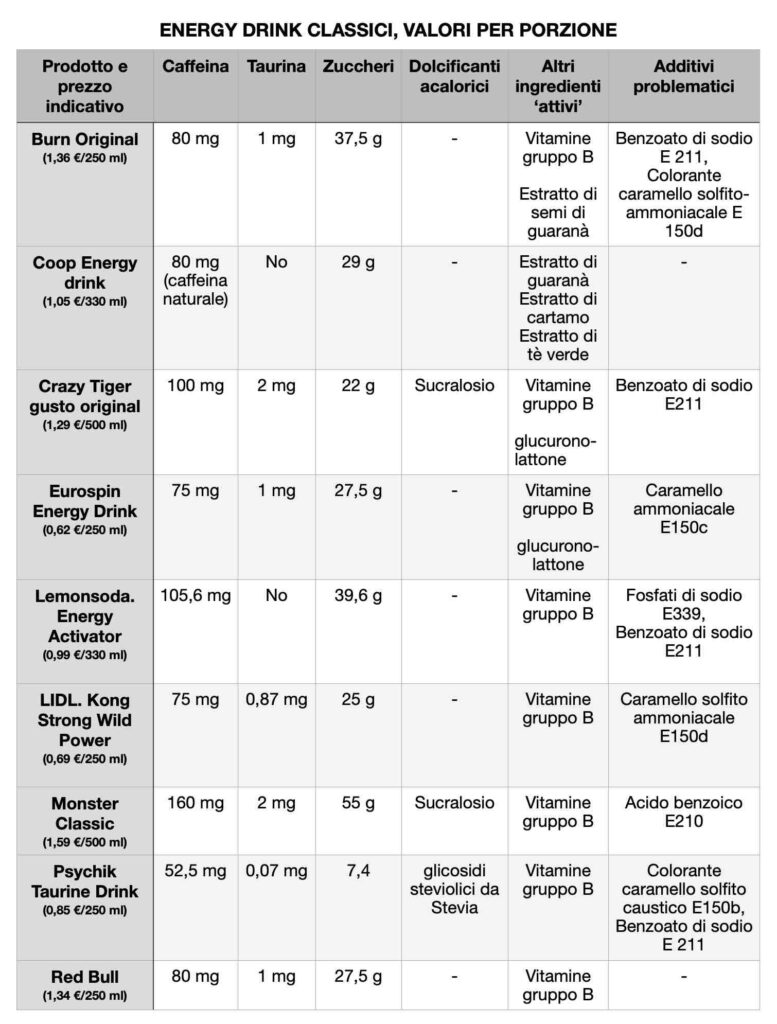
The market survey of 16 energy drinks available in Italy also reveals the presence of less than recommended colorants and chemical additives, as well as caffeine and sugar in quantities.
Red Bull, Monster and other energy drinks
The basic recipe of energy drinks is composed of a high caffeine content, in combination with taurine, sucrose (or synthetic sweeteners, in the sugar free versions), group B vitamins, ginseng and other herbal extracts.
Caffeine, in all the products examined, always has a concentration above 150 mg/L. And it is therefore mandatory to include the warning on the label of these drinks, pursuant to the Food Information Regulation (EU) 1169/11:
'High caffeine content. Not suitable for children or pregnant or breastfeeding women.
Caffeine, crazy concentrations and doses
Concentration of caffeine, in the 16 products examined, varies from 240 to 320 mg/L. That is to say, from 160% up to 213% compared to the dose that the European legislator classifies as 'high'.
The amount of caffeine moreover it increases in proportion to the size of the can, up to exceeding 160 mg of caffeine in a can of Monster. An objectively excessive dose.
Caffeine, 'health claims' not allowed and food safety
The ingredient characteristic of energy drinks - caffeine, of provenance declared as natural in Coop's drink alone - can stimulate the central nervous system and increase mental clarity, reducing drowsiness. Furthermore, the related 'health claims' have not been approved, pursuant to the Nutrition and Health Claims Regulation (EC) 1924/06, and their even implicit suggestion is therefore prohibited.
Food safety of drinks containing caffeine was evaluated by EFSA (European Food Safety Authority) in 2015. According to the Authority, they do not cause concern in a healthy adult weighing 70 kg
– single doses up to 200 mg of caffeine e
– up to 400 mg of substance in total throughout the day. (1)
Children and teenagers, one drink is enough to go over the limit
For children and teenagers However, 'the information available is insufficient to derive a safe intake of caffeine', states the Authority. The criterion established for healthy adults is therefore extended to this segment of the population (vulnerable by definition).
The daily dose not to be exceeded is therefore established at 3 mg per kg of body weight. Namely, for example
- 150 mg per day for a body weight of 50 kg, typical of a teenager
- 120 mg for a pre-adolescent (13 years old) weighing 40 kg
- 75 mg for a 10-year-old child weighing 25 kg.
The calculations are soon done. For younger people, a can of energy drink is enough to exceed the safety threshold. Not to mention the further consumption of caffeine contained in other food sources such as tea, chocolate and other drinks (such as Coca-Cola, which contains over 106 mg/L).
Excess caffeine, what effects?
The adults have almost certainly experienced at least once the unpleasant effects of an excess of caffeine, even just because of one too many coffees. Effects that 'energy drinks' can amplify, due to the dosage and combination with sugar and other ingredients (see the next paragraph).
Agitation, palpitations, insomnia and other sleep disorders are the most well-known side effects. But not the only ones. In fact, the cardiovascular system is also affected.
A study (Kaur et al., 2022) highlights that the consumption of energy drinks has been repeatedly associated with damage to the cardiovascular system, such as atrial and ventricular arrhythmias, myocardial infarctions, cardiomyopathies and sudden cardiac death. The authors define its consumption as 'a growing public health problem in recent decades'. (2)
Caffeine mixed with other stimulants
Every ingredient of energy drinks can contribute to these harmful effects.
Caffeine acts on the cardiovascular system through various mechanisms - such as blocking vasodilation of the vascular beds, increasing sympathetic tone and positive inotropic action on the myocardium - which determine the acute increase in heart rate and blood pressure.
The other ingredients characteristic of energy drinks - such as taurine, sugars and B vitamins - in turn 'can contribute to these outcomes by increasing heart rate, blood pressure (BP) and contractility of the heart, as well as prolonging the QTc (the interval measured with the ECG, ed.)'.
Simple sugars, cardiovascular disease and diabetes
Simple sugars, i.e. sucrose, glucose or high fructose corn syrup, are also responsible for the cardiovascular risks described in the current study. In the products we examined, sugars vary from 7.4 to 15%. Up to a dose of 55 g – equal to 11 teaspoons of sugar in a single portion – in a can of Monster.
'It has been noted that sugar and caffeine have synergistic effects that cause a significantly high increase in blood sugar and insulin after their consumption.' This means that in the long term the consumption of these drinks leads to obesity and insulin resistance. 'And diabetes is a major risk factor and one of the most common causes of cardiovascular disease.'
Other 'active' ingredients
B vitamins they are almost always present in energy drinks. Known as a beneficial supplement, these also likely enhance the stimulatory effects of the other ingredients in these drinks, the study authors hypothesize.
Guarana and yerba mate, two plants often present in energy drinks, are also rich in caffeine. 'These ingredients may also increase the adverse effects of caffeine on the cardiovascular system,' the researchers note.
Ginkgo biloba and ginseng, in turn often present in energy drinks, are indicated by researchers (Kaur et al., 2022) as potentially harmful:
– some clinical cases describe serious hemorrhagic events due to ginkgo biloba extracts, probably due to its antagonism effect on platelet activation factor;
– prolonged use of ginseng is instead associated with cardiovascular side effects, such as increased blood pressure, long QT syndrome or atrial fibrillation.
Salt/sodium
Despite the sweetened flavors, energy drinks also contain non-negligible doses of salt.
The highest tenor, 0.24%, is present in the Eurospin drink which thus provides 60 mg of salt per serving. The maximum dose of salt per can is contained in the Monster, 0.96 g.
Additives and colorants
Additives, flavorings and colorings complete the recipe for 'energising' drinks.
Physik, Burn, Monster, Lemonsoda, Crazy Tiger and Eurospin contain the preservative sodium benzoate (E 211) or benzoic acid (E 210), the widespread use of which in drinks suggests that it is easy to exceed the tolerable daily dose for children. Both additives are associated with hypersensitivity and allergic reactions (asthma, itching, redness) and are suspected of promoting hyperactivity in children, alone or in mix with some azo dyes.
Lemon soda instead it contains sodium phosphates, linked to an increase in cardiovascular risk and worsening of intestinal inflammation. (3)
Lots of energy drinks 'classics' also contain dyes that are strongly discouraged:
– Burn and Lidl they add ammonia caramel (E 150d), which may contain a compound suspected of being carcinogenic (group 2b) by the IARC and should be avoided in case of intolerance to sulphites.
– Eurospin and Lidl zero instead they use caramel E150c, based on ammonia, which may contain an immunotoxic substance (THI) and one suspected by Iarc of being carcinogenic (class 2b). Psychic instead it contains caramel 150b, to be avoided in case of intolerance to sulphites.
Saint Benedict finally, it adds a dye from Southampton, E129 red which, as the mandatory warning on the label states, 'May negatively affect the activity and attention of children'.
Sugar free, from the frying pan to the grill
Searching for sugar free products it is a consolidated and growing trend, as the Imagine Observatory has noted for some years. (4) The offer is also thriving among energy drinks. But what is sugar replaced with?
In the sample, the sugar free version is always based on synthetic sweeteners: aspartame, acesulfame k and sucralose. In Eurospin and San Benedetto products we also find cyclamates. All these substances are not recommended by the WHO because they are useless for losing weight and expose you to diseases such as type 2 diabetes, cardiovascular diseases and mortality. (5)
Aspartame and acesulfame K Furthermore, in a recent cohort study conducted on 102,865 French adults (Debras et al., 2022) they are also associated with an increased risk of cancer, particularly breast cancer, and obesity-related tumors. (6)
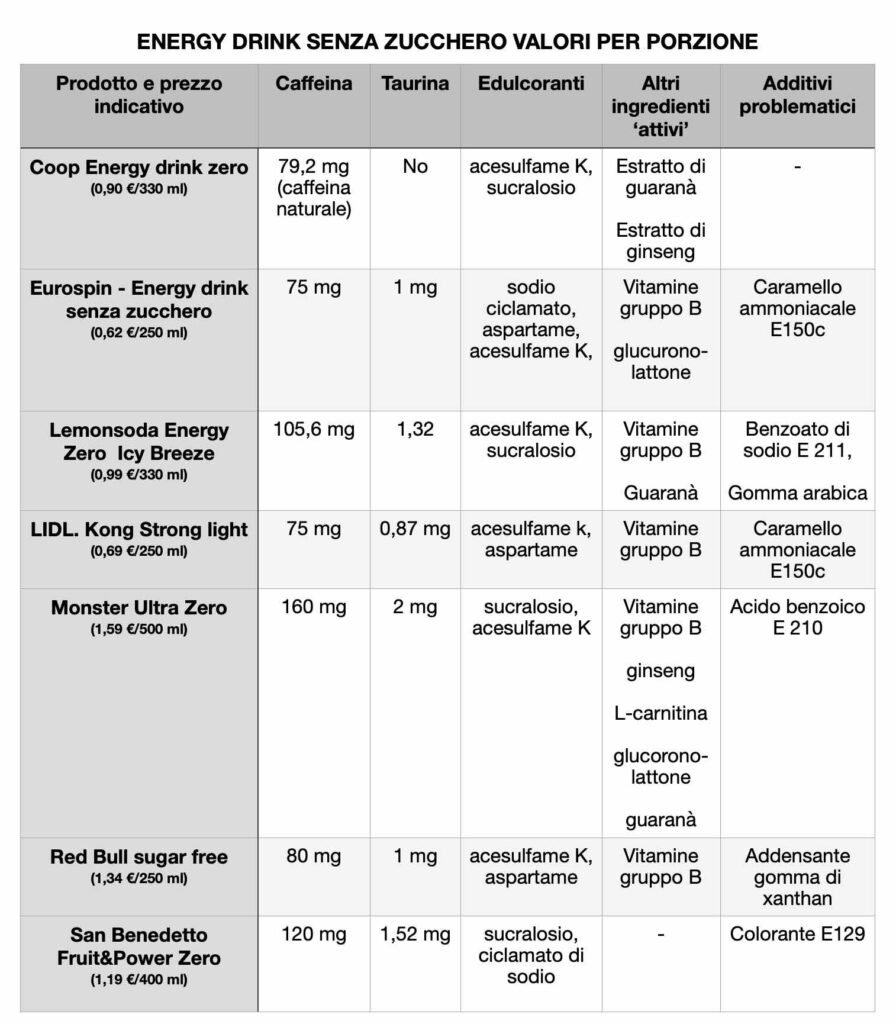
The 'no added sugar' versions they sometimes contain gum arabic and xanthan, the abuse of which causes intestinal disorders.
Flavors and colorings in the fruit flavor version
With or without sugar, fruit-flavored energy drinks are multiplying. A subgroup which is not better from the point of view of nutritional quality.
The basic recipe it is substantially identical to that of 'classic' energizing drinks. Same quantity of sugars or synthetic sweeteners, caffeine, taurine etc.
The various flavors they are obtained with synthetic aromas (generically defined as 'flavors'), as in Red Bull, or natural aromas (in Monster) which recall the flavor of the fruit mentioned on the label.
As for the dyes, in addition to the presence of the caramels already mentioned, we would like to point out Monster Energy Ultra Strawberry Dreams which in its drink with 160 mg of caffeine per portion also includes E129 and E110 reported as a cause of ADHD and therefore accompanied by the warning on the label: 'It can negatively influence the activity and attention of children'.
Use, abuse and warnings
In any shape and taste, it is a fact that energy drinks are understood by certain segments of the population as a stimulant useful for getting high.
Downing several cans of drinks or combining it with alcohol (with the effect of reducing alcohol-induced drowsiness but not the dizzying effects) is however dangerous and the producers - who are aware of it - try to limit their responsibilities with warnings on the label such as:
'Do not mix with alcohol. Consume responsibly', Monster.
'Consume responsibly', Burn.
'Consume moderately', Red Bull and Lemonsoda.
'Not suitable for diabetics and people sensitive to caffeine. Do not consume with alcohol or during intense sporting activity', Lidl.
Unbridled marketing
It's difficult reconciling the warnings of caution with the encouragement of consumption conveyed by marketing and sponsorships with sporting events and personalities considered a model to emulate. Some examples.
Drink a can of Burn 'it will fuel the fire that is in you. Artists, Musicians, Stylists and Enthusiasts all know what we are talking about. Open a can of Burn Energy and you'll find out too!'.
The creatives – or aspiring ones – are in the crosshairs of marketing. 'Musicians, revolutionaries, students, road warriors, metalheads, geeks, hipsters and bikers love it... you will love it too!', guarantees Monster.
Temporary and permanent damage
The consumption of energy drinks, despite the marketing, is associated with temporary suffering and very serious reactions. The authors of the study in question (Kaur et al., 2022) summarize them as follows:
‘Gli effetti collaterali acuti associati agli ED (energy drink, ndr) sono mal di testa, disagio, irritabilità, eccitabilità, malessere, disidratazione, nervosismo, insonnia, nausea/vomito, dolore addominale e xerostomia (secchezza delle fauci, ndr).
Some other more serious and even fatal consequences that have been reported from ED consumption include seizures, intracerebral hemorrhage, acute hepatitis, rhabdomyolysis, acute renal failure, and psychosis.
All of this in addition to the aforementioned cardiovascular damage, which 'includes supraventricular and ventricular arrhythmias, coronary vasospasms, myocardial ischemia/infarctions and sudden cardiac death in otherwise healthy patients. The presenting symptoms in these patients were often chest pain, palpitations, nausea and vomiting.
A recent Italian study (Costantino et al., 2023) offers a comprehensive review of the confirmed effects of acute or chronic energy drink abuse on human health. An impressive collection of data accompanied by a disturbing consideration:
'This review highlights the need for greater rigor in the assessment of sudden cardiac death, particularly in young people, as legal substances such as energy drinks may be involved,' the study authors write. (7)
Restrictions on the sale of energy drinks
The researchers they call for the regulation of these drinks and for more studies on the interaction of the various ingredients contained in them. Energy drinks, however, continue to be available without restrictions, even in vending machines.
Only in some countries There are restrictions on sales to minors. In Poland, Lithuania, Latvia and Türkiye, sales are only permitted to those over 18 years of age. The Czech government has voted for a similar measure and the United Kingdom is discussing it. (8)
Marta Strinati
Notes
(1) EFSA Panel on Dietetic Products, Nutrition and Allergies. Scientific Opinion on the safety of caffeine. EFSA Journal. 27.5.15 https://doi.org/10.2903/j.efsa.2015.4102
(2) Amandeep Kaur, Hamza Yousuf, Devyani Ramgobin-Marshall, Rahul Jain, Rohit Jain. Energy drink consumption: a rising public health issue. Rev. Cardiovasc. Med. 2022, 23(3), 83. https://doi.org/10.31083/j.rcm2303083
(3) Marta Strinati. Ginseng coffee, be careful of additives. 20 products compared. GIFT (Great Italian Food Trade). 5.7.24
(4) Marta Strinati. Food consumption in Italy in the XVI edition of the Osservatorio Imagine. FT (Food Times). 21.12.24
(5) Marta Strinati. 'Sugar-free'? Synthetic sweeteners are useless and harmful, warns WHO. GIFT (Great Italian Food Trade). 15.5.23
(6) Marta Strinati. Aspartame and health risks, brief scientific review. FT (Food Times). 20.8.23
(7) The Italian study. Costantino A, Maiese A, Lazzari J, Casula C, Turillazzi E, Frati P, Fineschi V. The Dark Side of Energy Drinks: A Comprehensive Review of Their Impact on the Human Body. Nutrients. 2023 Sep 9;15(18):3922. doi: 10.3390/nu15183922. PMID: 37764707; PMCID: PMC10535526.
(8) Energy Drink: Europe calls for bans for children, but EFSA does not set limits for young people. Beverfood. 29.11.24

A professional journalist since January 1995, he has worked for newspapers (Il Messaggero, Paese Sera, La Stampa) and periodicals (NumeroUno, Il Salvagente). Author of journalistic investigations on food, she published the volume 'Reading labels to know what we eat'.


