

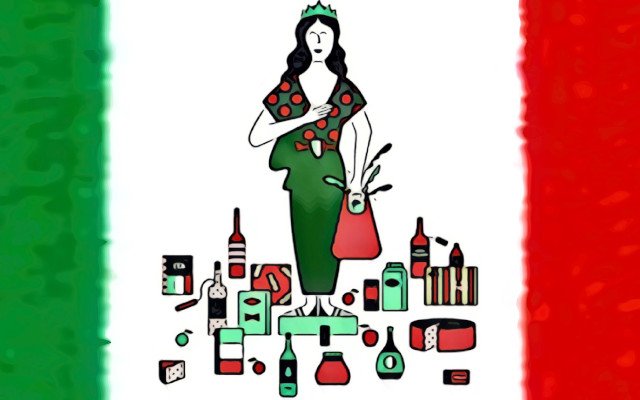
100% Italian, organic, whole, palm oil free, no added sugars, vegan. TheObservatory Immaginor, through the claim on food labels and sales data, shows us the evolution of the shopping cart of Italians.
Osservatorio Immagino No. 5, 2018 data
The Osservatorio Immagino by Nielsen GS1-Italy, now in its fifth edition, crosses label information of over 100 thousand references (over 68 thousand food) with consumption and sales data in Italy. ‘Product labels tell the consumption habits of Italians’, reads the introduction. Previous reports have intercepted some rising stars at birth, such as the Made in Italy on the label, the products ‘without’ and those inspired by intolerances (real or presumed). As well as the establishment of ‘identity’ consumption, as they show adherence to a lifestyle that includes certain dietary choices. This is true for organic and biodynamic, fair chain, vegetarian and vegan, kosher and halal.
The shopping cart 2018, as emerges from the Osservatorio Immagino No. 5 report, deserves attention from various aspects. In brief:
– the organic continues to grow, along with whole products and those without added sugars,
– the free from slows down slightly in consolidating the boom recorded in past years. There are new entry, like the clean labels which are however not easy to monitor (as they are mainly distinguished by the simplicity of ingredient lists, in contrast to ultra-processed foods),
– new emerge trend, such as claim ‘without antibiotics’ – which Coop has paved the way for – and ‘sustainable agriculture’,
– the indications ‘not fried’, ‘rustic’, ‘flavored’ appear on a growing number of products. Details follow.
‘Free from’, Italy market trends
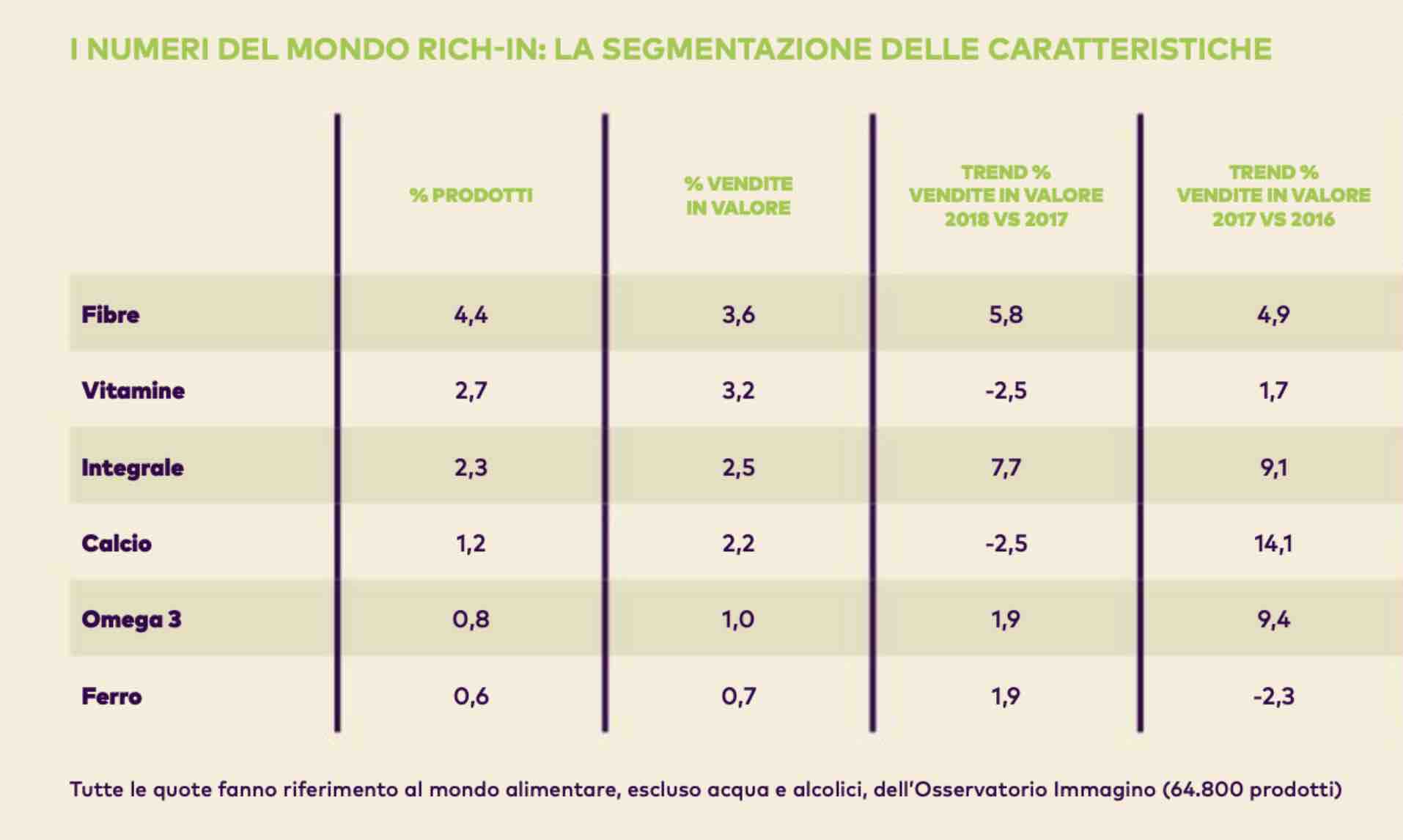
‘Also in 2018 the largest ‘family’ in supermarkets and hypermarkets is that of ‘free from’ products. ‘Without palm oil’ and ‘without GMOs’ (on animal-based products), we remind, are the most requested guarantees by European consumers and not coincidentally ostracized by lobby of Big Food. ‘Without colorants’, ‘without preservatives’, ‘without additives’ are added to the list. ‘They are 18.4% of the 64,800 food products monitored by the Immagino Observatory [27% in value, ed.] and generate a turnover of 6.8 billion euros. But in 2018, for the first time, this phenomenon stopped growing (+0.1% versus +2.3% in 2017) and instead there was a revision of the many claims used.’
The ‘without palm oil’ is one of the phenomena whose growth is slowing down. +3.8% in 2018, although it continues to record excellent growth results on biscuits, snacks, and sweets. Also decreasing are the ‘without preservatives’, ‘Without colorants’ and ‘without hydrogenated fats’, perhaps also because they have become the norm in many food categories.
Others claim, such as those highlighting a reduction in sugars, grow faster. The expansion of claim ‘low sugars’ (+5.1%) and ‘no added sugars’ (+5.4%), also in new categories of mass consumption. No longer only on carbonated soft drinks but also on snacks and jams, milk and Greek yogurt, still drinks and milk substitutes, up to cereals and dried or shelled fruit. Increase again, the ‘without additives’ and ‘without glutamate’. Excellent start also for the ‘without antibiotics’.
Made in Italy and ‘100% Italian’, the real champion
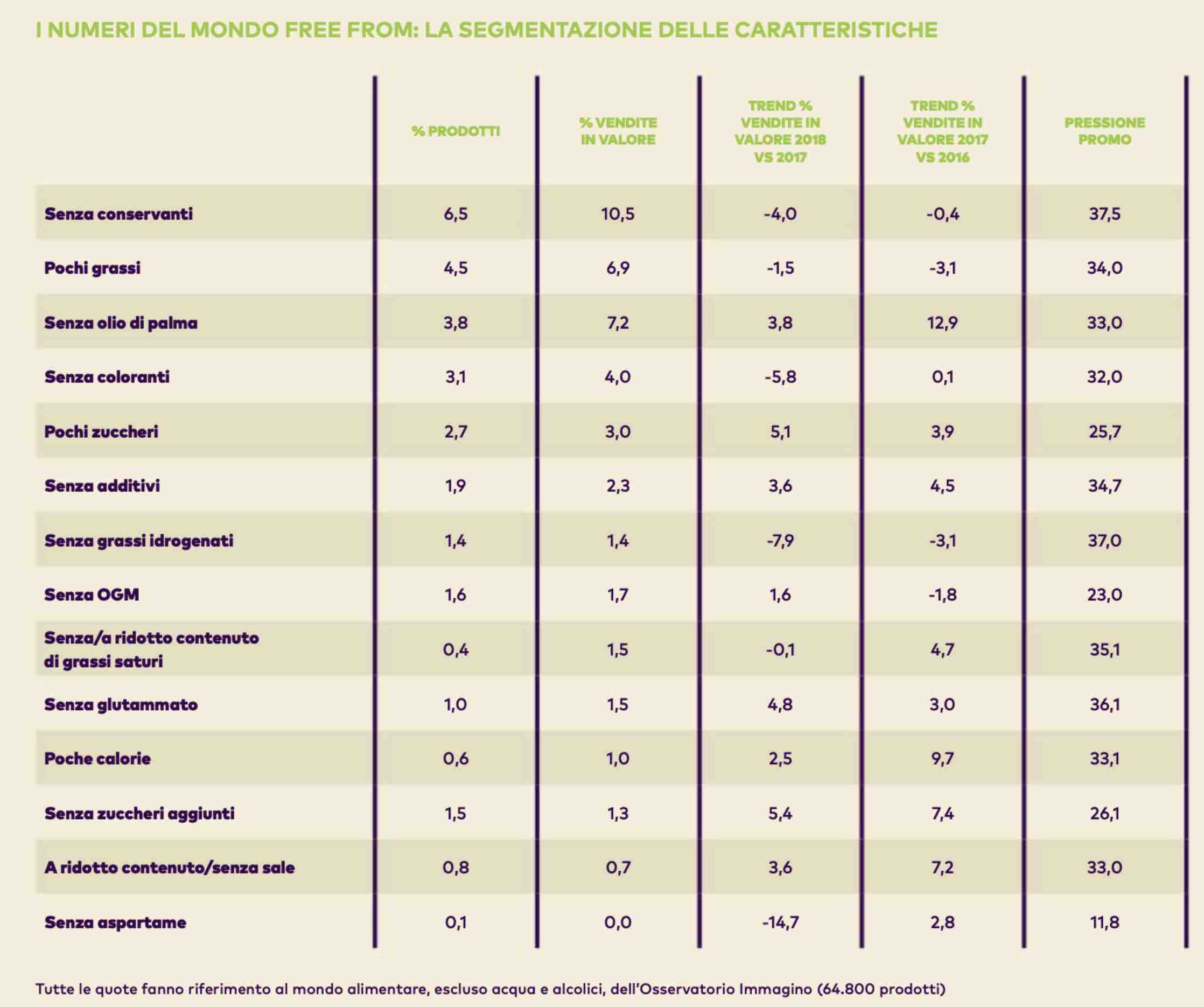
Italian identity, together with ‘without…’, remains the most significant phenomenon in the promotion of prepackaged food products. Although it also records a slight decline, after years of extraordinary success. The same applies to the pride Made in Italy – which includes over 25% of the more than 72 thousand products in the analyzed food basket and generates a total turnover of 6.8 billion euros – ‘in 2018 the expanding sales trend slowed down (+1.9% compared to +4.5% the previous year) and the growth rate of the new products supply’.
‘Aalso in 2018 the visual most used on packs to indicate the Italian identity of a food product was the Italian flag, appearing on more than 10 thousand products. This also made it number one in turnover, with over 4 billion euros in sales, with an annual growth of +1.7%’, reads the Immagino report. But the ‘100% Italian’ is the real champion of 2018, ‘entered powerfully and transversely into Italian families’.
Whole, ‘source of’ and ‘rich in’, gluten and lactose free
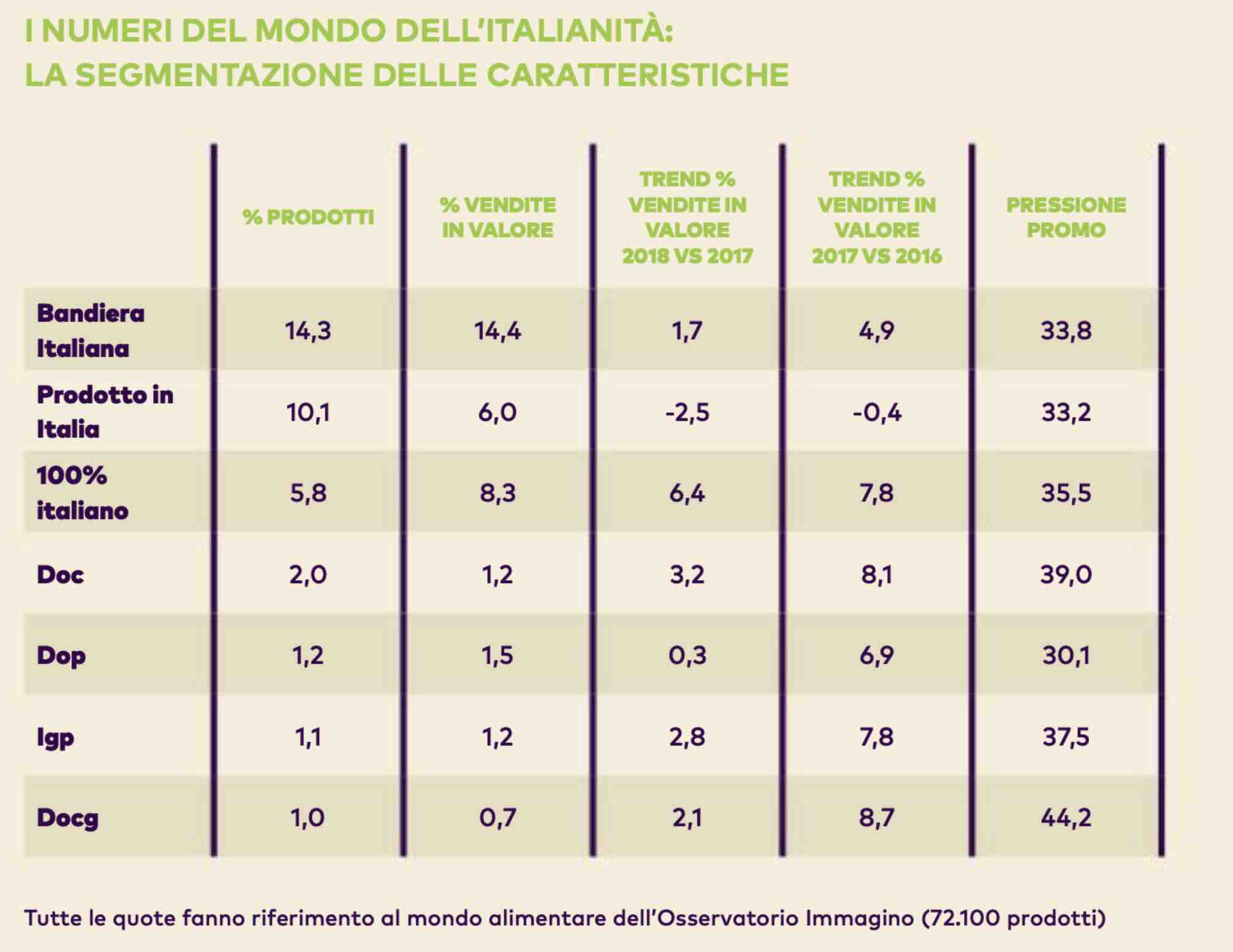
Sales of products that highlight on the label a plus nutritional – e.g. ‘with vitamins’, ‘with Omega 3’, ‘rich in iron’, ‘source of calcium’ – have in turn lost some momentum. +1.6% growth in 2018, compared to +8.0% the previous year. With some distinctions, as sales of products with continue to grow very well claim ‘whole’ and ‘rich in fiber’. Also worthy of attention is the growth of probiotics.
Slight decline the demand for ‘gluten free’ and ‘lactose free’ +1.7% in 2018 compared to +4.4% in 2017. Such labels are nevertheless present on over 13% of the products in assortment in supermarkets and hypermarkets, with a turnover that in 2018 exceeded 3.4 billion euros.
Lifestyles, unstoppable organic
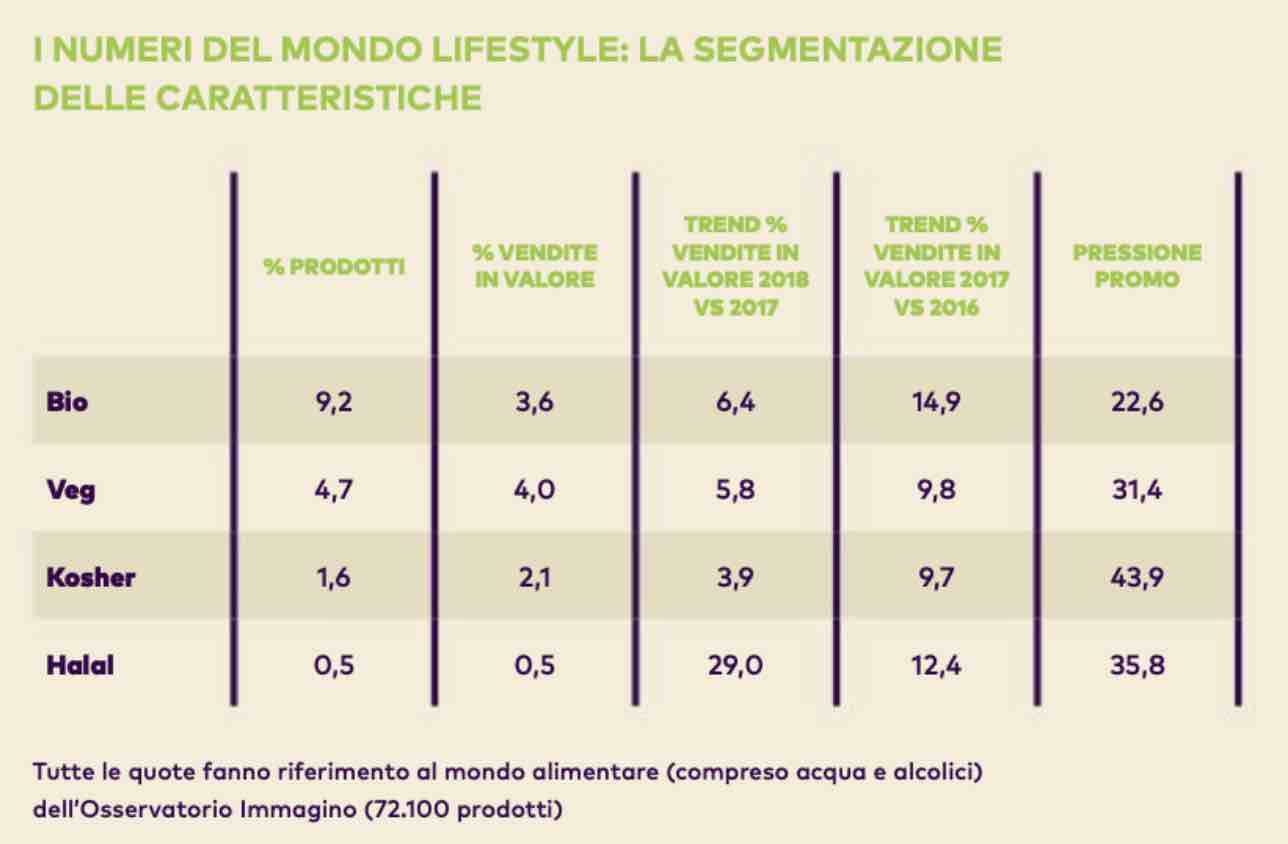
Organic foods now occupy almost 10% of the food products considered by the Immagino Observatory. 6,656 references, substantial sales growth (+6.4%) also stimulated by a substantial expansion of the offer (+9.0%). ‘Eggs, breakfast cereals, and jams have been the products that gave the largest contribution to the growth of the organic claim business volume, although the increase is quite generalized and involved almost all food categories.’
The 'identity' products included in the category lifestyle – e.g. 'vegetarian, vegan, halal, kosher, besides organic – scored in 2018 a +5.5%, reaching 2.4 billion euros turnover between supermarkets and hypermarkets. Although the category's growth slowed compared to +10.7% in 2017, the lifestyle actually covers 13.4% of the products and 8.6% of the overall turnover of packaged foods. Among the claim emerging – with still limited but positive performance data – is the claim ‘sustainable agriculture' (often at risk of deception, editor's note).
The food to go finally, the ‘ready to eat’ with a high service component that allows easy preparation or heating of ‘gourmet’ meals, seems to be emerging successfully as well. Sales of such products grew by 12.3%, exceeding 1.3 billion euros.
Dario Dongo and Sabrina Bergamini

Dario Dongo, lawyer and journalist, PhD in international food law, founder of WIISE (FARE - GIFT – Food Times) and Égalité.

Journalist. Consumption, rights, food, social, environment. Editorial manager of Help Consumers. Collaborated with ResetDOC, Il Riformista, La Nuova Ecologia, IMGPress.


