

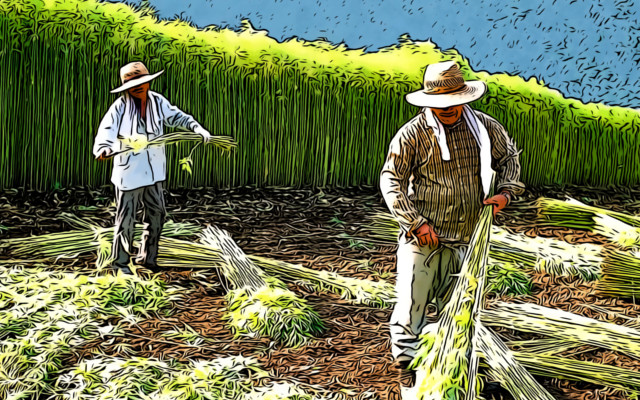
Hemp industrial, superfood for nutritionists and a crop to be enhanced in Italy, according to the Ministry of Agricultural Policies. The recent technical advisory opinion of the Higher Health Council however introduced some misunderstandings, derailed into widespread misinformation.
Industrial hemp, the rules in Italy and their implementation
The Ministry of Health – according to what is provided by law 242/16, on the agro-industrial hemp supply chain – should have adopted within 6 months the maximum THC limits to be allowed in foods containing hemp. Referring in any case only to products derived from varieties of cannabis sativa admitted to the single community list.
The National Institute of Health (ISS) has always been the reference authority in Italy for the scientific assessment of risks in the food chain. Also in this case, therefore, the Ministry of Health should have referred to the ISS for the toxicological analysis of products derived from industrial hemp. And the consequent definition of THC thresholds in foods that do not hinder their consumption under safe conditions. For the best protection of public health.
Industrial hemp, the opinion of the Higher Health Council
The Higher Health Council (CSS), it is worth noting, is a body that assists the Ministry of Health in assessing any risks associated with food or other consumer products. Its opinions have no legal value, as they are precisely limited to offering support to the risk assessment and management activities incumbent on the central health administration.
In relation to hemp, the Higher Health Council was called by the Ministry of Health to issue an urgent opinion. In the face of a regulatory gap that has caused and still causes uncertainty among supply chain operators, from farm to fork.
In its opinion 10.4.18, the CSS limited itself to recalling the following:
– the need to promptly establish the long-requested limits (THC on hemp and its parts or foods),
– the indeterminacy of the risk (‘risks cannot be excluded…’). With regard to consumption methods of hemp sativa inflorescences that go beyond, among other things, their use for food purposes.
The reading of the opinion of the CSS by the press organizations thus inevitably lent itself to undue overreach. Outside the scope of the legislation to be implemented.
Industrial hemp for food use, misunderstandings and risks for the Italian food chain
The operators of the food supply chain Italian, following the publication of the opinion of the Higher Health Council, have unsuccessfully tried to clarify the matter.
The issue, of science and law, does not in fact pertain to any possible use of the inflorescences of cannabis. Rather, simply, to the THC limits to be defined for the safe consumption of foods containing hemp sativa and/or its derivatives. Such as for example the seeds, the oil, flour. As well as the inflorescences, for use only in herbal teas.
The misunderstanding induced by misinformation about the CSS opinion, moreover, risks damaging the Italian hemp supply chain compared to that produced or imported in other EU Member States. Because based on the principle of 'mutual recognition', Italy cannot prohibit the trade of hemp foods legally produced in other EU countries.
The real risk is therefore that of disadvantaging productions of hemp-derived foods 'Made in Italy’, to the exclusive advantage of imported products. (1) Thus the inflorescences – which in the opinion of the CSS would not be sellable in Italy (2) – are freely marketed in the Internal Market.
Industrial hemp, recommendations to operators
The Higher Council of Health has reported commercial activities ‘outside any possibility of monitoring and controlling the amount actually consumed and therefore the psychotropic effects that it may produce…’.
It is therefore recommended – to those who intend to sell hemp or its parts for ornamental purposes, or for research purposes (3) – to consider the opportunity to introduce appropriate warnings, aimed at preventing improper uses. Such as, for example, ‘prohibited to minors under 18 years', 'keep out of reach of children, pregnant or breastfeeding women', 'non-food use', 'not intended for combustion’, etc.
It is also necessary to adopt all appropriate procedures to ensure strict compliance with the THC limits provided for in plants (0.2%).
Dario Dongo
Note
(1) The call for controls to prevent the free sale of Cannabis Sativa light is itself without any legal basis. Beyond the due application of the Consolidated Narcotics Act (law 309/90) on varieties of psychoactive plants, which are expressly excluded from the scope of law 242/16
(2) Law 242/2016, strictly speaking, does not prohibit the trade of inflorescences. The MIPAAF circular 22.5.18 even appears to allow their sale
(3) Hypotheses actually contemplated by law 242/16. Among the permitted uses is the use of hemp (without distinction between parts) for cultivations dedicated to educational and demonstrative activities, as well as research by public or private institutions. In addition to cultivations intended for floriculture

Dario Dongo, lawyer and journalist, PhD in international food law, founder of WIISE (FARE - GIFT – Food Times) and Égalité.


