

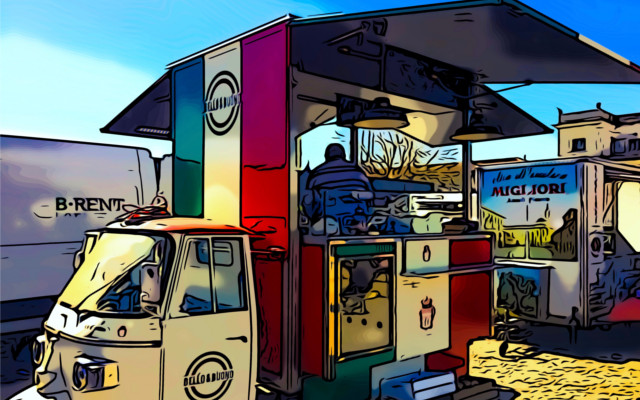
Food truck in the spotlight in Italy. Nearly 3 thousand street food businesses were registered by Unioncamere in the first quarter of 2018. Brief considerations on the resurgence of street food on the Apetta.
Street catering, growth data and its possible reasons
A new business every two days, in street catering, according to Unioncamere data. 2,729 activities recorded at the end of March 2018, compared to 1,717 in 2013. The phenomenon can have various explanations.
On the supply side, the start-up of many micro-enterprises shows the widespread need to find new forms of livelihood, in an economy where the labor market is stagnant and precarious. Whereas – with relatively modest investments, and the personal involvement of entrepreneurs – it is relatively easy to start paths like the one under examination. (1)
The current growth of demand, in turn, can be explained by the increase in meals outside the home – mainly due to work needs – and the simultaneous reduction of spending power. In this context the street food, thanks to the variety of the offer and the convenience of the meal ‘on the go’, reaps success. Especially in a country like ours, where the climate is generally favorable to consuming foods on the street.
street food, challenges and medium-term scenarios
Compliance with rules in force regarding food safety e consumer information, in the humble opinion of the writer, is the first issue to be addressed carefully in street catering.
Licenses, in recent years, have been granted with widespread generosity. Not because of sudden neoliberalism of local administrations in Italy, but rather to try to compensate – within the limits of everyone's possibilities – for the continuous rise in youth unemployment.
The official public control authorities, on their part, have so far shown marked leniency towards this category of operators in the food sector. Nonetheless, the same rules that are applied with (albeit relative) diligence to traditional public establishments must also be respected by Food truck.
It is therefore inevitable that sooner or later, perhaps also prompted by competition, the control authorities begin to do their job also on the shiny Ape Piaggio equipped to serve the street food. And the sanctions introduced by Legislative Decree 231/17 regarding consumer information are anything but light for micro individual enterprises. (2)
If on one hand the'effective implementation of official public controls on this sector could force less careful operators to close their business, on the other hand it is not certain that the market can absorb such a marked growth in the medium term. It is therefore worth reflecting carefully before riding a wave that could also break on the rocks.
Dario Dongo
Notes
(1) Not by chance, over 20% of street food activities are carried out by young people (under 35) and 11% by foreigners (+52% compared to 2013)
(2) In this regard see the free ebook ‘1169 penalties. EU Reg. 1169/11, information on food, controls and sanctions’. On https://www.greatitalianfoodtrade.it/libri/1169-pene-e-book-gratuito-su-delitti-e-sanzioni-nel-food

Dario Dongo, lawyer and journalist, PhD in international food law, founder of WIISE (FARE - GIFT – Food Times) and Égalité.


