
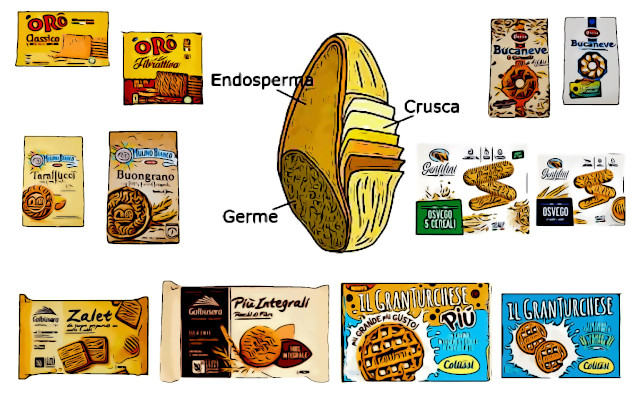
Among all baked goods for breakfast, cookies seem to be the lightest choice. Especially if whole grain. We compared 12 branded biscuits, in classic and whole grain versions. Colussi, Galbusera, Saiwa, Gentilini, Mulino Bianco, Doria.
Breakfast cookies, nutritional profiles
The nutritional profiles of cookies – calories, sugars, fats and saturated fats in particular – tend to be underestimated, with the idea that breakfast is anyway quickly ‘burned’. However, some elements deserve attention.
The cookies examined were chosen based on two criteria, brand diffusion and the availability of a version with wholemeal flour, alongside the one with refined flour (e.g., type 00).
Saturated fats, with caution
The two elements most interesting in the nutritional profile of dry biscuits or cookies (adjacent categories) are the amount of saturated fats and dietary fibers. The former should be consumed sparingly, the latter generously. (1)
The 12 biscuits examined have a saturated fat content that varies significantly, from 0.9 to 7.8%, as shown in the table:
– among the ‘classics’ with refined flours (or ‘refined’), the minimum amount of saturated fats is found in Oro Saiwa Classico (0.9%). At the top of the list are Gentilini’s Osvego (7.8%) and Doria’s Bucaneve (7.4%), with a substantial difference in quality as the first are made with butter, the traditional pastry fat, and the latter with an economical tropical fat (coconut oil),
– in wholemeal biscuits, the minimum content of saturated fats is in Oro Saiwa Fibrattiva (1.4%), the maximum in Osvego 5 Cereali (6.5%), followed by Colussi Più with wholemeal flour and chocolate chips (4.6%).
The value of dietary fiber
Cereals – together with legumes, fruit and vegetables – are the primary sources of dietary fiber. True health ingredients, as scientific research has discovered in recent years. Their regular intake is even associated with a reduction in premature mortality from various causes, as well as the prevention of certain forms of cancer. Also thanks to their ability to promote eubiosis (that is, the balance) of the intestinal microbiota. Their recommended intake is 25 grams/day for a 70 kg adult.
Among the 12 biscuits under examination, wholemeal ones are obviously the richest in fiber:
– the 'classic' ones with refined flour actually contain from 1.4 to 3.4 grams of fiber per 100g of product, while
– the wholemeal or multigrain ones record the highest amounts of fiber. Starting from Gentilini's Osvego 5 cereals (6.5g/100g), followed by Colussi Più (7.1g/100g), up to the maximum value of 14g/100g in Oro Saiwa Fibrattiva (14g/100g).

Wholemeal, true or false?
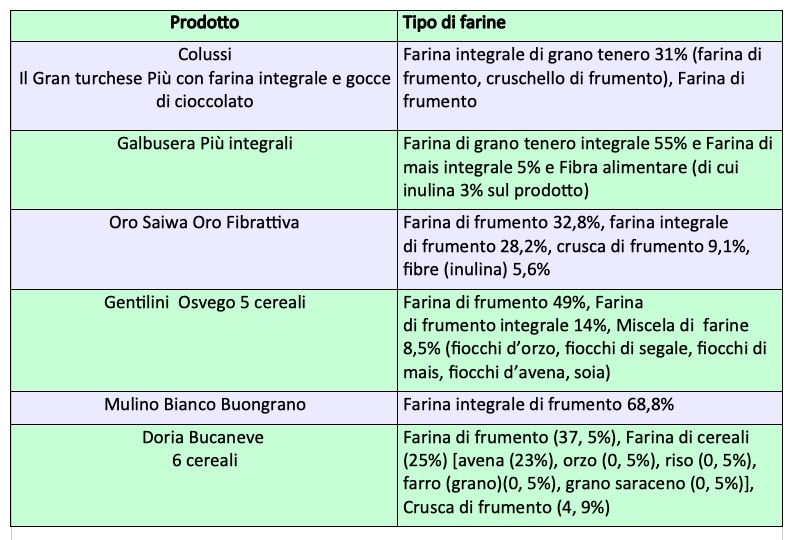
Buying wholemeal biscuits requires a bit of attention. The Claim such as 'rich in fiber' are not enough to distinguish the true wholemeal from the 'false'. A distinction that is useful to remember:
– true wholemeal is the product made with only wholemeal flour, that is from wheat ground whole that includes the wheat germ, a source of vitamins, unsaturated fats and phytocompounds beneficial to health,
– 'false' wholemeal is instead the mix of refined flours (e.g. type 00) with added bran and fine bran. Although the fiber amount is comparable, this solution has a different nutritional value, being devoid of the germ.
Only the biscuits Galbusera, Più integrali and Mulino Bianco Buongrano (whose label precisely states 'Buongrano is made only with wholemeal flour, without using other types of flours‘) can be qualified as ‘true whole’ among the six examined in this category.
Consumer information
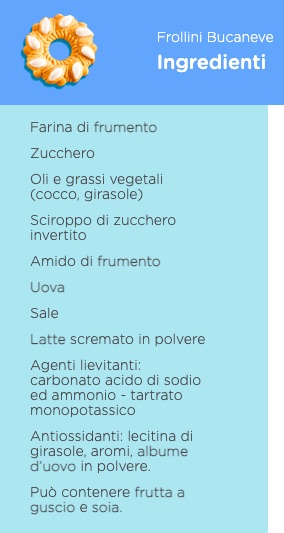
The 6 producers considered correctly report on the websites web company the list of ingredients and the nutritional table.
Only Doria, on its website web, violates the rule of listing ingredients in descending order of quantity.

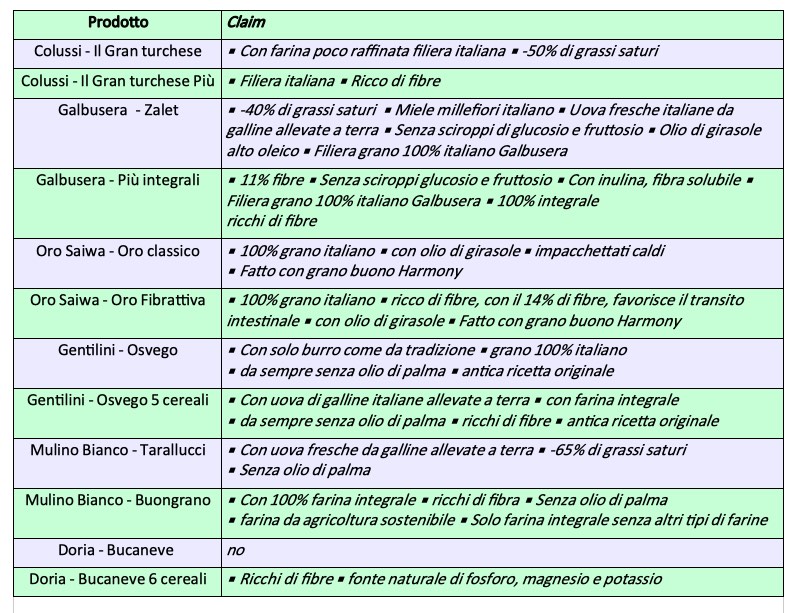
Further insights are provided through voluntary label information. Claim nutritional claims on fiber quantity, but also evidence of wheat origin, egg quality, in some cases Italian and free-range, etc.
Marta Strinati
Notes
(1) The recommended daily nutrient quantities are referred to in the ‘Dietary Reference Values’ of EFSA https://www.efsa.europa.eu/en/topics/topic/dietary-reference-values

Professional journalist since January 1995, she has worked for newspapers (Il Messaggero, Paese Sera, La Stampa) and magazines (NumeroUno, Il Salvagente). Author of journalistic investigations on food, she published the book 'Reading labels to know what we eat.'


