

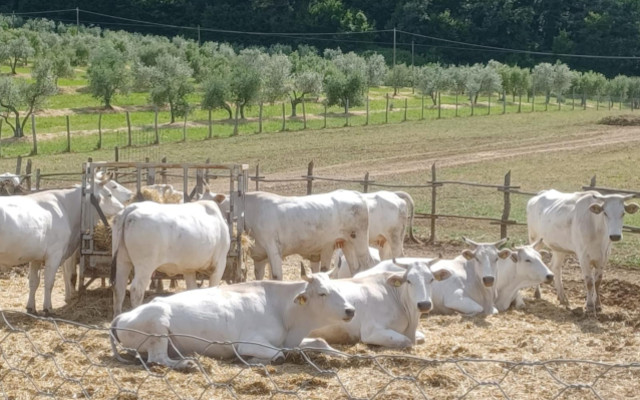
The Vitellone Bianco dell'Appennino Centrale PGI holds a double record: it was the first protected geographical indication for fresh beef approved by the European Union for Italy (1998) and today represents the most important national supply chain in terms of value and volumes in the certified fresh meat sector. Based on native breeds Chianina, Marchigiana and Romagnola, the denomination protects a production system which in 2024 exceeded 161 million euros in consumer value (ISMEA-Qualivita, 2025), confirming itself as the leader of the 'DOP economy' in the meat sector.
According to the XXIII ISMEA–Qualivita Report (2025), which captures the PDO economy Italian to 2024, the Vitellone Bianco dell'Appennino Centrale PGI is confirmed at first place among fresh Italian meats in Geographical Indication, in terms of production and value: certified production of 7.006 kt in 2024 (-6.4% compared to 2023); production value of €47 million (-6.4%); consumer value of €161 million (-2.1%).
In 2025 the cattle sector has faced a serious crisis due to the shortage of meat at European level, with a consequent reduction in calves for fattening and imports. The impact was particularly significant in Italy, due to the strong dependence on the import of rearing calves - especially from France - and the reduction in national stocks. The Consortium for the protection of the Vitellone Bianco dell'Appennino Centrale PGI is carrying out important study and research work on the sustainability of the certified supply chain and their valorisation.

Breed identity: Chianina, Marchigiana and Romagnola
Cattle breeding in the Apennine regions has very ancient roots. The breeds at the basis of the PGI derive from populations raised since Etruscan and Roman era, as documented both by literary sources and by artistic representations.
Chianina. The Chianina is one of the oldest cattle breeds in the world. Originating from the Val di Chiana between Tuscany and Umbria, it was used by the Romans for agricultural work and ritual sacrifices thanks to its imposing stature and white coat. It is the largest breed among Italian native breeds and the main numerical basis of PGI certification.
Marchigiana. The Marchigiana developed in the 19th century in the Marche through the crossing between local Apennine cattle and Podolian breeds, selected to improve slaughter yields and adaptability to mountain pastures. Today it represents the second breed in terms of number of certified animals.
Romagnola. Romagnola, widespread in Emilia-Romagna Apennine, derives from cattle of Podolian origin adapted to high altitude environmental conditions. Until the mid-20th century these breeds were mainly used as working cattle; with agricultural mechanization the selection was oriented towards the production of quality meat.
The denomination 'Vitellone Bianco dell'Appennino Centrale' was born in the 1980s as a project to valorise native breeds and obtained registration as Protected Geographical Indication In 1998 (European Commission, 1998). The specification was subsequently amended by Regulation (EC) No 1301/2011 and updated in 2023, with a further amendment procedure initiated in November 2025 (Emilia-Romagna Region, 2025).

The specification: SEUROP parameters, ageing and carcass quality
The denomination 'Vitellone Bianco dell'Appennino Centrale IGP' is reserved exclusively for meat produced by male and female cattle Chianina, Marchigiana and Romagnola breeds, obtained in accordance with the conditions laid down in the production specification (specification, art. 1).
Geographical zone
The production zone is defined along the Apennine ridge of Central Italy and includes the relevant provinces in the regions:
- Emilia-Romagna (Bologna, Ravenna, Forlì-Cesena, Rimini);
- Marche (Ancona, Ascoli Piceno, Fermo, Macerata, Pesaro and Urbino);
- Abruzzo (Teramo, Pescara, Chieti, L'Aquila);
- Molise (Campobasso, Isernia);
- Campania (Benevento, Avellino; Caserta limited to some municipalities);
- Lazio (Frosinone, Rieti, Viterbo; Rome and Latina limited to some municipalities);
- Umbria (Terni, Perugia);
- Tuscany (Grosseto, Siena, Arezzo, Florence, Prato, Livorno, Pisa, Pistoia. Disciplinary, art. 2).
Breeds and identification
PGI meat comes exclusively from breeds of cattle Chianina, Marchigiana and Romagnola, aged between 12 and 24 months at the time of slaughter, born and raised in the defined geographical area. Cattle must be registered with Herd Register of Young Livestock of the National Herd Book. THE'Control body authorized is the 3A-PTA - Umbria Agri-food Technology Park, based in Todi (disciplinary, art. 3).
Rearing and feeding
From birth to weaning, systems are permitted grazing, free housing and semi-wild breeding. 'In the phases following weaning and up to slaughter, the subjects must be raised exclusively in free, fixed-stall, semi-wild housing'. The calves must come breastfeed naturally from mothers until weaning.
After weaning, the diet is based on 'fresh or preserved fodder coming from natural and artificial meadows and herbaceous crops typical of the indicated geographical area; in addition, the use of simple or compound concentrated feeds and the addition of food supplements is permitted. The ration must, however, be calculated in such a way as to ensure high or medium-high nutritional levels and a protein content of between 13% and 18% depending on the animal's stage of development.
Among them prohibited foods, to preserve the organoleptic quality of the meat: a series of co-products from the food industry, for the entire life of the animal, and silage in the last four months before slaughter (disciplinary, art. 4).
Product characteristics
The recent proposal to amend the specifications updates the selection criteria carcasses in light of the European classification system. The SEUROP system evaluates the category (age and sex), muscle development (conformation) and fat level (state of fattening) of the animal. The carcasses of cattle intended for the production of Vitellone Bianco dell'Appennino Centrale PGI meat must therefore be of a particular type:
- categories: A (young uncastrated males, under 24 months), C (castrated males) and E (females that have already given birth, cows);
- conformation not less than R: conformation measures the development and shape of the carcass musculature according to the S-E-U-R-O-P scale (from excellent to poor). The minimum quality requirement (R) prescribed by the standard corresponds to good musculature;
- state of fatness between 2 and 4: the amount of covering fat is assessed on a 1-5 scale. The standard excludes values 1 (too lean) and 5 (too fat).
In summary, only carcasses from specific categories of cattle are permitted, with at least good musculature and moderate fat coverage.
'The color of the exposed fleshy parts of the carcass must not present anomalous colors (magenta or tending towards black). The color of the visible fat must not tend towards ashy yellow nor must it have veins tending towards deep yellow.
In order to 'improve the tenderness of the carcasses of male animals, which have a lower capacity to deposit fat even intramuscularly compared to females', a ageing minimum for male carcasses of 4 days for all cuts (excluding ground cuts), 10 days for topside, knuckle, silverside and loin muscle.
'The average quality parameters of 'Vitellone Bianco dell'Appennino Centrale' meat must be:
– pH between 5.2 and 5.8;
– ether extract (on as purchased) less than 3%;
– ash (on as purchased) less than 2%;
– proteins (on as purchased) greater than 20%;
– cholesterol less than 50 mg/100 g;
– ratio unsaturated/saturated fatty acids greater than 1.0;
– fresh loss less than 3%;
– hardness degree (raw) less than 3.5 Kg/cmq;
– color (daylight 2667K L greater than 30; C greater than 20; H between 25 and 45).' (Disciplinary, art. 5).
Marking, labelling and commercialisation
White veal meat from the Central Apennines must be released for consumption with a specific marking. guarantee of origin and of the product identification. The mark must be imprinted at the slaughterhouse, by an expert appointed by the control body, on the surface of the carcass, corresponding to the external face of the 18 cuts indicated.
The mark – consisting of the logo bearing the writing 'Vitellone Bianco dell'Appennino Centrale' – has dimensions of 5 x 5 cm with a rounded upper base and shows: in the center a stylized bovine with a 5 forming the head and with legs made up of an R repeated four times semi-overlapping; at the base the breed name (Chianina, Marchigiana, Romagnola) and on the three remaining sides the writing Vitellone Bianco dell'Appennino Centrale.
THE'label must report, in addition to the mandatory data required by current regulations, the following information:
- numero di riferimento o codice di rintracciabilità;
- la denominazione ‘Vitellone Bianco dell’Appennino Centrale’ e/o il logo;
- il logo dell’Unione previsto dalla normativa vigente. In aggiunta è possibile riportare la dicitura ‘Indicazione Geografica Protetta’ e/o l’acronimo I.G.P.;
- the breed of the subject with the exception of lots consisting of multiple breeds.
The marketing of meat can take place at the counter or packaged:
- in the case of sale by cut, the label must be displayed and clearly visible in the area of the sales counter intended for the PGI 'Vitellone Bianco dell'Appennino Centrale' meat;
- portioned packaged meat, fresh or frozen, must be placed for sale only in closed and labelled packages with the information indicated above.
'Packaging can only take place in authorized cutting laboratories and butchers' shops and under the control of the relevant body which allows the Protected Geographical Indication logo to be stamped on individual packages' (regulation, art. 6).
Controls and traceability
Every production phase — breeding, slaughtering, cutting, packaging and sales — is documented and verified by the 3A-PTA Control Body. All registered operators declare the number of calves born, raised, slaughtered, cut, portioned and packaged, ensuring complete traceability of the product (regulations, art. 7).
Nutritional characteristics: proteins, heme iron and lipid profile
Meat from Chianina, Marchigiana and Romagnola breeds, raised in extensive or semi-extensive systems, presents significant nutritional characteristics. The protein content of PGI lean beef is between 20 and 22% and provides all the essential amino acids in optimal proportions, with a high biological value.
On the lipid front, beef raised on pasture or with local forage shows a more favorable fatty acid profile compared to intensive feedlot systems. Recent studies document:
- a omega-6/omega-3 ratio significantly lower in meat from forage compared to that from concentrates (Varre et al., 2025);
- higher concentrations of CLA (conjugated linoleic acid) and long-chain omega-3 fatty acids (EPA, DPA);
- higher content of antioxidants such as alpha-tocopherol and carotenoids (Davis et al., 2022).
Beef is also an excellent source of heme iron — the form of iron with the highest bioavailability for the human organism — as well as vitamin B12, zinc and selenium. The low fat content makes it a high-fat food protein/calorie ratio, in line with the indications of the Mediterranean diet (Daley et al., 2010).
Use and cuts: from bistecca alla Fiorentina to traceability on the label
To recognize the true Vitellone Bianco dell'Appennino Centrale PGI it is essential to check the presence of it on the label denomination 'Vitellone Bianco dell'Appennino Centrale' and/or the logo, in addition to the logo European PGI, and the tracking code.
Certified meat, depending on the cuts, is suitable for bistecca alla fiorentina, tagliatelle, and numerous other preparations also suggested in the recipes on the Consortium website.
Choose products certified organic ensures compliance with the highest standards of animal welfare and sustainability, in accordance with Regulation (EU) 2018/848.
Conclusions
The Vitellone Bianco dell'Appennino Centrale PGI consolidates itself as the reference model for quality Italian livestock farming. The ability to combine the protection of historic breeds with rigorous technical parameters (minimum maturation and SEUROP classification) guarantees a constant and traceable product, essential for high-level catering and conscious domestic consumption. Despite the fluctuations of the stall market in 2025, the first Italian bovine PGI maintains its central role in the valorisation of the Apennine territory and the true Florentine steak.
Dario Dongo
Credit cover Agricultural Company Fratelli Iacomini, Cetona (Siena)
- Commission Regulation (EC) No 134/98 of 20 January 1998 supplementing the Annex to Regulation (EC) No 1107/96 on the registration of geographical indications and designations of origin [Vitellone Bianco dell'Appennino Centrale' PGI]. http://data.europa.eu/eli/reg/1998/134/oj
- Commission Implementing Regulation (EU) No 1301/2011 of 9 December 2011 approving non-minor amendments to the specification for a name entered in the register of protected designations of origin and protected geographical indications [Vitellone bianco dell'Appenninocentral PGI]. http://data.europa.eu/eli/reg_impl/2011/1301/oj
- Consortium for the protection of Vitellone Bianco of the Central Apennines. (2026). Vitellone Bianco dell'Appennino Centrale PGI, Salvi: '2026 will be the year of challenges'. https://www.vitellonebianco.it/vitellone-bianco-dellappenino-centrale-igp-salvi-2025-positivo-questo-sara-lanno-delle-sfide/
- Consortium for the protection of Vitellone Bianco of the Central Apennines. (2025). Production regulations. https://www.vitellonebianco.it/download/disciplinari/
- Consortium for the protection of Vitellone Bianco of the Central Apennines. (2026). Recipes and video recipes. https://www.vitellonebianco.it/in-cucina/le-video-ricette/
- Daley, C. A., Abbott, A., Doyle, P., Nader, G., & Larson, S. (2010). A review of fatty acid profiles and antioxidant content in grass-fed and grain-fed beef. Nutrition Journal, 9(10). https://doi.org/10.1186/1475-2891-9-10
- Davis, H., Magistrali, A., Butler, G., & Stergiadis, S. (2022). Nutritional benefits from fatty acids in organic and grass-fed beef. Foods, 11(5), 646. https://doi.org/10.3390/foods11050646
- ISMEA–Qualivita. (2025). XXIII ISMEA–Qualivita Report on Italian agri-food and wine productions PDO PGI TSG — 2024 data. Rome: ISMEA. https://www.ismea.it/flex/cm/pages/ServeBLOB.php/L/IT/IDPagina/13232
- MASAF – Ministry of Agriculture, Food Sovereignty and Forestry. (2025). Production specifications for PDO, PGI and TSG agricultural products — 1.1 Fresh meat. Rome. https://www.masaf.gov.it/flex/cm/pages/ServeBLOB.php/L/IT/IDPagina/3338
- Emilia-Romagna Region. (2025, November 5). Proposal to amend the PGI specification 'White veal of the central Apennines'. Official Bulletin of the Emilia-Romagna Region, n. 274. https://agricoltura.regione.emilia-romagna.it/dop-igp/notizie/2025/Modifica%20disciplinare%20Vitellone%20bianco%20Appennino%20centrale%20Igp
- Regulation (EU) 2024/1143 of the European Parliament and of the Council of 11 April 2024 on geographical indications for wine, spirit drinks and agricultural products, as well as traditional specialities guaranteed and optional quality terms for agricultural products, amending Regulations (EU) No 1308/2013, (EU) 2019/787 and (EU) 2019/1753 and repealing Regulation (EU) No 1151/2012. http://data.europa.eu/eli/reg/2024/1143/oj
- Varre, J. V., Statham, T., Smith, A. F., Ahsin, M., Cloward, J., Herrera, M. C., Mittendorf, C., Crompton, C., Ward, R. E., Evans, T., Bird, T., Lyons, S., Pinelli, A., Kittredge, D., & Van Vliet, S. (2025). Nutritional Composition of Beef: A Comparison of Commercial North American Grass- and Grain-Finishing Systems. Journal of animal science, skaf436. Advance online publication. https://doi.org/10.1093/jas/skaf436

Dario Dongo, lawyer and journalist, PhD in international food law, founder of WIISE (FARE - GIFT – Food Times) and Égalité.


