

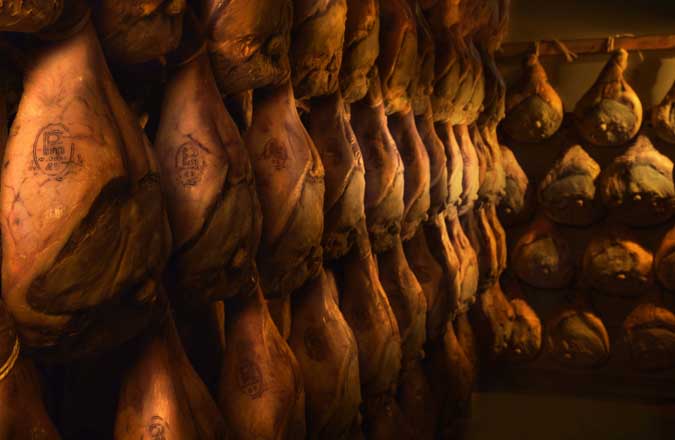
The Prosciutto di Modena PDO represents one of the most authentic expressions of Emilian cured meats, the result of a virtuous balance between territory, artisanal know-how, and strict production rules. Protected by the EU PDO mark, this raw ham stands out for aromatic profile, sweetness balanced and structure compact: elements that make it a benchmark product for quality catering and international gourmet markets. Its identity is closely linked to the hilly and foothill area of the province of Modena, where microclimate and natural ventilation favor a slow and controlled seasoning (Consortium for the Protection of Prosciutto di Modena PDO, 2026).
The most recent data confirms a dynamic trend for this niche denomination, which is joined by ten only producers (Emilia-Romagna Region, 2025b). In 2024:
- branded hams sent to production numbered 37,746, with an increase of +20% compared to 31,486 in 2023, for a production value of about 4 million euros;
- sales dropped from 47,533 units in 2023 to 34,271 in 2024 (–28%);
- the segment of pre-sliced in tray has increased from 642,704 to 683,788 units (+6.5%), a sign of a consolidated consumer preference for convenience and longer shelf life;
- theexport stood between 7% and 8% of production, with the United States first foreign destination market (Consortium for the Protection of Modena DOP Ham, 2025; Alimentando, 2025).
Historical roots: the millennia-old heritage of the Modena territory
The historical reconstruction of the origins, documented in the DOP application dossier prepared by the Protection Consortium and approved by the Ministry of Agriculture, finds its first authoritative textual anchor around 151 BC, when the Greek historian Polybius crossed Cisalpine Gaul and noted in his Histories the extraordinary fertility of the Po Valley. The abundance of oak woods and acorns had made that region the main source of pigs for the entire Italian peninsula, both for private nutrition and for the sustenance of the Roman armies (Polybius, Histories, II, ca. 151 BC).
With the consolidation of the Roman presence and the spread of rural villas in the Po Valley, pig farming became a structured practice, integrated into small processing industries annexed to the farm: the meats destined for other regions were salted, smoked, or transformed into cured meats for preservation. Pork meat was both a subsistence food for peasant families — who often paid the landowner an annual tribute in shoulders and hams — and a sought-after product in large noble estates, such as that of Migliarina (Carpi), dependent on the Monastery of Santa Giulia.
Documentation becomes more precise in the Renaissance era. In 1540, in the city of Modena, a population of 17,000 pigs, an indication of an already fully consolidated livestock vocation. In 1547 i 'lardaroli and salsicciai' of Modena — until then assimilated to 'butchers' — formed into guild independent, a formal recognition of a craft appreciated far beyond the city limits and with already particularly significant qualitative and quantitative levels.
The first explicit documentary reference to Modena ham as a distinct product dates back to 1670: in the archives of Camera Ducale Estense an inventory of the supplies of Cardinal Rinaldo d’Este's kitchen is kept in which the distinction between ‘mountain ham’ and ‘local ham’ already appears — the first evidence of a qualitative differentiation by territorial origin that anticipates the very logic of the modern PDO.
Legal protection at the national level arrived with the law of the Italian Republic on January 12, 1990, no. 11, followed by recognition as Denomination of Protected Origin with EC Regulation no. 1107/96. The Protection Consortium was founded on October 6, 1969 by seventeen producers, who had already voluntarily introduced an internal specification and branding at the end of aging.
Update of the specification: technical precision and quality
The protected designation of origin «Prosciutto di Modena», protected under regulation (EU) 2024/1143, is reserved for the product that meets the requirements established in its production specification covering the entire supply chain, ‘from stable to table’. In 2025 the Consortium has initiated the procedure for modification of the specification, to update two technical parameters (Region Emilia-Romagna, 2025b). Details follow.
Strictness in raw material: heavy pigs and animal welfare
The production is limited to the hill area of the hydrographic basin of the Panaro river, up to 900 meters altitude, delimited in 34 municipalities of Emilia-Romagna, including 19 in the province of Modena, 9 in Bologna, and 6 in Reggio Emilia.
Modena PDO ham must be produced exclusively from fresh thighs By heavy Italian pigs meeting the following characteristics:
- birth, rearing and slaughter in ten regions of Central-Northern Italy (Emilia-Romagna, Veneto, Lombardy, Piedmont, Molise, Umbria, Tuscany, Marche, Abruzzo, Lazio);
- traditional breeds mainly Large White, Landrace, Duroc, or other breeds, crossbreeds and hybrids, provided they come from selection or crossing schemes compatible with those of the Italian Herdbook, for the production of heavy pigs. Belgian Landrace, Hampshire, Pietrain, Duroc and Spot Poland pure breeds are excluded;
- average live weight of 160 kg (±10%).
thebreeding must be carried out by operators previously recognized and registered by the authorized body, complying with specific infrastructure and feeding requirements aimed at ensuring animal welfare and the quality of the raw material (specification, section C). One of the two specification modifications proposed in 2025 concerns the use of feed additives during the weaning phase.
The requirements of fresh hams
The fresh pork thighs to be used must come only from carcasses classified H Heavy and belong to classes U, R, O of the EU table for the classification of pork carcasses (European Commission, 2025). The carcass must weigh between 110.1 kg and 180.0 kg (instead of 168 kg), according to the second AAA modification to the specification proposed in 2025.
The fresh thigh the trimmed must have on the outer part a thickness of the fat – measured vertically at the head of the femur (sottonoce) – not less than 15 millimeters, rind included, depending on the size.
The right consistency of the fat is estimated by determining the iodine number (< 70) and/or the linoleic acid content (< 15%), to be performed on the internal and external fat of the subcutaneous adipose panniculus of the thigh (specification, section B).
The method: eight processing stages between art and nature
The processing of Modena ham is divided into the eight stages illustrated below.
- Isolation. The pig from which the fresh thigh intended for the preparation of Modena DOP ham is derived must be ‘healthy, white breed, fed in the quarter preceding slaughter with substances that limit the fat intake to less than 10%, rested and fasting’. After slaughter, the thigh is sectioned, sent to the production plant and subjected to the necessary checks.
- Cooling. ‘The fresh thighs deemed suitable are placed in a special cell, where they rest for the period necessary to allow the meat to reach a temperature around 0 degrees’. The thighs must be processed no earlier than 24 hours and no later than 120 hours after slaughter.
- Trimming. Trimming removes fat and rind to give the ham the characteristic ‘pear’ shape, correct imperfections, favor salting, and identify any defects. The thighs must not undergo any treatment except refrigeration (freezing prohibited).
- Salting. The thighs are massaged and sprinkled with salt, then placed in the ‘first salt’ cell (5-7 days, 0-4 °C, 80-90% relative humidity). The residual salt is then removed, massage and salting repeated, and the process continues in ‘second salt’ for another 12-15 days under the same conditions. During salting the ham absorbs salt and loses moisture.
- Resting. After the removal of residual salt, the thighs rest for at least 60 days in a room at 2–5 °C and 65–75% humidity. ‘During the resting phase, the absorbed salt gradually penetrates uniformly within the muscle mass, distributing evenly’.
- Washing. At the end of resting, the thighs are ‘groomed’ to refine the surface, then washed with brushes and jets of water mixed with air at ≤50 °C, removing surface residues, toning the tissues and revitalizing the meat.
- Drying. After draining, the thighs pass into a drying room at 24–26 °C and 85–90% humidity for 5–10 hours; then the dehumidifying phase is activated, lasting about a week, preparing the product for aging.
- Aging. Aging is divided into pre-aging and actual aging. In pre-aging, the meats acclimate at 10–20 °C with decreasing humidity. The hams are then transferred to aging rooms with natural temperature and ventilation conditions. In this phase, which usually lasts eight months, only ‘sugnatura’ is performed – with a mixture of lard, salt, pepper, and cereal derivatives – to soften and protect the exposed surface without altering the osmotic action.
‘During aging, in the meats occur the biochemical and enzymatic processes that complete the preservation process induced by the previous treatments, determining the characteristic organoleptic priorities thanks to the contribution of theexternal natural environment (low humidity, natural ventilation that determine the aroma and taste of the product’.
The complete cycle, from salting to the end of aging, lasts at least 14 months (12 months for batches
Product characteristics
The organoleptic characteristics of Modena ham, at the end of aging, ‘meet the following requirements:
- shape pear-shaped, excluding the small foot obtained by removing excess fat through trimming and removal of part of the rind and covering fat;
- minimum weight not less than seven kilograms; usually between eight and ten kilograms;
- color bright red of the cut;
- taste savory but not salty;
- aroma pleasant aroma, sweet but intense even in the needle tests;
- consistency characteristic of the meat of the animal of origin.
The chemical-physical characteristics to be verified before the application of the label are instead:
- humidity between 59% and 63.5%;
- sodium chloride between 4.5% and 6.7%;
- index of proteolysis between 21% and 31%;
- weight between 8 and 10 kg, never less than 7 kg (regulation, section B).
Scientific research: the nutritional properties of a high-end product
The Experimental Station for the Food Preserving Industry (SSICA) – in collaboration with the Consortium for the Protection of Prosciutto di Modena DOP – presented in Modena on December 1, 2025, the results of a scientific research that confirms the nutritional, sensory, and shelf life profile of this Italian excellence. The strengths highlighted by the study:
- high biological value proteins, whose concentration increases during aging (from 26.4% at 16 months to 27.6% at 24 months), supporting consistent nutritional quality and texture over time;
- abundance of essential minerals such as highly bioavailable heme iron, zinc, phosphorus, and potassium;
- presence of B vitamins (B1 thiamine, B3 niacin, B6 pyridoxine) in excellent content, relevant for metabolic health and energy function;
- balance of lipid profiles, whose content is moderate in the lean slice (6.47–8.09%).
In a perspective of conscious consumption of raw ham, within a varied and balanced diet, it is important to favor The quality over quantity. CREA indicates a reference portion By 50 g, considering the average salt content – about 6.1 g/100 g for raw ham – whose intake must be moderated (within the 5g/day threshold recommended by WHO).
Uses
Prosciutto di Modena DOP is suitable for both traditional consumption and contemporary gourmet uses. Pure, thinly sliced, as starter or in guided tastings. Paired with typical Emilian products (Parmigiano Reggiano DOPtigelle, fried gnocco). In fine cuisine, to enhance vegetable or white meat dishes, thanks to its balanced aromatic profile, which clearly distinguishes it from hams with shorter aging or stronger salty profiles.
Advice for buyers
To consumers more attentive it is recommended to prefer Prosciutto di Modena DOP with seasons longer. Consider suppliers adopting farming practices organic, where available, to guarantee the highest standards of environmental protection, biodiversity and welfare (EU regulation 2018/848).
The team of GIFT (Great Italian Food Trade) provides international buyers a highly specialized expertise, offering concrete support in the selection of reliable producers, to build solid and aware partnerships, facilitating strategic choices in the Italian food market.
Conclusions
The Prosciutto di Modena PDO embodies a model of territorial excellence capable of combining tradition, regulatory rigor and premium positioning. I dati 2024 rivelano una filiera che cresce nella produzione certificata e nel preaffettato, pur affrontando pressioni strutturali sulla materia prima e sui costi energetici. Con la procedura di aggiornamento del disciplinare in corso (BUR Emilia-Romagna, ottobre 2025) e l’export verso gli USA sotto osservazione per via delle tensioni tariffarie, la sfida per il Consorzio è consolidare la reputazione internazionale del prodotto diversificando i mercati e rafforzando la comunicazione del valore aggiunto della DOP. Per buyer e consumatori evoluti, il prosciutto di Modena DOP rappresenta una scelta di alto profilo gastronomico e culturale, nella Italian delicatessen of excellence.
Dario Dongo
References
- Commission Implementing Decision (EU) 2025/122 of 22 January 2025 authorising grading methods for the classification of pig carcasses in Italy and repealing Implementing Decision 2014/38/EU. http://data.europa.eu/eli/dec_impl/2025/122/oj
- Commission Regulation (EC) No 1107/96 of 12 June 1996 on the registration of geographical indications and designations of origin under the procedure laid down in Article 17 of Council Regulation (EEC) No 2081/92. Consolidated text: 20/11/2008 http://data.europa.eu/eli/reg/1996/1107/2008-11-20
- Consortium for the Protection of Modena Ham PDO. (2026). Production regulations of the Protected Designation of Origin 'Prosciutto di Modena'. https://consorzioprosciuttomodena.it/wp-content/uploads/disciplinare.pdf
- Consortium for the Protection of Modena Ham PDO. (2026). https://consorzioprosciuttomodena.it/
- Consortium for the Protection of Modena Ham PDO. (2025, 1 December). Press release: In Modena, a conference to present the new research on nutritional values, sensory quality and shelf life of Modena Ham PDO. https://consorzioprosciuttomodena.it/wp-content/uploads/Comunicato-Stampa_Convegno.pdf
- CREA – Council for Agricultural Research and Economics. (2019). Food composition tables. Raw ham, deboned, trimmed. https://www.alimentinutrizione.it/tabelle-nutrizionali/110526
- Ministry of Agriculture, Food Sovereignty and Forestry. (2025). PDO and PGI specifications for agricultural products — 1.2 Meat-based products [includes the specification of Modena Ham PDO, 411.93 KB]. https://www.masaf.gov.it/flex/cm/pages/ServeBLOB.php/L/IT/IDPagina/3339
- Polybius. (ca. 150 BC). Histories, Book II [modern Italian translation: Polybius, Histories, edited by M. Mari, BUR, 2001].
- Emilia-Romagna Region. (2025, 30 October). Modena Ham PDO, excellent quality and great prospects. Agriculture, hunting and fishing – PDO, PGI and quality productions. Retrieved from https://agricoltura.regione.emilia-romagna.it/dop-igp/food-valley-news/news/2025/prosciutto-di-modena-qualita-eccellente-e-grandi-prospettive
- Emilia-Romagna Region — Department of Agriculture, Hunting and Fishing. (2025, October 8). Started the amendment of the specification of the PDO Prosciutto di Modena (Official Regional Bulletin no. 252 of October 8, 2025). https://agricoltura.regione.emilia-romagna.it/dop-igp/notizie/2025/avviata-la-modifica-del-disciplinare-della-dop-prosciutto-di-modena
- Regulation (EU) 2018/848 of the European Parliament and of the Council of 30 May 2018 on organic production and labelling of organic products. Consolidated text: 25/03/2025. http://data.europa.eu/eli/reg/2018/848/2025-03-25
- Regulation (EU) 2024/1143 of the European Parliament and of the Council of 11 April 2024 on geographical indications for wine, spirit drinks and agricultural products. http://data.europa.eu/eli/reg/2024/1143/oj

Dario Dongo, lawyer and journalist, PhD in international food law, founder of WIISE (FARE - GIFT – Food Times) and Égalité.


