

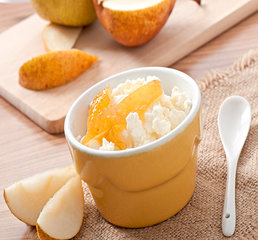
A 'no added sugar' jam contains only the sugars naturally present in fruit. A 'sugar-free' jam cannot exceed 0.5 grams of sugar per 100 grams. A 'reduced sugar' jam contains at least 30% less than a similar product.
The three indications have distinct conditions of use and are not interchangeable (EC regulation 1924/2006, Annex). This guide describes the requirements and links them to the composition rules of jams, to the permitted sweeteners with their respective limits and to the mandatory labelling statements.
Nutritional claims on sugars
The conditions below must be verified on the finished product, ready for consumption, and not on the recipe alone.
| Claim | Condition of use |
| 'Sugar free' | no more than 0.5 g of sugars per 100 g |
| 'Low sugar' | no more than 5 g of sugars per 100 g |
| 'No added sugar' | no addition of mono- or disaccharides or other foods used for their sweetening properties; if sugars are naturally present, the label must specify this |
| 'Reduced sugar content' | at least 30% less sugar compared to a similar product, with equal or lower energy value |
No added sugars
Fruit naturally contains sugars (glucose, fructose and sucrose) in proportions that vary according to species, variety and ripeness. A jam made from fruit alone it retains an appreciable quantity, which cooking concentrates through evaporation of the water.
The indication 'No added sugars' excludes the addition of sugars, honey and syrups. It also excludes concentrated juices and other foods used for their sweetening properties: replacing sucrose with a grape or apple concentrate does not allow the indication if the function of the ingredient is to sweeten.
No sugars and low sugar content
The thresholds of 0.5 and 5 grams per 100 grams include fruit sugars. In a jam with at least 450 grams of fruit per kilogram, such thresholds are practically unattainable.
Reduced sugar content
It is a comparative indication. The comparison must be made with products of the same category and the difference must be indicated, for example '30% less sugar' (EC regulation 1924/2006, art. 9).
The indication 'leggero' or 'light' follows the same conditions and must be accompanied by the characteristic that makes the product lighter (EC regulation 1924/2006, Annex).
Composition: soluble dry matter
Jams must have at least 60% By soluble dry matter, determined by refractometer (Legislative Decree 50/2004, art. 2.4). Soluble dry matter does not, however, coincide with the sugars in the nutrition declaration, as it also includes organic acids and other soluble solids.
From 14 June 2026, the rule does not apply to products that satisfy the conditions of the 'reduced sugar content' indication and to those in which the sugars are replaced, in whole or in part, by sweeteners. These products therefore retain the name 'jam'.
Italy also allows a content between 45 and 60% with the words 'to be kept in the refrigerator after opening', which is not required on small disposable packages (Legislative Decree 50/2004, art. 2.4).
The other requirements remain unchanged: minimum quantities of fruit, raw materials and ingredients allowed. Products that do not comply with them adopt a descriptive name, such as 'fruit preparation'.
Sweeteners permitted in jams
The sweeteners they are a functional category of additives and can only be used in the food categories and under the conditions established by the European Union list (EC regulation 1333/2008, Annex II, part E).
Jams fall into two categories, for the purposes of the application of the European regulation on additives: 04.2.5.1, extra jam and extra jelly, and 04.2.5.2, jams, jellies, marmalades and chestnut cream.
The intense sweeteners are permitted only in products with reduced energy value, that is with energy value reduced by at least 30% compared to the original product or to an analogous product (Regulation (EC) 1333/2008, art. 3.2).
| Sweetener | E Number | Maximum level (mg/kg) |
| Acesulfame K | And 950 | 1.000 |
| Aspartame | And 951 | 1.000 |
| Cyclamic acid and its sodium and calcium salts | And 952 | 1,000, expressed as free acid |
| Saccharin and its sodium, potassium and calcium salts | And 954 | 200, expressed as free imide |
| Sucralose | And 955 | 400 |
| Neohesperidin DC | And 959 | 50 |
| Steviol glycosides | E 960a-960d | 200, expressed as steviol equivalents |
| Neotame | And 961 | 32 |
| Aspartame-acesulfame salt | And 962 | 1,000, expressed as aspartame equivalents |
| Advantame | And 969 | 10 |
The values are identical in the two categories. Thaumatin, E 957, is not authorized in jams.
I polyols quantum satis are allowed both in products with reduced energy value and in those without added sugars. This group includes sorbitols (E 420), mannitol (E 421), isomalt (E 953), maltitols (E 965), lactitol (E 966), xylitol (E 967) and erythritol (E 968). Polyglycitol syrup (E 964) is permitted under the same conditions, up to 500,000 mg/kg.
Two sweeteners are also allowed in low doses as flavor enhancers: neotame, up to 2 mg/kg, in products with reduced energy value; neohesperidin DC, up to 5 mg/kg, only in fruit jellies of category 04.2.5.2.
The other spreads based on fruit or vegetables belong to category 04.2.5.3. The same sweeteners are allowed in products with reduced energy value and in creams based on dried fruit with reduced energy value or without added sugars. There are two differences: 500 mg/kg for cyclamates and advantame only in dried fruit-based creams.
Label: mandatory statements
The name of foods containing sweeteners is accompanied by the words 'with sweetener(s).'. If added sugars are also present, the wording is 'with sugar(s) and sweetener(s)' (EU regulation 1169/2011, Annex III, point 2).
Foods with aspartame or aspartame-acesulfame salt carry a warning about the presence of a source of phenylalanine. Those with more than 10% of polyols added the warning 'excessive consumption may have laxative effects'.
In the list of ingredients, sweeteners appear with the name of the category, 'sweetener', followed by the specific name or E number (EU Reg. 1169/2011, Annex VII, part C).
The statement on the fruit used remains mandatory, in the same visual field as the denomination (d.lgs. 50/2004, art. 3.3).
Nutritional declaration
A'nutrition claim makes the nutrition declaration always mandatory (Regulation (EC) 1924/2006, art. 7).
The voice 'of which sugars' includes all mono- and disaccharides, natural and added, excluding polyols (Regulation (EU) 1169/2011, Annex I, point 8).
I polyols are included in carbohydrates. For the purposes of calculating energy, 2.4 kcal per gram are valid, with the exception of erythritol whose value is zero (EU regulation 1169/2011, Annex XIV).
The energy value of a jam therefore depends on the entire recipe and can be read in the table, not in the indication on the front of the package.
Technology and preservation
Sugar contributes to sweetness, consistency and stability. Recipes with less sugar require pectins suitable for low levels of soluble solids and a process validated on pH, water activity, heat treatment and closure.
Sweeteners differ in sweetening power, heat stability and contribution to structure. Polyols also provide bulk, intensive sweeteners only sweetness.
Label reading criteria
The denomination indicates whether the product is a jam or a fruit preparation. The ingredient list shows sugars, juice concentrates and sweeteners.
The item 'of which sugars' reports the total content. The quantity of fruit declared and the portion, usually 20 grams, complete the picture.
Conclusions
The indications on sugars describe different characteristics of the recipe. The regulations in force from 14 June 2026 allow jams with less sugar to maintain the legal denomination.
The choice of sweeteners depends on the product category and its energy value, within precise limits. Denomination, statements and nutrition declaration must reflect the recipe.
Our team of FARE (Food and Agriculture Requirements) assists food industries and retail operators in the design and development of new products compliant with current regulations regarding composition, characteristics and labelling.
Dario Dongo
Frequently asked questions
Does a jam without added sugars contain sugars? Yes, those naturally present in fruit.
Is concentrated grape juice compatible with the 'no added sugar' claim? No, if it is used to sweeten the product.
Which sweeteners are permitted in jams? Ten intensive sweeteners, in reduced-energy products only, and polyols, also in products without added sugars.
Can a jam with sweeteners have less than 60% soluble dry matter? Yes. The 60% rule does not apply when sugars are replaced, in whole or in part, by sweeteners.
When is the indication 'reduced sugar content' permitted? When the product contains at least 30% less sugar compared to an analogous product and an equal or lower energy value.
References
European Union regulatory sources
Council Directive 2001/113/EC of 20 December 2001 relating to fruit jams, jellies and marmalades and sweetened chestnut purée intended for human consumption. Consolidated text: 14/06/2026. http://data.europa.eu/eli/dir/2001/113/2026-06-14
Directive (EU) 2024/1438 of the European Parliament and of the Council of 14 May 2024 amending Council Directives 2001/110/EC relating to honey, 2001/112/EC relating to fruit juices and certain similar products intended for human consumption, 2001/113/EC relating to fruit jams, jellies and marmalades and sweetened chestnut purée intended for human consumption, and 2001/114/EC relating to certain partly or wholly dehydrated preserved milk for human consumption. OJ L, 2024/1438, 24.5.2024. http://data.europa.eu/eli/dir/2024/1438/oj
Regulation (EC) No 1924/2006 of the European Parliament and of the Council of 20 December 2006 on nutrition and health claims made on foods. Consolidated text: 13/12/2014. http://data.europa.eu/eli/reg/2006/1924/2014-12-13
Regulation (EC) No 1333/2008 of the European Parliament and of the Council of 16 December 2008 on food additives. Consolidated text: 18/08/2026. http://data.europa.eu/eli/reg/2008/1333/2026-08-18
Regulation (EU) No 1169/2011 of the European Parliament and of the Council of 25 October 2011 on the provision of food information to consumers. Consolidated text: 01/04/2025. http://data.europa.eu/eli/reg/2011/1169/2025-04-01
Italian regulatory sources
Legislative decree 20 February 2004, n. 50, Implementation of Directive 2001/113/EC concerning fruit jams, jellies and marmalades, as well as chestnut cream, intended for human consumption. Regulatory. Latest consolidated version: [date to be read on Normattiva]. https://www.normattiva.it/uri-res/N2Ls?urn:nir:stato:decreto.legislativo:2004-02-20;50!vig=
Legislative Decree 30 December 2025, No. 207, Implementation of Directive (EU) 2024/1438 of the European Parliament and of the Council of 14 May 2024. Official Journal No. 3 of 5 January 2026. https://www.gazzettaufficiale.it/eli/id/2026/01/05/26G00001/sg

Dario Dongo, lawyer and journalist, PhD in international food law, founder of WIISE (FARE - GIFT – Food Times) and Égalité.


