

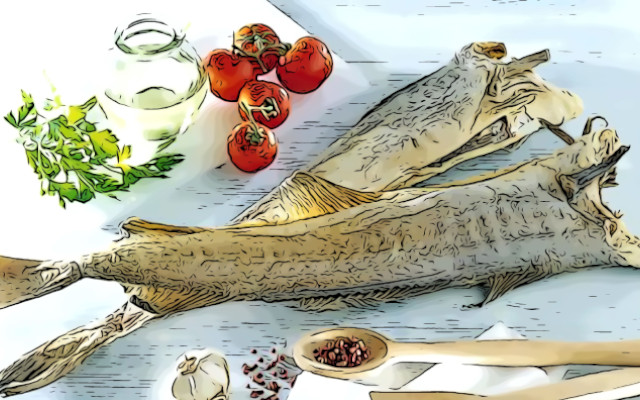
Stockfish, stock, stockfish. The fish (fish) hard as a stick (stock) is not only a delight, but also an ally of good health. Naturally.
Cod, stockfish and salt cod
The cod is the historic protagonist of fishing, economy and diet of coastal communities on the northeastern side of the Atlantic Ocean. From Portugal to the Basque Country, Netherlands and Great Britain, Scandinavian peninsula and Iceland. Its lean and delicate meat preserves better than any other, for entire seasons, thanks to preservation by traditional methods:
– air-dried, stockfish (stockfish),
– salt-cured, salt cod (salt cod).
Exploitation of the seas, in recent decades, has caused the depletion of fish stocks. Leading operators to increasingly preserve smaller fish, of lower value (herrings) and economic worth (e.g. anchovies), under salt.
Stockfish and salt cod, the differences
The differences between stockfish and salt cod are substantial, although the fish that forms the raw material is identical. The bacalao is produced in several countries by salting cod fillets. The product quality varies widely, depending on the production method and size of the fish. Finished products have a high salt content and must be desalted by soaking in cold water (periodically replaced) for at least 24/36 hours.
The stockfish – strictly made from Norwegian Arctic cod (Gadus morhua) – comes only from Northern Norway, particularly the Lofoten Islands. Its production is linked to seasonal fishing, from February to April, and continues until June. This is the ideal period to dry cod outdoors, on special racks, with the sole help of sun and wind. In turn, it must be soaked in water for one or two weeks before consumption, for rehydration. It is a product of superior value, both economically and nutritionally.
Stockfish, nutritional virtues
Stockfish is a true concentrate of valuable nutrients, considering that 1 kg of stockfish corresponds to about 5 kg of fresh fish. The nutritional virtues, according to CREA tables:
– 100 grams of dry stockfish contain 12 g of water, 80.1 g of protein (!), 3.5 g of lipids, 1.1 g of carbohydrates. Also 1,500 mg of potassium, 540 mg of phosphorus, 500 mg of sodium (equal to 2.5 g of salt), 60 mg of calcium, 3.3 mg of iron, 3.5 mg of niacin (vitamin B3), 0.5 mg of riboflavin (vitamin B2), 0.14 mg of thiamine (vitamin B1).
– 100 g of soaked stockfish contain 76.1 g of water, 20.7 g of protein, 0.9 g of lipids, 0.3 g of carbohydrates. Also 340 mg of potassium, 163 mg of phosphorus, 51 mg of sodium (equal to 0.25 g of salt), 9 mg of calcium, 0.6 mg of iron, 1 mg of niacin (vitamin B3), 0.08 mg of riboflavin (vitamin B2), 0.01 mg of thiamine (vitamin B1). (1)
Health benefits
Together with peanuts, stockfish is one of the foods richest in arginine (1.8 g/100 g). An amino acid of great importance:
– for children, who need it to stimulate the release of growth hormone,
– in the general population, to strengthen the immune system (2,3),
– in the elderly, to promote cardiovascular health by stimulating endothelial nitric oxide synthesis. (4)
'Arginine plays an important role in many physiological and biological processes, beyond its role as an amino acid incorporated in proteins. Dietary supplementation of arginine can improve wound healing, regulate endocrine activity, and enhance immune activity.' (3)
From Norway to Magna Graecia
From Norway to Magna Grecia, stockfish characterizes Italian regional cuisines passing through Veneto and Liguria, Marche, Campania, Calabria, and eastern Sicily. It is also the mineral content of the water where the stockfish is soaked, even before the recipe, that defines its flavor.
Precisely the water is the identity hallmark of the renowned Calabrian stockfish, which includes two municipal denominations in the province of Reggio. The Stocco di Cittanova De.Co. and the Stocco di Mammola De.Co., ‘found’ for about 15 days in the cold mountain waters of the Aspromonte Apennines areas, respectively the Zomaro and the Limina, as well as the Serre.
The stockfish of Aspromonte
The water of Calabrian stockfish is mountain water from Aspromonte. A very light water, minimally mineralized (fixed residue
These elements give the stockfish savoriness, taste, and texture, as well as naturally accelerating the hydration of the fish. The local culinary art is also characterized by innovative cooking techniques that preserve the nutritional and nutraceutical properties of the stockfish. Jar cooking, oil cooking, and vacuum. Supreme delight from Aspromonte.
The Italian way of stockfish
'The Italian way of stockfish' is the book being published by theAcademy of Stockfish of Calabria, formed thanks to the chef Enzo Cannatà in Cittanova (RC). To celebrate the history and virtues of the Viking fish, whose traces date back to the 10th century, in the gentle Mediterranean variation.
The presentation of the book is available on YouTube, in the video linked here.
Dario Dongo and Rosario Previtera
Notes
(1) Crea. Food composition tables. Entries 'melù or molo fish, stockfish, dry' https://www.alimentinutrizione.it/tabelle-nutrizionali/121320 and 'soaked’ https://www.alimentinutrizione.it/tabelle-nutrizionali/121330
(2) Santarelli L, Valentino M, Bracci M, Rapisarda V, Soleo L, Mocchegiani E. (2004). Reversibility of thymulin production impairment by L-arginine supplementation in mice exposed to inorganic mercury. Int J Immunopathol Pharmacol. 2004 May-Aug;17(2 Suppl):123-8. doi: 10.1177/03946320040170S220
(3) Efron D, Barbul A. (2000). Role of arginine in immunonutrition. J. Gastroenterol. 35 Suppl 12:20-3. PMID: 10779211
(4) Mangoni AA, Rodionov RN, McEvoy M, Zinellu A, Carru C, Sotgia S. (2019). New horizons in arginine metabolism, ageing and chronic disease states. Age Ageing. 2019 Nov 1;48(6):776-782. doi: 10.1093/ageing/afz083

Dario Dongo, lawyer and journalist, PhD in international food law, founder of WIISE (FARE - GIFT – Food Times) and Égalité.

President of the ‘Nutraceutical Academy’ and CEO of the ‘LYKION’ business network. Agronomist, passionate researcher of values that unite local food chains, sustainable development and health


 duro come bastone (stock) non è solo una delizia, ma anche un alleato della buona salute. Al naturale.)