

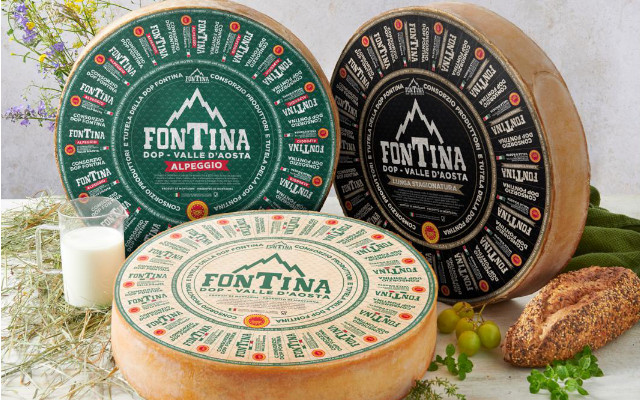
The Fontina PDO represents one of the most important expressions of the agri-food culture of the Aosta Valley. Produced with Milk cow's coming exclusively from Valdostana breed cows raised throughout the regional territory, this cheese specialty embodies the deep connection between the alpine environment, fodder biodiversity, pastoral traditions and artisanal skills handed down through centuries. Thanks to the Protected Designation of Origin recognized by the European Union, Fontina enjoys legal protection that guarantees traceability, production method, and quality characteristics. Its unique sensory profile – soft and melting paste, aroma of milk and alpine flowers, sweet and delicate taste that evolves with aging – makes it one of the most appreciated Italian cheeses on the domestic and international market.
Supply chain numbers, export shares, and price dynamics
The Fontina DOP supply chain is coordinated by the Consortium of Producers and Protection of the DOP Fontina, founded in 1952, which carries out protection, promotion and control activities (Consorzio Produttori e Tutela della DOP Fontina, 2025). The supply chain includes 700 farms, 200 mountain pastures and 162 associated producers.
According to the data communicated by the Consortium in October 2025, production has stabilized at about 39,000 forms per year (3,900 tons), with expectations of confirmation also for 2026 (Food, 2025). Fontina DOP ranks tenth among Italian cow's milk cheeses with Geographical Indication, according to the Ismea-Qualivita Report on the DOP Economy (2025). The consumer value is around 60 million euros, of which about 7.5 million are generated by exports (Food, 2025). Large-scale retail represents 80% of sales, while the 15% of production is destined forexport, mainly to the United States and France, with growing interest from Northern European countries. The consumer price in large-scale retail is around 14-15 euros per kilo in the standard range, up to 27 euros for the Alpine type, with a increase of 35-40% in the last five years.
The medieval roots of Fontina in the Aosta Valley
The origins of Fontina date back to the Middle Ages. The oldest known representation dates back to a fresco in the castle of Issogne dated to the end of the 15th century, in which forms attributable to the current Fontina appear. The name could derive from the Fontin alpine pasture, from the locality of Fontinaz, or from the Fontin family, mentioned in historical Aosta Valley documents, though historians have not yet reached a definitive consensus on the etymology. According to popular tradition, Fontina was born from theneed to preserve the abundant Milk produced during the season of alpine pastures, progressively refining the processing and maturation techniques in natural mountain caves. The product's notoriety has grown over the centuries until it was recognized Designation of Origin in 1955 and subsequently of the European PDO.
The specification updated to 2026
The latest consolidated version of the production specification, updated in February 2026, precisely defines every phase of the supply chain, from bovine genetics and feeding to the marketing of the final product (Fontina DOP Specification, 2026).
Designation, production area and raw material
Fontina DOP is defined semi-cooked fat cheese, produced with whole cow's milk. The specification regulates production, aging and portioning (art. 1 – Designation).
All stages – milk production, processing, aging and portioning – must take place exclusively within the entire territory of Valle d’Aosta (art. 2 – Production area).
The cheese is made from whole milk raw or thermized produced in Valle d’Aosta and coming from cows of Valdostana breed (Red Spotted, Black Spotted or Chestnut) and their crosses (art. 3 – Raw material).
Feeding of cows
The feeding of cows must be based on fresh or hay fodder from permanent polyphytic meadow, ryegrass and alfalfa, or cereal straws such as wheat, barley, oats, rye, triticale.
The ratio fodders:concentrates must not be less than 67:33, with at least 60% of the dry matter coming from the geographical area of the PDO. Hay, fresh fodder, cereals, oilseed seeds, legumes and related derivatives are allowed.
They are prohibited the silages or fermented fodder, as well as numerous fresh agro-industrial by-products, and urea as nitrogen source (art. 4 – Feeding).
Processing
The updated regulations introduce the possibility for breeders to carry out only one milking per day, aiming to reduce operating costs and promote generational change. The Milk, resulting from one or more consecutive milkings, must be sent for processing within 40 hours from the first milking. If the milk is not sent for processing after each milking, it must be kept at a temperature between +2°C and +6°C using appropriate equipment with a stirrer.
The regulation reform (2026) also introduces the possibility to subject the milk sent for processing to a process of thermization (minimum 64°C for at least 40 seconds), in order to reduce ‘the microbial load of pathogenic and anti-cheese bacteria’.
Only cultures of autochthonous lactic bacteria selected in the production area, distributed by the Consortium. The coagulation takes place in copper or steel vats using calf rennet; followed by cutting on heat, the shaping using molds with concave sides and pressing. The brining phase is optional and lasts a maximum of 12 hours; it may precede a period of drying up to 15 days, not counted for the aging process (art. 5 – Processing).
Aging
The minimum aging period is of 80 days. During this phase the cheeses are subjected to turning, dry salting and rubbing with water and salt solution, to promote the development of the characteristic washed rind.
The latest reform of the specification also introduces the possibility to subject the certified cheese to treatment HPP (High Pressure Processing) before placing on the market (art. 6 - Aging).
Aging must take place in environments with humidity of at least 90% (88% in traditional caves) and temperature between +4 and +12 °C. Freezing or deep-freezing of Fontina DOP is strictly prohibited (art. 7 - Aging warehouses).
Product characteristics
The cheeses have a flattened cylindrical shape, 30-45 cm diameter, 7-10 cm height, 7.5-12 kg weight. The rind is compact and thin, color ranging from light brown to dark brown. The Pasta is elastic and soft, with widespread eyes and coloring from ivory to straw yellow.
‘Microbiological characteristics: high content of live lactic ferments.
Organoleptic characteristics: the melting paste in the mouth has a characteristic sweet and delicate flavor, more intense as ripening progresses’.
The specification also recognizes additional mentions:
- Fontina DOP Alpine pasture (cheeses produced on alpine pasture, in the summer management of cattle herds moved from valley floor barns to pastures at ever-increasing altitudes);
- Fontina DOP Long Aging (minimum 180 days from its start. Art. 8 - Product characteristics).
Connection with the territory
The quality of Fontina derives from the inseparable interaction between mountain environment of the Aosta Valley, forage flora local, cattle breed Valdostana and traditional cheesemaking knowledge.
The breed Aosta Valley style - with its morphological structure muscular compact and suitable for movements on mountain pastures – transforms mountain grass into an original dairy product.
I human factors - the addition of native lactic ferments, coagulation with veal rennet, dry salting – are operations handed down through the centuries in the delimited geographical area (art. 9 - Link with the territory).
Identification of the shapes
Each form is identified by a casein plaque with alphanumeric code on the side (green with letter ‘A’ for alpine productions), from the ‘Consorzio Tutela Fontina’ (CTF) molds with producer numeric code, and by the ink mark impressed after the minimum aging period of 80 days. The alpine sites are identified with numbering below 600 (art. 10 - Product identification).
Packaging and labeling
The portioning must take place exclusively in Valle d’Aosta, due to the high humidity of the crust and the paste, which make the storage and packaging phases delicate. The labels must mandatorily include:
- the European logo;
- the wording ‘Mountain product‘ / ‘Produit de montagne‘;
- the Fontina DOP logo.
Forms with Alpeggio mention use a white logo on a green background; those with Long Aging a white logo on a black background (art. 11 - Packaging and labeling).
Nutritional properties: a treasure of minerals and vitamins
According to the Food Composition Tables of CREA (2019), 100 grams of Fontina provide on average:
- energy: 361 kcal
- proteins: 24.5 g
- total lipids: 28.9 g, of which saturated fatty acids: 18.6 g
- carbohydrates: 0.8 g
- salt: 1.7 g
From the point of view of micronutrients, the Fontina DOP is characterized by the extraordinary richness of:
- calcium: 870 mg per 100 g, equal to 109% of the Nutrient Reference Value (800 mg) established in Annex XIII to Regulation (EU) No 1169/11;
- phosphorus: 561 mg per 100 g, equal to80% of the NRV (700 mg);
- vitamin A: 420 μg per 100 g, equal to 53% of the NRV (800 μg);
- zinc: 4.25 mg per 100 g, equal to 43% of the NRV (10 mg);
- vitamin B2 (riboflavin): 0.45 mg per 100 g, equal to 32% of the NRV (1.4 mg).
Traditional uses
Fontina is the protagonist of Aosta Valley gastronomy:
- among the most famous traditional preparations are the fondue Aosta Valley style, the polenta concia with Fontina, the Aosta Valley-style cutlet, alpine soups and gratin of vegetables and potatoes;
- the younger cheeses are suitable for table consumption, while the long aged ones express more complex aromas and are particularly appreciated in tasting with structured honeys and characterful Aosta Valley white wines.
Tips for buyers
Consumers should prioritize certified and branded Fontina PDO, with particular attention to productions from alpine pasture and any certifications organic, which offer further guarantees on sustainable pasture management, biodiversity protection and animal welfare.
Professional buyers should evaluate complete traceability, the possible availability of additional certifications (e.g. organic), production capacity, logistical reliability and export experience.
The team of GIFT (Great Italian Food Trade) offers qualified support to international buyers in selecting reliable suppliers, facilitating the meeting between international demand and the best Italian producers.
Sustainable evolution of a great protected designation
The Fontina PDO It represents one of the most authentic examples of European territorial cheese. The regulations updated to 2026 protect a supply chain entirely rooted in the Aosta Valley, introducing technological flexibility – thermized milk, single milking, HPP treatment – without compromising the identity of the product. The ban on silage, the use of autochthonous ferments, rigorous aging, and the inseparable link with the Valdostana breed and the Alpine environment confer distinctive sensory and nutritional characteristics to Fontina. Forconsumers and buyers, the choice of Fontina DOP from mountain pastures today represents the most advanced synthesis between gastronomic excellence, environmental sustainability and enhancement of mountain communities.
Dario Dongo
Credit cover Consorzio Produttori e Tutela della D.O.P. Fontina
References
- Consorzio Produttori e Tutela della DOP Fontina. (2026). Production specification of the DOP Fontina (modification 2025 and integration 19-11-25). Consorzio Produttori e Tutela della DOP Fontina. https://www.fontina-dop.it/wp-content/uploads/2026/03/DISCIPLINARE-DI-PRODUZIONE-DELLA-DOP-FONTINA-modifica-2025-e-integrazione-19-11-25.pdf
- CREA – Research Center for Food and Nutrition. (2019). Food composition tables. Fontina. Council for agricultural research and agricultural economics analysis. https://www.alimentinutrizione.it/tabelle-nutrizionali/162020
- Food. (2025, October 15). Fontina DOP: stable production in 2025, prices growing by 40%. Food. https://www.foodweb.it/2025/10/fontina-dop-produzione-stabile-nel-2025-prezzi-in-crescita-del-40/
- Ismea & Qualivita Foundation. (2025). ISMEA-Qualivita 2025 report on Italian agri-food and wine productions DOP, IGP and STG (23rd ed.). Qualivita Editions. https://www.ismea.it/flex/cm/pages/ServeAttachment.php/L/IT/D/1%252Fe%252F8%252FD.fefdd2e7c08546544955/P/BLOB%3AID%3D13512/E/pdf?mode=download
- Regulation (EU) No 1169/2011 of the European Parliament and of the Council of 25 October 2011 on the provision of food information to consumers. Consolidated text: 01/04/2025. http://data.europa.eu/eli/reg/2011/1169/2025-04-01

Dario Dongo, lawyer and journalist, PhD in international food law, founder of WIISE (FARE - GIFT – Food Times) and Égalité.


