

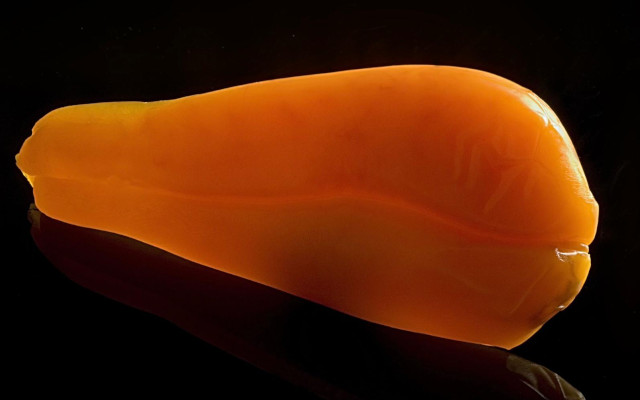
There Mullet bottarga it is among the least famous and equally distinctive fish products of Italian regional culture. It is obtained from the ovaries of the mullet or mullet (Mugil cephalus), salted, pressed and dried. The method described in both sheets of Traditional Agri-Food Products of Sardinia e Tuscany it is now also taken up in productions on the Po Delta, in Emilia-Romagna.
2026 adds a new element: the FAO technical manual on mullet breeding, drawn up with the IMC Foundation of Oristano (Vallainc et al., 2026), paves the way for a programmable supply chain, with seed produced in the hatchery rather than taken from the wild. For international buyers, knowing the origin of the raw material, labeling rules, nutritional profile and reference prices is the prerequisite for purchasing with knowledge.
What is mullet bottarga?
The ingredients of the bottarga there are two, ovaries of mullet (or mullet) and sea salt. The ovarian sacs are extracted immediately after fishing without breaking the membrane, cleaned of blood vessels, arranged in layers with medium-fine grain sea salt on wooden surfaces, pressed to drain the brine and finally seasoned with natural or controlled ventilation, with periodic turning. In fish weighing 1-2 kg the ovaries weigh approximately 200-500 g (Sardinia Region, n.d.). The finished product has form rectangular, consistency compact and color amber, from light to dark.
The transformation concentrates i nutrients. A study by the University of Cagliari followed the processing of the ovaries of mullet caught in the Tortolì lagoon: the humidity drops to 25% and the pH to 5.46, while on the dry basis the bottarga contains the 56% protein, 34% fat and 3.6% sodium chloride (Caredda et al., 2018). A second work, also Sardinian, measured the transition from the fresh ovary to the matured product: humidity from 50.7% to 24.8%, total lipids from 2.46 to 7.46 g/100 g (Corrias et al., 2020). There weight loss during processing, between 40 and 50% according to the technical data sheets, is one of the structural reasons for the price high.
An ancient process, an Arabic name
The official sheets of Traditional Agri-Food Products attribute to Phoenicians the spread of salting mullet eggs and to the Arabs the spread of the product in the Mediterranean with the name battarikh, salted fish roe, from which the Italian 'bottarga' (Tuscany Region, n.d.; Sardinia Region, n.d.).
The Tuscan record also documents a continuity of six centuries in the Orbetello lagoon, where in Middle Ages the buttagre were paid as compensation for water exploitation rights.
The only mullet bottarga with a registered name in the European Union today is Avgotaracho Messolongiou DOP, produced in Greece in the Missolungi lagoons, and is also different from the Italian one as it is covered in beeswax.
Production locations in Italy
There Sardinia it is the productive heart. The regional sheet allows the geographical mention 'of Sardinia' or 'Sardinian' for the product obtained on the island (Sardinia Region, n.d.). The historic centers are the Cabras pond, in the Oristano area, and the lagoons of Tortolì, Sant'Antioco and Marceddì. In Cabras, on 22 November 2022, the Chamber of Commerce of Cagliari and Oristano organized the first international bottarga auction: only twelve whiskers from 328 to 514 g, starting price of €250/kg according to the consortium price list, awards up to around €600/kg (ANSA, 2022; Il Sole 24 Ore, 2022).
There Tuscany has its second hub in the Orbetello lagoon. The Orbetello mullet bottarga, regional PAT, is aged for about two weeks which makes it softer than the others, it is produced from August to October and marketed vacuum-packed in sizes from 150 to 400 g (Tuscany Region, s.d.).
The Po Delta it is the hub under construction. In September 2025, the Department of Veterinary Medical Sciences of the University of Bologna presented a project to produce bottarga from mullet in the Emilia-Romagna valleys, using salt from Cervia and the Comacchio valleys. The scientific director, Oliviero Mordenti, observed that many Italian companies process imported ovaries, mainly from North Africa, and that the valley mullet, nourished by crustaceans and oily fish present in the basin, has its own sensorial characteristics; the prices indicated range from 100-130 €/kg for industrial whiskers to over 200 €/kg for the product processed with traditional methods (RavennaNotizie, 2025).
Sardinia, PGI objective
In September 2022, the Sardinia Region had instead announced its intention to accelerate towards one PGI of Sardinian bottarga, with the aim of differentiating regional production from that obtained with foreign raw materials (ANSA, 2022a, 2022b). In November 2022, after the first international Borsino of the Cabras bottarga, the fishermen and some producers in turn had confirmed this objective (Il Sole 24 Ore, 2022).
In the 2025, the Regional Agency for Agricultural Research (AGRIS) and the Fisheries and Aquaculture Service of the Sardinia Region have started the project 'Multidisciplinary characterization of Sardinian Bottarga', financed under the EMFFA (European Fund for Maritime Affairs, Fisheries and Aquaculture) (AGRIS Sardinia, 2025).
In May 2025, the Slow Food Presidium of the mullet bottarga and the traditional fishing of the Cabras pond, with the aim of enhancing and distinguishing the product made with local raw materials compared to that obtained from imported raw materials (ANSA, 2025; L'Unione Sarda, 2025).
The risk It is clear to narrow the horizon of the Protected Geographical Indication only to '100% Made in Sardinia' products, whose production volumes are completely marginal - as shown by the numbers of the first Cabras bag, in the order of a few kilograms of product - with a production potential limited by natural factors. Where instead the production of bottarga from Sardinia, with only the raw materials available on the market (mainly foreign), responds to an international demand that brings a different order of value and employment to the island.
Customs rules, labeling and authentication
The bottarga is classified in customs among the substitutes for caviar, subheading NC 1604 32 00, as confirmed in Italy by the Customs and Monopolies Agency with note dated 1 February 2018. It therefore Not is among the products subject to obligation to provide the information required by the fishing CMO, such as capture area e method of production (EU regulation 1379/2013, art. 35.1 and Annex I), as clarified by the MIPAAF circular of 22 December 2017 (Dongo, 2018).
The place of customs origin is that of the last substantial transformation (EU regulation 2026/2108, art. 169.2), therefore the bottarga processed in Sardinia with imported eggs can indicate Sardinia as the place of production. However, when the label - outside of the registered trademark (Dongo, 2023) - evokes a origin, with words, flags or images, and the primary ingredient has different provenance, it becomes mandatory to report this information with alternative wording such as for example with 'mullet eggs: non-EU origin' or 'made with mullet eggs of different origins' (EU reg. 1169/2011, art. 26.3; EU exec. reg. 2018/775, art. 2).
Researchers are also working on analytical tools authentication. The stable isotopes of carbon, nitrogen and sulfur were tested on the Greek PDO to distinguish Missolungi bottarga from that of other origins (Thomatou et al., 2022), with a probabilistic model which is also suitable for a few samples (Tsirogiannis et al., 2022). In Sardinia, the DNA barcoding correctly identified the species in botargo produced from the ovaries of Mugil cephalus e Mugil capurrii fished in the central-eastern Atlantic (Piras et al., 2018).
Data on production and prospects
Unfortunately, there are no disaggregated public statistics on bottarga: the customs heading NC 1604 32 in fact aggregates all caviar substitutes. The available data concern the species. According to the FAO manual, the world production of mullet he reached 1.07 million tons In the 2024, of which 400,606 t from aquaculture, equal to 37,4% (Vallainc et al., 2026). The raised share of Mugil cephalus strictly speaking, however, it is still minimal, 5,934 t in 2024 (Randazzo et al., 2026), since farming still depends on the collection of wild fry.
The FAO manual n. 699, signed by researchers from the IMC Foundation of Oristano, the Catalan IRTA and the FAO, collects over ten years of research on captive breeding, larval rearing, juvenile production and fattening (Vallainc et al., 2026). The tests conducted in Oristano between 2016 and 2019 on broodstock taken from the Sardinian lagoons achieved fertilization rates of 83% and hatching rates of 76%, with larval survival at 60 days between 10 and 19% (Vallainc et al., 2021).
Nutritional properties
The food composition tables indicated by CREATE — Food and Nutrition Research Center (2019) refer to the following nutritional values for mullet mullet roe (code 120590, 50 g portion), per 100 g:
- energy 1,696 kJ / 405 kcal;
- fat 25.7 g;
- of which saturated fatty acids: n.a.;
- carbohydrates 0 g;
- of which sugars 0 g;
- fibers 0 g;
- proteins 43.5g;
- salt: data not reported by CREA. On dry basis, Sardinian bottarga contains on average 3.6% sodium chloride (Caredda et al., 2018).
Nutrition and health information
The data provided by CREA indicate that proteins provide approximately 43% of the energy and it is therefore possible to use the nutritional indication in the labeling and advertising of bottarga 'high in protein' (EC regulation 1924/2006, Annex).
Several scientific studies have also measured the lipid fraction:
- in three Sardinian bottarghe taken from the market the total fatty acids varied between 141.7 and 158.9 mg/g, with EPA between 10.5 and 13.0% e DHA between 15.2 and 15.9% of total fatty acids, in a fraction dominated by wax esters (Rosa et al., 2020a);
- an NMR analysis on Greek bottarga confirms the wax esters at 72.9 mol% of the lipids (Lidoriki et al., 2025). The oil obtained from processing waste salt is in turn rich in Omega-3, 122 g/kg (Rosa et al., 2020b);
- with these values it is reasonable to assume that the bottarga widely exceeds the threshold of 80 mg of EPA+DHA per 100 g required for the indication 'high in omega-3 fatty acids' (EC regulation 1924/2006, Annex), although their values can vary significantly with the raw material and processing (Corrias et al., 2020),
Furthermore, CREA does not report the values of Omega-3 fatty acids or those of micronutrients (vitamins and minerals). In any case, analytical data on representative samples of products are necessary to evaluate their contents in relation to the nutritional reference values set out in Annex XIII to Regulation (EU) no. 1169/2011, recalling that lower tolerance on the values that justify nutritional and health claims is not permitted (Dongo, 2023).
Our team of DO (Food and Agriculture Requirements) supports operators, their representatives and research consortia in the valorisation of products, in labeling and advertising, also through nutrition and health claims authorized pursuant to Regulation (EC) no. 1924/06.
Uses in the kitchen
The bottarga is a seasoning from the intense flavour which asks for measured pairings. There are two traditional uses reported in the regional cards: as a thinly sliced appetizer, with extra virgin olive oil and lemon and an accompaniment of 'music paper', bread carasau; followed by grated on the pasta (Sardinia Region, n.d.).
The writer adds his own recipe for a appetizers simple: thin slices of Sardinian bottarga accompanied by melon, in a pleasant contrast of sweet and savory, between the shades of orange and the warm ones of amber.
The spaghetti with bottarga of the Cucchiaio d'Argento include garlic and shallots in oil, grated bottarga added after the heat is off and a few slices to decorate (Cucchiaio d'Argento, n.d.).
In the professional kitchen it is used on seafood risottos, raw vegetables, eggs and whipped butter. In Orbetello the short maturation gives a softer product, suitable for cutting; the more seasoned Sardinian bottarga lends itself better to grating.
The intense aromatic profile of this product - which evokes the strength of the sea - suggests a gradual approach, for those who discover it for the first time: starting with small quantities on neutral bases allows the palate to progressively recognize its deep, ancestral and refined flavor at the same time.
Advice for buyers
Some practical criteria, for gourmets and professionals:
- observe the appearance and consistency of the whisker (the ovarian sac of the fish, with a naturally elongated and tapered shape, subjected to salting and drying): color uniform amber; membrane tight fit with no bubbles or voids; consistency compact, neither soft nor cracked;
- The sensory profile includes clean and marine aroma, balanced flavor, absence of rancid, ammonia or excessively bitter notes;
- consider i reference prices, which distinguish industrial whiskers (premium), traditional processes (super–premium) and the pieces luxury from local mullet eggs (RavennaNotizie, 2025);
- for the professional buyers, ask the supplier for traceability documentation of the raw materials, species and fishing or farming area, chemical analyzes of volatile compounds, ABVT/TMA and the main indicators of lipid oxidation;
- keep the intact product vacuum-packed in a cool, dry place and, after opening, in the refrigerator, according to the manufacturer's instructions.
The team of GIFT (Great Italian Food Trade) knows the structure of regional fish supply chains and assists foreign buyers in identifying excellent producers in the various price segments.
Conclusions
Italian mullet bottarga is a heritage of millenary history and artisanal knowledge, capable of offering a unique sensorial experience that combines an intense aromatic profile with excellent nutritional properties.
The supply chain moves between identity productions, different price ranges and perspectives essentially linked to innovation in aquaculture which the FAO report certifies and promotes (Vallainc et al., 2026).
The PGI registration for Sardinian bottarga is awaited with moderate enthusiasm, which will only be significant if it is able to enhance the entire production located on the island.
Dario Dongo
References
Scientific studies
Caredda, M., Addis, M., Pes, M., Fois, N., Sanna, G., Piredda, G., & Sanna, G. (2018). Physico-chemical, colorimetric, rheological parameters and chemometric discrimination of the origin of Mugil cephalus' roes during the manufacturing process of Bottarga. Food Research International, 108, 128–135. https://doi.org/10.1016/j.foodres.2018.03.039
Corrias, F., Atzei, A., Giglioli, A., Pasquini, V., Cau, A., Addis, P., Sarais, G., & Angioni, A. (2020). Influence of the technological process on the biochemical composition of fresh roe and bottarga from Liza ramada and Mugil cephalus. Foods, 9(10), 1408. https://doi.org/10.3390/foods9101408
Piras, P., Sardu, F., Meloni, D., Riina, M. V., Beltramo, C., & Acutis, P. L. (2018). A case study on the labeling of bottarga produced in Sardinia from ovaries of gray mullets (Mugil cephalus and Mugil capurrii) caught in Eastern Central Atlantic coasts. Italian Journal of Food Safety, 7(1), 6893. https://doi.org/10.4081/ijfs.2018.6893
Randazzo, B., Miccoli, A., Caccamo, L., Gai, F., Boggia, R., Turrini, F., Leone, A., Carboni, S., Concu, D., & Maricchiolo, G. (2026). Dietary black soldier fly meal remodels hepatic lipid metabolism and fillet fatty acids profile of flathead gray mullet Mugil cephalus (Linnaeus, 1758). Frontiers in Marine Science, 13, 1901130. https://doi.org/10.3389/fmars.2026.1901130
Rosa, A., Isola, R., Nieddu, M., & Masala, C. (2020a). The role of lipid composition in the sensory attributes and acceptability of the salted and dried mullet roes (bottarga): A study in human and animal models. Nutrients, 12(11), 3454. https://doi.org/10.3390/nu12113454
Rosa, A., Nieddu, M., Masala, C., Marincola, F. C., Porcedda, S., & Piras, A. (2020b). Waste salt from the manufacturing process of mullet bottarga as source of oil with nutritional and nutraceutical properties. Journal of the Science of Food and Agriculture, 100(15), 5363–5372. https://doi.org/10.1002/jsfa.10584
Thomatou, A.-A., Psarra, E., Mazarakioti, E. C., Katerinopoulou, K., Tsirogiannis, G., Zotos, A., Kontogeorgos, A., Patakas, A., & Ladavos, A. (2022). Stable isotope analysis for the discrimination of the geographical origin of Greek bottarga 'Avgotaracho Messolongiou': A preliminary research. Foods, 11(19), 2960. https://doi.org/10.3390/foods11192960
Tsirogiannis, G., Thomatou, A.-A., Psarra, E., Mazarakioti, E. C., Katerinopoulou, K., Zotos, A., Kontogeorgos, A., Patakas, A., & Ladavos, A. (2022). Probabilistic machine learning for the authentication of the protected designation of origin of Greek bottarga from Messolongi: A generic methodology to cope with very small number of samples. Applied Sciences, 12(13), 6335. https://doi.org/10.3390/app12136335
Vallainc, D., Concu, D., Gimenez Papiol, G., Loi, B., Leggieri, F., Brundu, G., Chindris, A., Sanna, G., Fois, N., Antognarelli, F., & Rossini, P. (2021). Producing flat-head gray mullet Mugil cephalus (Linnaeus, 1758) fries in captivity from sexually mature adults collected in Sardinian lagoons. Aquaculture Reports, 21, 100844. https://doi.org/10.1016/j.aqrep.2021.100844
Institutional reports and sources
AGRIS Sardinia. (2026). Multidisciplinary characterization of Sardinian Bottarga. Autonomous Region of Sardinia. https://www.sardegnaagricoltura.it/documenti/14_691_20260423134430.pdf
CREA — Food and Nutrition Research Center. (2019). Food composition tables: Bottarga, mullet mullet (code 120590). https://www.alimentinutrizione.it/tabelle-nutrizionali/120590
Sardinia region. (s.d.). Mullet bottarga. Traditional Agri-Food Product Sheet. Sardinia Agriculture. https://www.sardegnaagricoltura.it/documenti/14_43_20070607151008.pdf
Tuscany region. (s.d.). Traditional Tuscan Products: Product Sheet – Orbetello mullet bottarga. http://prodtrad.regione.toscana.it/LIB_ProdTrad/Prodotto.php?ID=8
Vallainc, D., Estevez, A., Ramos, S. J., Concu, D., Carboni, S., Duncan, N., & Lovatelli, A. (2026). Hatchery, nursery and grow-out techniques for the flathead gray mullet (Mugil cephalus) (FAO Fisheries and Aquaculture Technical Paper No. 699). FAO. https://doi.org/10.4060/cd9536en
European Union regulatory sources
Regulation (EU) 2026/2108 of the European Parliament and of the Council of 16 September 2026 establishing the Union Customs Code and the European Union Customs Authority, and repealing Regulation (EU) No 952/2013. http://data.europa.eu/eli/reg/2026/2108/oj
Regulation (EU) No 1379/2013 of the European Parliament and of the Council on the common organization of the markets in fishery and aquaculture products. http://data.europa.eu/eli/reg/2013/1379
Regulation (EU) No 1169/2011 of the European Parliament and of the Council of 25 October 2011 on the provision of food information to consumers. Consolidated text: 04/01/2025. http://data.europa.eu/eli/reg/2011/1169/2025-04-01
Regulation (EC) No 1924/2006 of the European Parliament and of the Council of 20 December 2006 on nutrition and health claims made on foods. Consolidated text: 12/13/2014. http://data.europa.eu/eli/reg/2006/1924/2014-12-13
Commission Regulation (EU) No 432/2012 of 16 May 2012 establishing a list of permitted health claims made on foods, other than those referring to the reduction of disease risk and to children's development and health. Consolidated text: 08/20/2025. http://data.europa.eu/eli/reg/2012/432/2025-08-20
Commission Implementing Regulation (EU) 2018/775 laying down rules for the application of Article 26(3) of Regulation (EU) No 1169/2011 regarding country of origin or place of provenance of the primary ingredient of a food. OJ L 131, 29.5.2018, p. 8. http://data.europa.eu/eli/reg_impl/2018/775/oj
Commission Regulation (EC) No 1263/96 supplementing the Annex to Regulation (EC) No 1107/96 on the registration of geographical indications and designations of origin. OJ L 163, 2.7.1996, p. 19. http://data.europa.eu/eli/reg/1996/1263/oj
Print and recipes
AGRIS Sardinia. (2025). Multidisciplinary characterization of Sardinian Bottarga. Autonomous Region of Sardinia. https://www.sardegnaagricoltura.it/documenti/14_691_20250415104949.pdf
AGRIS Sardinia. (2026). Multidisciplinary characterization of Sardinian Bottarga. Autonomous Region of Sardinia. See pages 25,26. https://www.sardegnaagricoltura.it/documenti/14_691_20260423134430.pdf
HANDLE. (2022, September 10). PGI label for Sardinian bottarga, the Region accelerates. HANDLE. https://www.ansa.it/sardegna/notizie/2022/09/10/marchio-igp-per-la-bottarga-sarda-la-regione-accelera_843a80fc-0c32-4370-85d3-6c983204851e.html
HANDLE. (2022, November 24). Up to 600 euros/kg for Cabras bottarga, the Sardinian caviar. HANDLE. https://www.ansa.it/canale_terraegusto/notizie/prodotti_tipici/2022/11/24/fino-a-600-euro/kg-per-bottarga-di-cabras-il-caviale-sardo_0a44058d-cb76-40e7-ade8-7bf72dc75edc.html
HANDLE. (2025, May 10). Cabras bottarga is a new Slow Food Presidium. HANDLE. https://www.ansa.it/sardegna/notizie/2025/05/10/la-bottarga-di-cabras-e-un-nuovo-presidio-slow-food_0aca333a-b339-4548-b90b-4177f0c5b15b.html
Silver Spoon. (s.d.). Spaghetti with bottarga. https://www.cucchiaio.it/ricetta/spaghetti-alla-bottarga/
RavennaNews. (2025, September 17). Relaunching valley farming. The UNIBO project on the production of mullet bottarga from the Po delta was presented. https://www.ravennanotizie.it/0-copertina/2025/09/17/rilanciare-la-vallicoltura-presentato-il-progetto-unibo-sulla-formazione-di-bottarga-di-cefalo-del-delta-po
The Sardinian Union. (2025). Cabras, the Slow Food Presidium arrives for bottarga. The Sardinian Union. https://www.unionesarda.it/news-sardegna/oristano-provincia/cabras-per-la-bottarga-arriva-il-presidio-slow-food-luo06wxr
Legal insights
Dongo, D. (2018, February 19). Bottarga, customs tariff and labelling. DO – Food and Agriculture Requirements. https://www.foodagriculturerequirements.com/notizie/bottarga-tariffa-doganale-ed-trattamento/
Dongo, D. (2023, April 17). Geographical indications, factory location and origin of raw materials. DO (Food and Agriculture Requirements). https://fareagrifood.com/2023/04/17/sede-stabilimento-origine-materie-prime/
Dongo, D. (2023, June 29). Nutrition and health claims, what tolerances on the declared values? FT (Food Times). https://www.foodtimes.eu/it/consumatori-e-salute/nutrition-health-claims-tolleranze-valori-dichiarati/

Dario Dongo, lawyer and journalist, PhD in international food law, founder of WIISE (FARE - GIFT – Food Times) and Égalité.


