

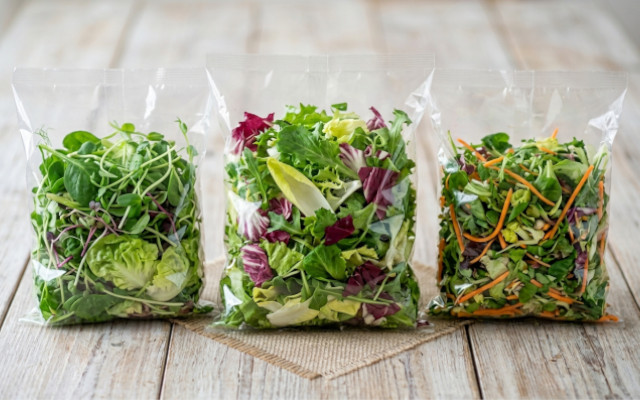
IV range against the wall. What was supposed to be a transition phase, a change of skin, after the Covid shock, has turned out to be a true cul de sac.
The hoped-for change of skin by the player of the sector was inspired by what happened to the US sector about 15 years ago: the transition from a disorganized and fragmented supply chain to a production fabric made up of large structured and technological companies thanks to an aggregation process.
Too many players in the IV range
I player main of the Italian sector had begun to exploit the post-Covid market conditions which had given a strong shock to the sector, to gradually aggregate the ultra-fragmented areas and the related weakened production fabric. Having large players in the sector would have allowed programming the production supply and preserving profitability throughout the supply chain, starting with the agricultural part.
The situation, experts explain to us, has definitely gotten out of hand and the excessive number of player (even improvised) hunting for profitability denounced by all sector courtyards is proving to be a boomerang unmanageable to the point that some have called for a cap or, worse, a cut, to the number of operators.
Recompaction operation
On this chessboard, today become incandescent, the next meeting of the IV range committee of the Interprofessional Organization (within Confagricoltura) is convened, whose presidency has been strategically assigned to Antonio Salvatore, former president of Op Oasi (supplier of Bonduelle which, in Italy, is the second market operator in the IV range sector after the distributor's brand).
The appointment of Salvatore is even more strategic because he is also vice president of Unaproa, a political voice, within Coldiretti, of UIF IV range, the association that gathers the nine main industries of the sector.
In summary, it represents a reassembling of the entire supply chain in the face of the difficult crisis phase that risks cutting the legs of a plethora of companies important for the country's agricultural economy due to the number of employees, turnover, and especially the push forward (read investments) towards sustainability which here is necessitated by a stringent law (that on the IV range).
In search of competitiveness
The regulation imposes, among other things, a strict storage temperature level along the cold chain, 8° C. A mandatory level that is not imposed on any other supply chain in the fresh fruit and vegetable world and which is hoped to be made even stricter with the expected reform of the same law that should bring the temperature along the cold chain.
‘In front of this crisis the path of aggregation is a necessary process‘, explains to us Massimiliano De Core, president of the Interprofessional Organization. ‘The government has already enacted two decrees aimed at the IV range supply chain with which Masaf recognizes the greater difficulties of this sector compared to others and its major critical issues related to higher energy consumption, for example, or plastic which has excessively increased costs without a corresponding price adjustment.
We trust the outcomes of the next meeting of the IV range interprofessional committee which will be convened by July 20. At the same time, at the end of June, we requested a meeting with the director general of Masaf, Luigi Polizzi, to try to understand how to restore competitiveness to this sector. We are awaiting a response.’.
The path towards aggregation (which has essentially turned into a ‘whoever perseveres wins’, with the securing of large industries under the umbrella of the private label that guarantees, at least, the movement of large volumes) is showing, however, that something is not going well. Proof are the glaring debaccle of some of the main companies operating in this industry, like Cultiva, queen of organic IV range.
The organic IV range sector, this known
The company from Rovigo was contacted but preferred not to respond following a communication line that has always been rather tight towards the press.
The ‘miniature multinational’ Veneto (self-defined as such) – which has also made a significant leap forward with production expansion in the USA and the agreement with Taylor Farms aiming to become the leading IV range supplier on the US East Coast – in Italy, had specialized in the production of organic IV range becoming, at first, the main PL supplier for some of the largest retailer of the Peninsula.
Then, also due to the failure of theupgrade commercial of theagrifood organic sector in general, which has not yet managed to carve out the desired space in mass distribution, had to capitulate in front of the higher costs of organic – already tripled for conventional products – which were not compensated by the prices recognized by the mass retail sector. Products from private label always move, even for significant weights such as 200g and 500g bags, around the price of 0.99 cents per package.
The spiral of price decreases
In the push for price reductions, in an anti-inflationary direction, there is no shortage of intentions of the retailer traditional players to retain customers in the no-holds-barred competition with the discount who are increasingly aligned with supermarket standards in terms of quality of the offer, format and assortment depth. In this scenario, the few organic (and biodynamic) IV range suppliers end up in a meat grinder that certainly does not help the sector to get out of crisis.
‘Today it is possible to cultivate and market organically the best-selling items such as arugula, baby lettuce, corn salad or mixed salad which allow for a lower cost price. For others, it is difficult to break even, explains Paolo Pari, director of Almaverde Bio.
‘Ismea is having a lot of difficulty defining a minimum price for IV range products, especially due to the strong differences characterizing all production areas. From North to South of the country‘, explains Felice Poli, president of OP Sole e Rugiada, which is the productive part of the La Linea Verde supply chain as well as co-vice president of Unaproa.
‘We are now working to define the price of arugula, the first IV range reference under study in implementation of the decree on unfair commercial practices, and the next will be baby lettuce and lamb's lettuce. Rather than average price, it might make more sense to talk about areas suited to each variety.
The situation in these weeks remains nonetheless heated. This is also due to a combination of factors. The difficult market conjuncture has occurred during a delicate phase of generational transition for many companies and not all young entrepreneurs are willing to invest in the family business under these conditions. Those who continue the entrepreneurial activity often opt for less 'complex' productions, such as those destined for the frozen food channel. It is certain that one cannot remain still in a context like this and Unaproa offersits full availability to participate in all tables dedicated to this crisis'.
Companies are closing
Beyond Cultiva, the sector has also lost other important pieces. Among the most recent to have had to surrender are the Romagna company Il Melograno or the Campanian group Adinolfi (also a producer of organic IV range) which has started a downsizing plan. The crisis is widespread. According to expert estimates, this year, precisely due to the lack of profitability, the sector has lost about 20% of the hectares dedicated to the sector.
‘Due to high costs that increase even more during the summer months related to the greater need for inputs such as water and energy, this year 30-40% of local producers have decided not to cultivate the summer product. In the hot months, in fact, there are few cuts that do not exceed three for the entire season. This makes the economic situation of companies even more burdensome to the point that stopping is more convenient', explains Vito Busillo, president of the Consortium of Arugula of Piana del Sele IGP.
Consumption trends
Looking closely, however, we are not witnessing a consequence of the decline in demand for the ready to eat which is actually growing on all shelves, fromambient, frozen and even freeze-dried products which have made giant strides also thanks to new low-temperature drying technologies which preserve the organoleptic and nutritional properties of the raw material intact and significantly lower production costs.
One has to ask why demand for the IV range does not grow which, in addition to meeting the demand for ready-to-use product, is perfectly aligned with other important trends of consumption such as healthiness and freshness, as well as low prices.
This does not apply to all chains.
‘In Cedigros, Selex group, the demand for IV range is growing. Both in terms of withdrawn and sold. As for private label references, there are no volume declines. We work with many important companies. Almost all are moving towards private labels.
In this sense, we need to see if they can then compensate with the volumes they sell under the manufacturer's brand. The last part of the cold chain could represent a critical issue for maintaining the temperature of 8°C due to the lack of specialized operators in the logistics sector but also in the sales departments, or due to the intervention of many intermediaries. In this phase, inefficiencies could perhaps be generated, dice Giancarlo Amitrano, purchasing manager I and IV Gamma of the group.
What politics does
In addition to the two decrees and the hoped-for definition of minimum prices, on June 30th the latest, highly contested V supply chain call was issued with funding exceeding one billion euros.
‘Only in Campania, most of the companies that participated are of IV gamma‘, clarifies Busillo.
The call provides funding up to 25 million per supply chain project and could, to some extent, support companies towards theupgrade technology on sustainability.
Today the technologies to make these productions green (added value) are all present. But it is practically impossible to access them due to lack of funding. Especially since there is no (for any supply chain) a carbon footprint from field to table that allows companies applying all the pluses technological sustainability measures, to concretely measure the exact amount of emissions they produce or, conversely, save.
‘In Lombardy we asked the agriculture assessor to create reference parameters within the PSR framework that can translate into concrete support for the sector born in this region from which a production tradition spread across the entire country', states Poli.
Mariangela Latella

Mariangela Latella
Professional journalist specialized in agriculture. She covers global agricultural and agri-food markets, ecological transition, green economy.


