

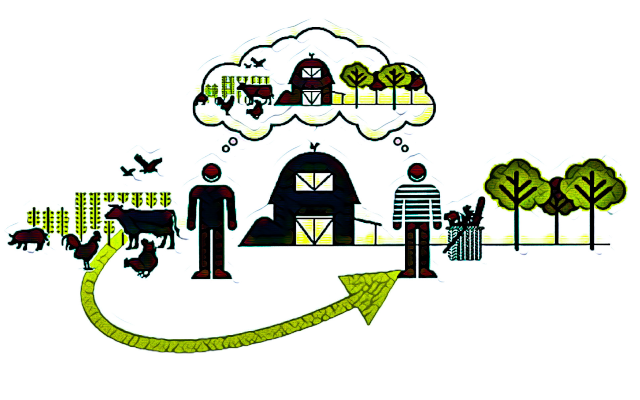
‘Short supply chain’. After the examination of EU rules and good practices, some insights are offered on market trends and current regulations in Italy.
The ‘supply chain’ on the label in the 2018 Immagino report by GS1-Italy
The Immagino Observatory of GS1-Italy, in its latest report, offers a comprehensive overview of mandatory and voluntary information displayed on the labels of 72,100 food products distributed through GDO channels in 2018. Among these, 613 labels – equal to 0.8% of the total – report information regarding the origin ‘supply chain’. In addition to indications subject to specific rules, such as PDO, PGI, organic.
The data in itself is not particularly significant, also considering the ambiguity and misleading nature of some expressions. (1) Moreover, there is the progressive spread of supply chain-related information (+14.1% compared to 2017), used on 55 brands in the production sector and on 10 GDO brands (Large-scale Organized Distribution). The two most popular expressions in 2018:
– ‘controlled supply chain’, on 345 products, sales exceeding €125 million (+12.3%),
– ‘certified supply chain’, 72 products, €48.5 million (+5.4%).
Looking closely these are statements completely devoid of meaning, redundant and often unlawful. (2) They reveal the lack of creativity of marketing departments and at the same time the lack of initiative of operators. Instead, they could characterize their specifications with additional elements related to the territory and the sustainability of each phase of the process. With the aim of building consumer loyalty through ‘social pacts’ that consolidate value in the territory.
‘Short supply chain’ and ‘products at useful kilometer’, the national regulations
Law 158/17 – ‘‘Measures for the support and enhancement of small municipalities, as well as provisions for the redevelopment and recovery of the historic centers of the same municipalities’ – aims to promote and encourage the sale of products coming from ‘short supply chain’ or ‘at useful kilometer’’.
For ‘agricultural and food products coming from Short supply chain’ means agricultural and food products coming from a supply chain made up of a limited number of economic operators who commit to promoting cooperation, local economic development and close socio-territorial relationships between producers, processors and consumers.’ (3)
Nothing new compared to the equally vague provision of the European legislator. The concept of short supply chain remains undefined, even if anchored to some values. Therefore, it remains the operator's burden to be able to demonstrate the truthfulness and concreteness of his claims. It is different in the case of
For ‘agricultural and food products ‘at useful kilometer’ means those ‘coming from a place of production or from a place of cultivation and breeding of the primary agricultural raw material used in the processing of products, located within a radius of 70 kilometers from the place of sale, as well as products for which a limited contribution of pollutant emissions resulting from transport is demonstrated, calculated from the production phase up to the moment of final consumption’. (4)
The Ministry of the Environment, in agreement with that of agriculture, should have defined the criteria and parameters to be observed to demonstrate the limited contribution of pollutant emissions. But the yellow-green government neglected this aspect, instead giving priority to legitimizing toxic sludge in agriculture.
Short supply chain, untapped opportunities
To the ‘100% Made in Italy’ goes the pink jersey of the Immagino 2018 report, as has been seen. Italian consumers have finally learned to appreciate products whose supply chains are rooted in the territory, as demonstrated by the sensational success of pasta made from Italian wheat. The agricultural raw material Made in Italy it is not necessarily better, but favoring it means contributing to our economy, employment and GDP, agriculture and related industries.
The 'short supply chain', nonetheless, it was recorded only on 16 of the 72,100 labels displayed on supermarket shelves in Italy in 2018. Shop conveniences or simple myopia? How can one not understand that consumers can appreciate the use of Italian wheat even in baked products, national legumes instead of Canadian ones loaded with glyphosate, krumiri biscuits with Italian butter instead of tropical palm oil?
‘Meditate people, meditate...’ (quote Renzo Arbore)
Dario Dongo
Note
(1) A widespread deception is the reference to the concepts of 'integrated pest management' or similar on IV and V range products. Indeed, since integrated pest management in agriculture is mandatory, in Italy as in Europe, boasting it on the label is to be considered prohibited, pursuant to EU regulation 1169/11, article 7.1.c. Where it is prohibited to attribute to a food product characteristics that are instead common to products of the same category
(2) For the legal reasons mentioned in note 1, boasting the control or certification of supply chain products with the distributor's brand is also to be considered prohibited. These are, once again, common characteristics of all packaged fruit and vegetables with private label
(3) See law 158/2017, art. 11.2.a
(4) Cf. law 158/17, art. 11.2.b

Dario Dongo, lawyer and journalist, PhD in international food law, founder of WIISE (FARE - GIFT - Food Times) and Égalité.


