

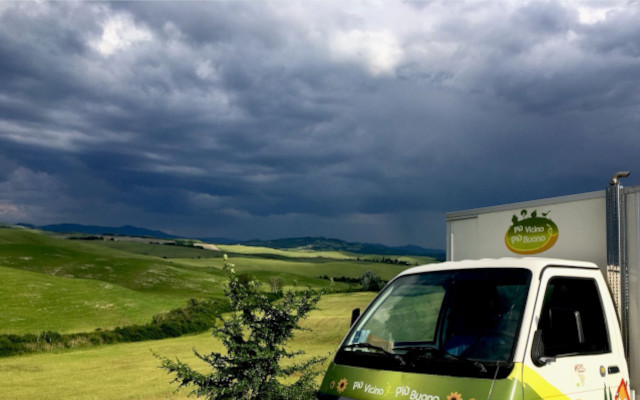
The Tuscany is today the excellence laboratory for the development oforganic agriculture in Italy and Europe. With 237,000 hectares cultivated biologically – equal to 36.5% of the surface used agricultural area (UAA), compared to a national average of 20.2% – and over 7,600 operators, the region leads the national ranking and has already exceeded the 25% target set by the strategy Farm to Fork for 2030 (CIA Tuscany, 2026; European Commission, 2020). Along with Sicily and Apulia, it concentrates 38.1% of the Italian organic UAA (ISMEA, 2025).
A story of avant-garde
The primacy is not accidental. Its roots go back to 1983, when in Florence the Tuscan Coordination of Organic Producers (CTPB), one of the first Italian associations of organic producers, established almost ten years before the European organic regulation (AgricolturaBio.info, 2019). After the first boom of the ’90s, growth continued up to the current 237 thousand hectares.
The driving force in recent years has been the policy of organic districts, or bio-districts. Tuscany was a pioneer with regional law 51/2019, which anticipated the Italian law 23/2022 (article 13) and the subsequent implementing decree where requirements and conditions for the establishment of bio-districts on the entire national territory were defined (Ministerial Decree December 28, 2022, no. 663273).
Thirteen bio-districts, a map of sustainability
I 13 bio-districts recognized in Tuscany involve 76 Municipalities e 5,214 farms (Region Tuscany, press release from the Municipality of Signa, 2026). Two of them operate in the dual capacity of rural and organic districts. The recognition process was rigorous: Fiesole, the first, born on July 27, 2021, then Val di Cecina (July 13, 2022), Calenzano (September 15, 2022), Montalbano (December 23, 2022), Chianti (January 31, 2023), Maremma Toscana (2023), Colline della Pia, Valli Senesi and Valdarno di Sopra (2024), Montecucco, Terre Apuane and Aldobrandesco, up to the Florentine Territory (March 17, 2026).
The landscape is extremely varied:
- large realities. The Maremma Toscana District, among the largest in Europe, encompasses an agricultural area of nearly 100,000 hectares, of which 41% is managed using organic methods (Toscana Chianti Ambiente, 2023);
- ‘micro’ realities. The Calenzano district, with an olive-growing vocation, covers only one municipality, with 36% organic UAA;
- the newest born. The Florentine Territory involves 95 farms and over 1,000 hectares in the Municipalities of Florence, Signa, Lastra a Signa and Scandicci, coordinated by Rete Semi Rurali and supported by Fondazione CR Firenze (Askanews, 2026).
In district territories, the incidence of organic farming rises steeply: the average organic UAA of the districts reaches almost 50% (Agenparl, 2025). That is double the target set by the National Strategic Plan of the CAP 2023-2027 for Italy – 25% organic UAA already by 2027, ahead of the European goal for 2030 (European Commission, 2020; ISMEA, 2025).
Why a company chooses the bio-district
The secret to success lies in the synergies. Companies signing the district agreement enjoy concrete advantages:
- bonuses in funding. Membership guarantees additional points in the calls for the Complement for Rural Development (CSR) of Tuscany, which allocated 231 million euros for the consolidation and development of organic farming (Agenparl, 2025);
- innovation and research. Projects like BIOVAL in Valdarno di Sopra have provided over 200 hours of technical training, while in Chianti the ‘Terre Bio’ project funds business coaching and international promotion (Region Tuscany, 2024);
- short supply chain and markets. From the opening of the ‘Bottega dei Sapori’ in Val di Cecina to digital logistics platforms for the social commerce, up to the renovation of the covered market of Montevarchi (Tuscany Region, 2024).
Not only agriculture, tourism and social
The biodistricts are also beginning to reveal their high potential as instrument of marketing territorial, capable of combining rural landscapes, cycle tourism, tourism not only eno-gastronomic and social inclusion, all integrated by the value of the organic certification of the territory.
The most emblematic experience is the BioBike Tour of the Colline della Pia, a cycle tourism event organized by the district together with ASD Amici 2 Ruote Gavorrano and reaching its fourth edition in 2025, sponsored by the Municipalities of Gavorrano, Massa Marittima and Roccastrada and the Province of Grosseto (Maremma News, 2025). Two loop routes – among organic vineyards, centuries-old olive groves and ancient wheat fields, with stops and tastings at the district’s companies (Colline della Pia, 2025) – are integrated with the format ‘At the Table with…’, which involves restaurateurs, villages and farm holidays with menus made with certified local products.
In the Upper Valdarno the pair organic wine tourism has taken on a structural dimension. All members of the Valdarno di Sopra DOC Consortium are organic certified or in conversion, and the designation aims to become the first in Italy entirely organic ‘by regulation’ (Wine Blog Roll, 2026): a game played at MASAF and involving side by side, the consortium, district and local administrations. And in April 2026 the district inaugurated at Montevarchi the new Farmers' Covered Market ‘Mercatale’, a structure designed according to the principles of green building and of theenergy efficiency, together with the Study Center of the National Consultation of Food Districts (Tourism of Taste, 2026), confirming the role of Valdarno as a national laboratory of district policies.
Attention to social issues is not lacking. The eco-solidarity farm Ramarella, in Laterina Pergine Valdarno, is dedicated to people under the care of public mental health services (ValdarnoPost, 2019), and is the lead of a project of social organic farming involving 27 people in fragile conditions in training workshops at other farms in Valdarno for the care of the garden, vineyards and olive groves, in ancient grains. Thesocial beekeeping is among the main activities: ten hives, a honey laboratory and a professional training path for two young people under the mental health service, with 120 kilos of product at the first honey extraction (Valdarno 24, 2023). Organic farming, in Tuscan districts, is also synonymous with inclusion.
The governance challenge towards 2028
A crucial challenge remains open, the real participation. Of over 5,200 organic farms registered in the district territories, only 283 are signatories of the agreements, about 6% (Tuscany Region, 2024). A data to be read with nuance:
- the signatories make up thedistrict assembly, the sovereign body that approves the integrated territorial economic project. A numerical minority, therefore, with significant decision-making power
- from that 6% must come the organic agricultural entrepreneurs that the ministerial decree requires in the amount of at least 51% of the members of the board of directors (Ministerial Decree December 28, 2022). A requirement that all districts must meet by December 31, 2027;
- the average hides strong disparities. Calenzano records 12 signatory companies out of 18 registered (66.7%), Fiesole 16 out of 45 (35.5%), Chianti 87 out of 591 (14.7%), Montalbano 24 out of 174 (13.8%). Maremma, precisely because of its size, stands at 10%, but with as many as 141 signatories out of 1,402 companies. In other districts (Val di Cecina, Valli Senesi, Montecucco) the share varies between 0.9% and 8.3%, and in some rural and organic districts the companies appear only through representation (Tuscany Region, 2024).
Provisional conclusions
Tuscany demonstrates that organic farming is the cornerstone of an economic model capable of regenerating soils, protecting the biodiversity and creating value for local communities. 2028 is near: it is time, for producers, to move from simple beneficiaries to real protagonists of regional agricultural policy.
Marco Bignardi
Credit cover Marco Bignardi
References
Agenparl. (2025, December 16). Organic districts, Marras: ‘The process to recognize the twelfth will soon be completed’. https://agenparl.eu/2025/12/16/distretti-biologici-marras-a-breve-concluso-liter-per-riconoscere-il-dodicesimo/
AgricolturaBio.info. (2019, December 20). Short supply chain and certified quality. Marco Bignardi tells the story and future of Toscana Biologica. https://www.agricolturabio.info/primo-piano/filiera-corta-e-qualita-certificata-la-storia-e-il-futuro-di-toscana-biologica-secondo-marco-bignardi/
Askanews. (2026, March 17). Recognized by Tuscany Biological District Florentine Territory. https://askanews.it/2026/03/17/riconosciuto-da-toscana-distretto-biologico-territorio-fiorentino/
CIA Toscana. (2026, February 16). In Tuscany 36.5% of agriculture is organic, but value must be better distributed. https://www.ciatoscana.eu/home/toscana-al-vertice-dellagricoltura-biologica/
European Commission. (2020). A ‘Farm to Fork’ strategy for a fair, healthy and environmentally-friendly food system. COM(2020) 381 final. https://eur-lex.europa.eu/legal-content/IT/TXT/?uri=CELEX:52020DC0381
Municipality of Signa. (2026, March). Signa protagonist in the new Organic District of the Florentine territory. https://www.comune.signa.fi.it/it/news/signa-protagonista-nel-nuovo-distretto-biologico-del-territorio-fiorentino
Colline della Pia. (2025). Bio Bike Tour. https://collinedellapia.it/bio-bike-tour/
Municipality of Massa Marittima. (2023, October). Presentation of Biobike Tour 2023. https://www.comune.massamarittima.gr.it/home/notizie-eventi/notizie/2023/10/Presentazione-Biobike-Tour-2023.html
ISMEA. (2025). Organic in numbers 2025. SINAB – National Information System on Organic Agriculture. https://sinab.it/wp-content/uploads/2025/12/Rapporto-BIC-ISMEA-2025-web_17_12.pdf
Lab Koinè. (n.d.). Aia di Ramarella. https://www.koine.org/tag/aia-di-ramarella/
Law March 9, 2022, no. 23. Provisions for the protection, development and competitiveness of agricultural, agri-food and aquaculture production using organic methods. Official Gazette, General Series no. 68 of 23.3.2022. https://www.gazzettaufficiale.it/eli/id/2022/03/23/22G00033/sg
Regional Law Tuscany July 30, 2019, no. 51. Regulation of organic districts. https://raccoltanormativa.consiglio.regione.toscana.it
Maremma News. (2025, September 27). The Bio Bike Tour 2025 edition returns. https://maremmanews.it/post/torna-il-bio-bike-tour-edizione-2025
Ministry of Agriculture, Food Sovereignty and Forestry. (2022). Decree December 28, 2022, no. 663273. Determination of requirements and conditions for the establishment of organic districts. Official Gazette, General Series no. 47 of 24.2.2023. https://www.masaf.gov.it/flex/cm/pages/ServeBLOB.php/L/IT/IDPagina/19278
Tuscany Region. (2024). Annual reports of organic districts (regional law 51/2019). Administrative documents.
Toscana Chianti Environment. (2023, August 14). The Organic District of Maremma officially recognized, it is one of the largest in Europe. https://www.toscanachiantiambiente.it/riconosciuto-ufficialmente-il-distretto-biologico-della-maremma-e-uno-dei-piu-grandi-deuropa/
Toscana Chianti Environment. (2024, August 2). Two new organic districts recognized by the Tuscany Region: now there are nine. https://www.toscanachiantiambiente.it/due-nuovi-distretti-biologici-riconosciuti-dalla-regione-toscana-adesso-sono-nove/
Toscana Chianti Environment. (2026, January 15). With Aldobrandesco the recognized organic districts in Tuscany rise to twelve. https://www.toscanachiantiambiente.it/con-laldobrandesco-salgono-a-dodici-i-distretti-biologici-riconosciuti-in-toscana/
Taste Tourism. (2026, April). Organic Rural District of Upper Valdarno. https://www.turismodelgusto.com/attualita/distretto-rurale-biologico-del-valdarno-superiore/
Valdarno 24. (2023, September 7). The Ramarella honey. The beautiful social agriculture project in the Pergine countryside. https://valdarno24.it/economia/il-miele-di-ramarella-il-bellissimo-progetto-di-agricolture-sociale-nelle-campagne-di-pergine/
Valdarno 24. (2025, June 2). The Ramarella Farm becomes energetically self-sufficient thanks to the synergy with Zucchetti Centro Sistemi. https://valdarno24.it/attualita/la-fattoria-di-ramarella-diventa-energicamente-autosufficiente-grazie-alla-sinergia-con-zucchetti-centro-sistemi/
ValdarnoPost. (2019, November 15). Social organic farming: in Valdarno a project involving three agricultural activities and 27 vulnerable people. http://valdarnopost.it/news/bioagricoltura-sociale-in-valdarno-un-progetto-che-coinvolge-tre-attivita-agricole-e-27-persone-fragili
Wine Blog Roll. (2026, March). Valdarno di Sopra Day 2026. The best wines of a historic territory with great prospects. https://wineblogroll.com/2026/03/valdarno-di-sopra-day-2026-migliori-vini/

Marco Bignardi
Computer scientist working as a farm worker in social agriculture. He was a professional agricultural entrepreneur, president of the CTPB, vice president of FederBio, administrator of the Toscana Biologica consortium.


