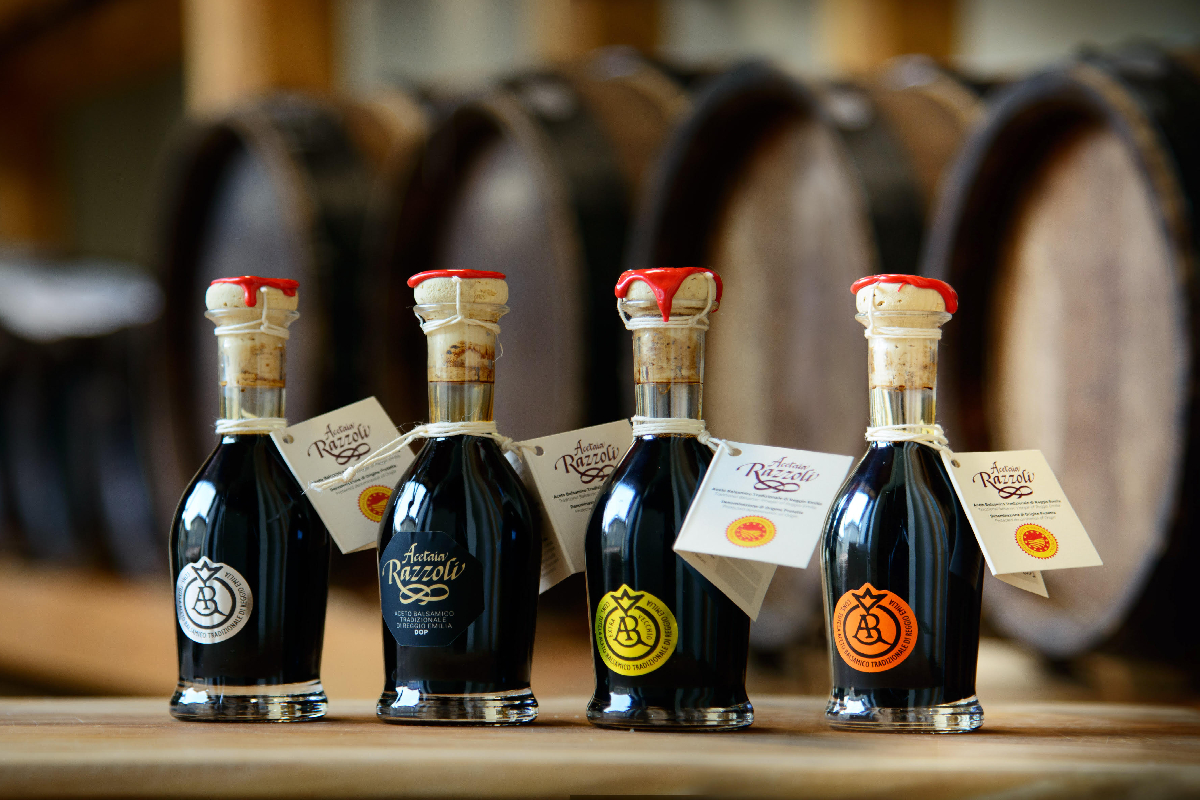
TheTraditional Balsamic Vinegar of Reggio Emilia PDO It stands out in the panorama of Geographical Indications for the exclusive use of cooked must, excluding wine vinegar or additives. With an annual production below 2,000 liters, it represents a highly specialized segment of Italian agri-food. Its technical and sensory identity is guaranteed by a regulation that requires minimum aging of 12 years in batteries of different woods, making it a case study for the protection of productive biodiversity and added value in exports.
According to the 23rd ISMEA-Qualivita Report on the Italian PDO economy, the category of PDO balsamic vinegars recorded the following results in 2024:
- production value: 386 million euros, with a 7.9% growth compared to 2023;
- export share: 93%;
- export value: 889 million euros, +8.7%, equal to 17.3% of total exports of Italian Geographical Indication foods. Second place, after cheeses (59%) and before meat-based products (12.7%).
Within the category, the Traditional Balsamic Vinegar of Reggio Emilia PDO maintains a niche position, with a production limited – 1,900 liters in 2024 (compared to 16,000 liters of the Traditional Balsamic Vinegar of Modena DOP) – and a still marginal export value, 0.7 million euros, although with a marked growth (+29% compared to 2023).
From the Este courts to the PDO: a millennium of history
The origins of traditional balsamic vinegar date back to Middle Ages. The first documented evidence dates back to 1046 when Emperor Henry III, passing through Piacenza, asked Boniface of Canossa about that ‘particular vinegar’ he had heard about. In the Estensi courts, the use of cooked and refined musts as prized products is documented as early as the 12th century, when these vinegars were given as precious gifts at aristocratic weddings and preserved as family heirlooms.
The tradition of ‘batteries of barrels’, passed down from generation to generation and often named after sons or grandchildren at birth, still represents an identity element of the producing families of Reggio Emilia. Regulation (EC) No 813/2000 has in fact recognized two distinct DOPs for the traditional balsamic vinegars produced in the neighboring provinces of Modena and Reggio Emilia.
The strictness of the regulation: from grape varieties to aging
The specification of the Traditional Balsamic Vinegar of Reggio Emilia DOP — approved by ministerial decree on May 15, 2000, and modified by implementing regulation (EU) No 1279/2013 — strictly defines every production stage. Here are its details.
Production area and ampelographic basis
The production area is limited to the territory of the province of Reggio Emilia, where all phases must take place, from grape cultivation to vinegar production, its aging and bottling. The sale of must outside this area definitively results in the loss of the right to the denomination (specification, article 3 – production area).
The Traditional Balsamic Vinegar of Reggio Emilia DOP must be obtained exclusively from the grapes of the following varieties: Lambrusco (all varieties and clones), Ancellotta, Trebbiano (all qualities and clones), Sauvignon, Sgavetta, Berzemino, Occhio di Gatta. The use of grapes registered in the provincial DOCs is also allowed (article 2 – Ampelographic base).
The grapes must ensure must a minimum content of 15 saccharometric degrees; the maximum production is set at 160 quintals per hectare, with a must yield not exceeding 70% (art. 4 – Characteristics of the raw material).
Production method
I fresh musts they can be subjected to decantation and refrigeration, without freezing. The use of silent musts or those with additives is prohibited. Following the reduction in volume resulting from cooking, to be carried out at atmospheric pressure in open vessels, the minimum sugar content of the cooked must must not exceed 40 degrees Brix.
The fermentation sugar and acetic fermentation takes place in traditional vinegar cellars, ‘exposed to necessary ventilation and natural temperature variations’.
Theaging mandatory minimum is 12 years in batches of small barrels made of different woods (oak, chestnut, cherry, mulberry, juniper, ash, locust), specifically numbered and marked for controls. The only allowed addition is the possible inoculation of bacterial colonies known as ‘mother’ (art. 5 – Processing method).
Product characteristics
‘The Traditional Balsamic Vinegar of Reggio Emilia, at the time of placement on the market, must meet the following characteristics:
- color: dark brown, clear, shiny;
- density: appreciable and smoothly syrupy;
- aroma penetrating and persistent, fragrant with pleasant acidity and characteristic bouquet also related to the woods used and long aging;
- taste: sweet and sour well blended with appreciable acidity and aromaticity in harmony with olfactory characteristics;
- total acidity: not less than 5 degrees (expressed in grams of acetic acid per 100 ml of product);
- density at 20 degrees Celsius: not less than 1.200 g/ml' (art. 6 – Characteristics at consumption).
The passing of theanalytical and sensory examination — conducted by qualified master tasters, with the assignment of a minimum score (240 points for the Aragosta Label, 270 for Silver, 300 for Gold) — is a binding condition for commercialization (art. 7 – Analytical, sensory tests and bottling).
Bottling and presentation
Bottling takes place exclusively in the province of Reggio Emilia, in the official bottle in the shape of an inverted tulip of 100 ml (type A) or 250 ml (type B), sealed with wax seal and numbered stamp (art. 7 – Analytical, sensory tests and bottling).
Any additional qualification, such as 'extra', 'fine', 'reserve', 'superior' and similar, is prohibited. The mention 'extra old' only for product aged at least 25 years. It is forbidden to indicate the production year (art. 8 – Designation and presentation).
Lobster, Silver and Gold: how to read the labels
The Traditional Balsamic Vinegar of Reggio Emilia PDO is distinguished and alternatively marked with three labels:
- the Aragosta Label (minimum aging 12 years, minimum score 240) is the most acidic of the three types, with a delicate aroma and intense acidity, ideal for marinades, carpaccios and final cooking;
- the Silver Label (12–25 years, minimum score 270) has greater concentration and sweet-sour aromatic complexity. Excellent raw on boiled meats, aged cheeses and risottos;
- the Extra Old Gold Label (minimum aging 25 years, minimum score 300) is the most exclusive product. Dense, enveloping, to be strictly enjoyed raw on Parmigiano Reggiano DOP, fruit, ice cream or dessert.
Reggio Emilia vs Modena: the differences between the two PDOs
Although both are DOP products obtained from only cooked grape musts, the two traditional balsamics are precisely distinguished in terms of classification, organoleptic profile and presentation:
- as far as classification system, Reggio Emilia adopts three colored labels (lobster, silver, gold) that integrate aging criteria and sensory score; Modena uses the indications ‘affinato’ (≥12 years) and ‘extravecchio’ (≥25 years);
- on the level organoleptic, the Traditional Balsamic Vinegar of Reggio Emilia is generally recognized for a more balanced and harmonious profile, with a lower acetic perception compared to that of Modena;
- in terms of presentation, the bottle official bottle from Reggio Emilia has an inverted tulip shape, that of Modena has a spherical shape, designed by Giugiaro.
The most recent scientific research has confirmed that the two DOPs present different sensory profiles, making a dedicated organoleptic evaluation system appropriate (Chen et al., 2025).
The science of authenticity: isotopes and sensory analysis
The scientific community shows growing interest in authentication and characterization methods of traditional balsamic vinegar:
- recent studies have shown that the analysis of stable isotopes (δ¹⁸O of water, δ¹³C of glucose, fructose and acetic acid) allows monitoring of the aging process and distinguishing the traditional product from imitations: δ¹⁸O values progressively increase with aging in barrel series, providing a reliable authenticity marker (Lancellotti et al., 2025);
- the revision of the system of sensory evaluation has in turn highlighted some critical issues in the methods in use (conservatism in scores, redundancy of descriptors, sensory fatigue), suggesting improvements that could increase the effectiveness of compliance control (Chen et al., 2025).
Gastronomic uses
Traditional Balsamic Vinegar of Reggio Emilia DOP is a finishing condiment to be used sparingly, a few drops at a time. The most appreciated culinary applications include pairings with:
- Parmigiano Reggiano DOP aged;
- strawberries and fresh seasonal fruit;
- red meats and game;
- creamy risottos;
- Ice cream and desserts.
It must never be used in cooking, to avoid dispersing the aromas and the aromatic bouquet developed over the years of aging.
Advice for buyers
For connoisseurs and professional buyers, some elements are essential in selection:
- first of all you must always verify the presence of the DOP mark, the official 100 ml inverted tulip bottle and the numbered wax seal of the Consortium: these elements guarantee that the product has passed all the analytical and sensory checks required by the regulations;
- the colored label guides the choice: Gold for gourmet applications and pure tasting, Silver for pairings with cheese and meat, Lobster for culinary use. Although not mandatory, organic certification adds value to the premium product.
The team of GIFT (Great Italian Food Trade) offers qualified support to international operators in selecting reliable producers and verifying compliance with DOP requirements.
Conclusions
The resilience of Traditional Balsamic Vinegar of Reggio Emilia DOP lies in the rigor of its certification. The structural growth of international demand and the refinement of analytical techniques for traceability consolidate the product's positioning in the premium market. For operators and buyers, proper reading of the label and seals remains the main tool to guarantee the authenticity of a supply chain that transforms time and territory into a unique economic asset.
Dario Dongo
Credit cover: Consorzio Tutela Aceto Balsamico Tradizionale di Reggio Emilia – Acetaia Razzoli
Bibliography
- Chen, F., Ma, Y., Corradini, G., & Giudici, P. (2025). The theory and practice of sensory evaluation of vinegar: A case of Italian Traditional Balsamic Vinegar. Foods, 14(5), 893. https://doi.org/10.3390/foods14050893
- Commission Implementing Regulation (EU) No 1279/2013 of 9 December 2013 approving non-minor amendments to the specification for a name entered in the register of protected designations of origin and protected geographical indications (Aceto balsamico tradizionale di Reggio Emilia PDO). http://data.europa.eu/eli/reg_impl/2013/1279/oj
- Consortium for the Protection of Traditional Balsamic Vinegar of Reggio Emilia. (2026). The product. https://www.acetobalsamicotradizionale.it
- Council Regulation (EC) No 813/2000 of 17 April 2000 supplementing the Annex to Commission Regulation (EC) No 1107/96 on the registration of geographical indications and designations of origin under the procedure laid down in Article 17 of Regulation (EEC) No 2081/92. http://data.europa.eu/eli/reg/2000/813/oj
- Ismea & Qualivita Foundation. (2025). 2025 ISMEA-Qualivita report on Italian agri-food and wine productions PDO, PGI and STG (23rd ed.). Qualivita Editions. https://www.ismea.it/flex/cm/pages/ServeAttachment.php/L/IT/D/1%252Fe%252F8%252FD.fefdd2e7c08546544955/P/BLOB%3AID%3D13512/E/pdf?mode=download
- Lancellotti, L., D’Eusanio, V., Morelli, L., Truzzi, E., Marchetti, A., & Tassi, L. (2025). Use of compound specific isotope analysis approach to monitor the aging process of Italian balsamic vinegars. Current Research in Food Science, 10, 100953. https://doi.org/10.1016/j.crfs.2024.100953
- Ministry of Agricultural, Food and Forestry Policies. (2000). Production specification of Traditional Balsamic Vinegar of Reggio Emilia PDO (Ministerial Decree 15 May 2000). Official Journal of the Italian Republic, n. 124 of 30 May 2000. https://www.masaf.gov.it/flex/cm/pages/ServeAttachment.php/L/IT/D/3%252Fa%252F2%252FD.5a2ca1222aa99db92fda/P/BLOB%3AID%3D3345/E/pdf
- OCQ PR – Regulatory Production Quality Control Body. (2024). Traditional Balsamic Vinegar of Reggio Emilia PDO. https://www.ocqpr.it/chi-ci-ha-scelto/prodotti-certificati-in-ambito-regolamentato/aceto-balsamico-tradizionale-di-reggio-emilia-dop

Dario Dongo, lawyer and journalist, PhD in international food law, founder of WIISE (FARE - GIFT – Food Times) and Égalité.