

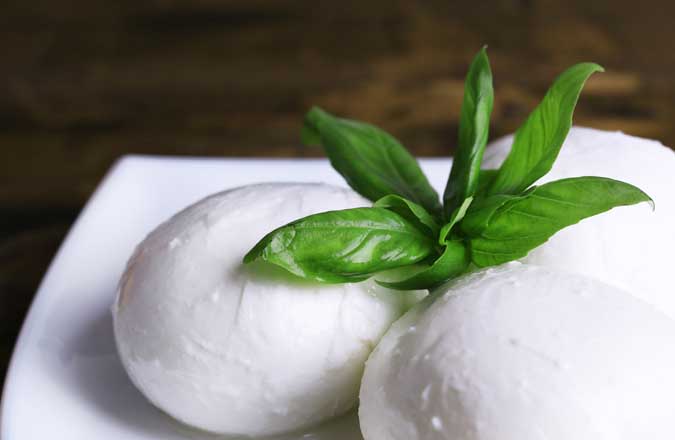
Mozzarella drives the production and export of Italian cheeses, with a value of foreign sales exceeding one billion euros. However, the market analysis highlights a complex reality: the legal protection of Made in Italy is partial and linked to only two DOP certified productions, which express approximately 15% of the overall national production.
This guide examines up-to-date customs data, European legal architecture, production methods and product characteristics. Noting among other things the substantial differences, on a nutritional level, between cow's milk (fiordilatte) and buffalo mozzarella. Finally, some notes on the scientific evidence on cheese consumption and health.
Legal protection of mozzarella in European law
Implementing Regulation (EU) 2022/1291 approved a substantial amendment to the standard of Traditional Speciality Guaranteed registered in 1998 as 'Mozzarella', changing the name to 'Traditional Mozzarella' and the protection regime, from 'without reservation of name' to 'with reservation of name'. However, the Commission clarified that the protection concerns only the denomination composed in its entirety - 'Traditional Mozzarella' - while the name 'Mozzarella' can continue to be used for products that do not comply with the TSG specifications throughout the Union (EU regulation 2022/1291, article 2).
Brussels' decision closed a two-year dispute between Italy and Germany, with two German oppositions and consultations that ended without an agreement. Germany argued, among other things, that the denomination 'mozzarella' had a generic character and that the coexistence of the TSG with the two PDOs could confuse the average consumer: the Commission rejected this last argument, observing that the prohibition on coexistence applies to the PDOs and PGIs, not to the TSGs.
The current legal framework thus articulates on three levels:
- two Protected Designations of Origin (Mozzarella di Bufala Campana PDO and Mozzarella di Gioia del Colle PDO);
- one Traditional Speciality Guaranteed (Mozzarella Tradizionale TSG, which however can be produced anywhere in the European Union by anyone who complies with its standard);
- one generic sales denomination usable by anyone, as long as it does not have the union symbol or the words 'traditional specialty guaranteed'.
Production volumes and export trends
Overall production and PDO
The data released by Assolatte on the occasion of the last annual meeting, held on 18 June 2026, places the mozzarella leading the cheese production Italian with 315 kt, ahead of Grana Padano PDO (218 kt), Parmigiano Reggiano PDO (163 kt), Gorgonzola PDO (63 kt) and Pecorino Romano PDO (39 kt); burrata and stracciatella worth 47.5 kt, of which 600 of Burrata di Andria PGI.
The Mozzarella di Bufala Campana PDO is accounted for separately: certified production was 57.574 kt in 2025, according to the Protection Consortium, after the 55,718 in 2024. The monthly series published by CLAL based on data from the control body indicates a total of 57,584 tonnes for 2025 (+3.35% on 2024), obtained by processing 203,477 tonnes of milk, equal to 65% of the total milk withdrawn from farms. In the first half of 2026, production reached 29,463 tonnes (+2.34%).
The Mozzarella di Gioia del Colle PDO, registered only in December 2020, does not have publicly available, disaggregated certified production data; the Ministry, at the time of registration, estimated a production value of around 80 million euros for Apulian mozzarella. This production of certified excellence therefore remains marginal.
Export 2025: the first billion
ISTAT data on foreign trade, referring to tariff item 04061030 (fresh mozzarella with fat content not exceeding 40%), mark the record: in 2025 Italy exported 160.759 kt (+5.6%) for 1.018 billion euros (+8.1%), with an average free on board price of €6.33/kg. It is the first time that mozzarella alone exceeds one billion euros. Ten years earlier, in 2015, volumes were 76.240 kt for 354 million: more than doubled in quantity and almost tripled in value.
The internal market European Union absorbs the majority, with 122,870 tons and 767.7 million euros; the'extra-EU it is worth 37,889 tonnes and 250 million, at a higher unit price (6.60 €/kg versus 6.25). 36% of the production of Mozzarella di Bufala Campana DOP is destined abroad, where France, Germany, Spain and Great Britain represent over 60% of the denomination's exports.
The picture 2026 however, it is less linear. In the first four months, volumes grew by 2.0% but the value fell by 1.3%, with a clear gap: intra-EU +5.4% in quantity, extra-EU -7.8% in quantity and -11.4% in value. Assolatte linked the slowdown to the increase in energy costs and logistical delays linked to the need to bypass the Red Sea, which for fresh products with a short commercial life such as mozzarella, burrata and stracciatella can involve up to 10–20 days of additional transit, effectively making shipping to some Asian markets difficult or incompatible.
The documented history of Italian mozzarella
The historical reconstruction documented by the Consortium for the protection of Mozzarella di Bufala Campana DOP places the arrival of the buffaloes in southern Italy in the Norman era, coming from Sicily where they arrived at the end of the 10th century. Around the 11th century, the swamping of the coastal plains of the Volturno and Sele rivers was completed, creating an environment suitable for farming; in the Swabian era (1189-1266) the buffaloes reached the current breeding areas.
The first documents on production date back to the 12th century: some manuscripts report that the monks of the monastery of San Lorenzo in Capua used to offer the pilgrims of the Metropolitan Chapter a cheese called mozza, or provatura (provola, ed.) when smoked, accompanied by a piece of bread. In the 14th century the marketing of 'mozze' and 'provature' took root in the Neapolitan and Salerno markets; smoking served to extend the shelf life.
In the 15th century appear the bufalare, circular masonry buildings with a central fireplace, which for the first time separate the place of milking from that of transformation, in dedicated and more hygienic environments where animals do not have access. The first written text in which the word 'appearsmozzarella'is from 1570: it is the work of Bartolomeo Scappi, chef of the papal court. In the eighteenth century, the Bourbons created a buffalo farm and an experimental dairy in the Royal Palace of Carditello, with a stable register in which each animal had a name inspired by court figures. After the unification he was born in Aversa la 'Tavern', a wholesale market that sets prices every day quotations and regulates the relationships between farmer-processor and distributor with annual contracts from 1 September to 31 August.
The cow's milk mozzarella has a more recent history, documented in Puglia in the PDO disciplinary rules of Gioia del Colle which cites a reference from 1885 to 'exquisite mozzarellas in Puglia' which appeared in 'L'Italiaagricoltura' (Redaelli, Milan), an article by Giovanni Carano Donvito from 1922 on 'Social reform' according to which 'the so-called mozzarellas of Gioia (del Colle) arrived appetising, sought after and well paid on the markets of Rome and Naples', and a documentary by the Istituto Luce filmed in Gioia del Colle on 28 August 1950 (disciplinary, article 6).
Microbiology and pasta spinning technology
The pasta filata was born from the meeting of three technological variables: the raw material, the microbial graft and the spinning temperature. The three Geographical Indications regulate them differently.
THE'acidification does not occur chemically in products with Geographical Indication. Both Mozzarella di Bufala Campana PDO and Mozzarella di Gioia del Colle PDO employ whey starter, obtained by allowing the whey from the previous processing to acidify under controlled conditions; Traditional Mozzarella TSG instead employs natural milk starter, prepared by selective enrichment of the microflora of raw milk from the collection area and used on site, consisting of an indefinite mixture of strains of Streptococcus thermophilus with the possible presence of enterococci and thermoduric lactic bacteria. The Gioia del Colle regulations expressly prohibit direct acidification with organic acids and the use of coagulants other than calf rennet (regulations, article 5).
The study by the University of Parma published in Frontiers in Microbiology has reconstructed the microbial ecology along the entire supply chain of two Mozzarella di Bufala Campana DOP dairies, one large and one medium-small. All samples, except raw milk, present a core microbiome dominated by Streptococcus spp. and Lactobacillus spp., with different ratios between the two genera in the two dairies; there brine, analyzed for the first time with this technique, is also dominated by the same genres (Levante et al., 2023). In the same work, the maturation of the curd is described as 4-4.5 hours at 35-37 °C up to a pH of approximately 4.9-4.8, with stretching in water at 90-95 °C.
The stretching temperatures prescribed in turn diverge: boiling water for the DOP Campania, hot water with salt at no less than 85 °C for Gioia del Colle, and for the TSG a final temperature of the pasta between 58 and 65 °C, which is different from the temperature of the water.
Production requirements for Mozzarella di Bufala Campana PDO
Registered with Regulation (EC) No 1107/96, the denomination Mozzarella di Bufala Campana PDO is regulated by the specifications attached to the ministerial decree of 18 September 2003, as amended with Regulation (EC) no. 103/2008. The text prescribes the exclusive use of fresh whole buffalo milk of Italian Mediterranean breed, raw, possibly thermized or pasteurized, plus calf rennet (specification, article 3).
The parameters of raw material are stringent: minimum fat content of 7.2%, minimum protein content of 4.2%, processing within the sixtieth hour from first milking. The finished product must have fat on dry matter not less than 52% and maximum moisture of 65%. The shapes permitted include, in addition to the round shape, morsels, braids, beads, cherries, knots and little eggs, weighing from 10 to 800 grams and up to 3 kg for braids. THE'smoking it is only permitted with natural processes, with the obligation to indicate the wording 'smoked'.
The comprehensive revision of the specification, approved by the Consortium in 2022 with the unanimous vote of processors, has not yet been finalized at the Union level: the applicable text remains that of 2008. Control functions are assigned to RINA Agrifood S.p.A.
The parameters of the Gioia del Colle PDO specification
Registered with Commission Implementing Regulation (EU) 2020/2018, the Mozzarella di Gioia del Colle PDO is obtained from only raw whole cow milk, possibly thermised or pasteurized, with the addition of native whey starter (regulation, article 2). The process had been slowed down by opposition to the protection of the term 'mozzarella' by Germany and the US organization of cheese exporters.
The most characterizing element concerns the breeding: cattle of Brown, Holstein, Red and White, Jersey breeds and their crosses must graze outdoors for at least 150 days a year, on autumn-spring fodder crops of legumes and cereals or on natural pastures; grass and hay from polyspecific forage crops must cover at least 60% of the dry matter of the ration, and no less than 60% of the feed must come from the delimited area (specification, article 5). The milk it must have minimum fat of 3.4% and minimum protein of 3.2%, and be processed within the forty-eighth hour of the last milking.
The area includes sixteen municipalities in the province of Bari, six in the province of Taranto and a portion of the municipality of Matera. The link with the territory it is traced back to the xerophilous vegetation of the Murgian plateau - Thymus striatus, Ferula communis, Foeniculum vulgare - rich in polyphenols and terpenes which reach the milk via the rumen or inhalation (disciplinary, article 6). The product has lactose not exceeding 0.6% and fat content between 15 and 21% on a dry matter basis.
Two useful clarifications for operators. The ordinary modification approved by decree of 1 October 2024 affected, among other things, milk processing times; the single document published there indicates a humidity of 58-65%. The checks are entrusted to DQA.
The processing rules for Traditional Mozzarella TSG
The 'Traditional Mozzarella' is the only one TSG Italian dairy and is at the same time stateless - unfortunately, due to the effective German industrial lobby - since it can be produced anywhere in the European Union, provided that its specifications are respected. Which essentially provides:
- the exclusive use of whole raw cow's milk arriving at the facility, possibly adjusted only in fat content;
- pasteurization at 71.7 °C for 15 seconds;
- inoculation with natural milk starter, liquid bovine rennet with peptic activity between 20 and 30%;
- coagulation at 35-39 °C and lactic maturation up to pH 5.0-5.4;
- execution of all phases in continuous cycle in the same facility.
I analytical requirements include: fat on the dry matter minimum 44%, humidity 58-66% for the spheroidal shape and 56-62% for the braid, pH 5.1-5.6, L(+) lactic acid greater than 0.2%, sodium chloride not greater than 1%, furosine maximum 10 mg per 100 g of protein substance (indicator which limits the use of milk subjected to high heat treatments) and characteristic microflora not less than 10⁷ cfu/g. The permitted shapes are spheroidal from 20 to 250 g, possibly with head, and braided from 125 to 250 g.
Analytical composition and comparison between cow's milk and buffalo milk mozzarella
The food composition tables indicated by CREA (Food and Nutrition Research Centre, 2019) report to cow's milk mozzarella (or fiordilatte) and buffalo milk mozzarella the nutritional values listed below, per 100 g of edible portion.
| Cow's milk mozzarella | Buffalo milk mozzarella | |
| Energy | 1058 kJ / 253 kcal | 1205 kJ / 288 kcal |
| Fats | 19.5 g | 24.4 g |
| of which saturated fatty acids | N/A | N/A |
| Carbohydrates | 0.7 g | 0.4 g |
| of which sugars | 0.7 g | 0.4 g |
| Fibre | 0 g | 0 g |
| Protein | 18.7 g | 16.7 g |
| Salt | 0.50 g | N/A |
Unfortunately, the CREA sheets do not report the breakdown of fatty acids for these two foods, nor the sodium content of buffalo mozzarella: missing values are therefore indicated as unavailable rather than estimated. The content of Water is 58.8% in cow's milk mozzarella and 55.5% in buffalo mozzarella, a difference that explains much of the energy difference.
The micronutrients admitted to the 'nutrition claims' on the label
Both types of Italian mozzarella - according to CREA data, which must be verified by analysis on representative samples of the products, for the purposes of using specific nutrition claim on the label and in advertising (Regulation (EC) No. 1924/06) — are characterised by a generous supply of minerals and vitamins.
Following, in descending order, the micronutrients contained in 'significant quantities' pursuant to Regulation (EU) no. 1169/2011 — i.e. in quantities equal to or greater than 15% of the nutritional reference values defined in its Annex XIII — and the corresponding nutritional indications admitted in the European Union.
Cow's milk mozzarella:
- 'to high phosphorus content'. 350 mg per 100 g, equal to 50.0% of the VNR;
- 'to high calcium content'. 350 mg, equal to 43.8% of the VNR;
- ‘source of vitamin A'. 219 µg retinol equivalent equal to 27.4% of the VNR;
- ‘source of zinc'. 2.60 mg, equal to 26.0% of the VNR;
- ‘source of vitamin B2’ (riboflavin). 0.27 mg, equal to 19.3% of the NRV.
Buffalo milk mozzarella:
- ‘source of phosphorus'. 195 mg per 100 g equal to 27.9% of the VNR;
- ‘source of calcium'. 210 mg equal to 26.3% of the VNR;
- ‘source of vitamin A'. 164 µg retinol equivalent equal to 20.5% of the VNR.
Other micronutrients are present in less than significant quantities and therefore cannot be mentioned even in the nutritional declarations on the label: in cow mozzarella potassium expresses 7.3% of the VNR, selenium 4.5%, vitamin E 3.3%, iron 2.9%; in buffalo milk vitamin E stops at 2.0% and iron at 1.4%.
The most significant and little-known fact is that cow milk mozzarella surpasses buffalo mozzarella on all measured micronutrients, including calcium and phosphorus, due to the higher density of dry matter protein compared to lipid.
The matrix effect of cheeses in health studies
The largest umbrella review available on cheese reviewed 54 meta-analysis articles, updating 35 and conducting four from scratch, for 47 distinct health outcomes. The cheese consumption is inversely associated with mortality from all causes (RR 0.95; 95% CI 0.92-0.99), cardiovascular mortality (RR 0.93; 0.88-0.99), incidence of cardiovascular disease (RR 0.92; 0.89-0.96), ischemic heart disease (RR 0.92; 0.86-0.98), stroke (RR 0.93; 0.89-0.98), type 2 diabetes (RR 0.93; 0.88-0.98), total fractures (RR 0.90; 0.86-0.95) and dementia (RR 0.81; 0.66-0.99). The authors emphasize that this is observational associations, with heterogeneous quality of evidence (Zhang et al., 2023).
The most solid mechanistic hypothesis is that of cheese matrix. A randomized controlled trial on overweight adults compared the same amount of dairy fat administered inside the cheese or broken down into its components: the lipid profile responses differ depending on the matrix in which the fat is consumed (Feeney et al., 2018). A subsequent human intervention by the same research group examined the effect of the matrix on the size distribution of lipoprotein particles (Dunne et al., 2023).
On buffalo milk a systematic review — in addition to describing its composition more concentrated in proteins, lipids and minerals compared to cow milk (unlike what happens for mozzarelles derived from them, as seen, as far as proteins and micronutrients are concerned) — emphasizes the presence of bioactive compounds such as δ-valerobetaine and acetyl-L-carnitine, with antioxidant and anti-inflammatory activity documented in vitro; the same authors report that heat treatments can reduce natural antimicrobial factors (Liao et al., 2025).
Two clarifications are necessary: none of the works cited specifically concerns mozzarella, nor does it allow the use of the related health claims. Research on the microbiota of Mozzarella di Bufala Campana PDO (Levante et al., 2023) in turn describes the microbial composition of the product but not also the probiotic effects on the host, which were not the subject of the study.
Our team of FARE (Food and Agriculture Requirements) is available to operators, their associations and consortia, including research ones, who intend to plan clinical studies and prepare scientific dossiers aimed at requesting authorization to use specific health claim in commercial information relating to products.
Gastronomic indications
The Italian cuisine was registered on 10 December 2025 in the Representative List of the intangible cultural heritage of UNESCO, with the dossier 'Italian Cuisine between sustainability and biocultural diversity'; the'Art of Neapolitan pizzaiolo had entered it in 2017. In both cases the recognition concerns practices and knowledge, not individual products.
On an operational level, the two types of mozzarella have different vocationss:
- The Buffalo milk mozzarella, with humidity up to 65% and fat in the dry matter over 52%, is suitable for use raw: Caprese, appetisers, combinations with cured meats. Raw also on pizza, after cooking;
- the fiordilatte (mozzarella from cow's milk) and Traditional Mozzarella STG, with lower humidity parameters in the braided shape (56-62%), release less water during cooking and are more used for pizza, parmigiana and baked pasta. In addition to raw consumption, of course.
Selection criteria for consumers and professionals
The first tip of this guide is also the simplest: always choose authentic mozzarella Made in Italy. What distinguishes the Italian product is therefore not in the word, but in what can be verified: the origin of the milk, the times between milking and boiler, the use of whey starter or natural milk starter in PDO productions and in numerous others, the analytical and organoleptic parameters of the finished product.
For PDO products the verification on the label is summarized in three elements: the European PDO symbol, the logo or mark of the denomination and the reference to the control body.
In more general terms, when choosing mozzarella it may be useful to also consider the following aspects:
- organic certification, where available. The organic farming method imposes strict criteria — access to pasture, lower stocking density, GMO-free feed and restrictions on veterinary treatments — and is the most solid standard to guarantee animal welfare, subject to additional controls;
- ‘lactose-free' for the intolerant. Mozzarella is already among the fresh cheeses with the lowest lactose content, due to lactic fermentation: the specification for Mozzarella di Gioia del Colle PDO sets a ceiling of 0.6% (article 2). Those with a diagnosis of intolerance can still choose versions declared 'lactose-free', widely available in the vaccine segment where mozzarella represents the best-selling type in the category;
- i vegetarians they must give up DOP and TSG mozzarella, as the three specifications prescribe the use of calf rennet. Their choice must therefore be directed towards products made with microbial rennet (Dongo, 2017);
- storage. Fresh mozzarella must be stored in its brine, which guarantees microbiological and sensory stability. Outside of only immediate or near-immediate consumption, the product should be stored in the refrigerator between 0 and +4 °C.
International buyers who are located in territories far from Italy can choose products frozen products, outside of the PDOs whose specifications do not allow this treatment. The IQF (individually quick freezing) technology in particular individually freezes cherries, cubes, julienne and even whole mozzarella, which are thus shipped without preserving liquid (to reduce logistical and environmental costs) to the different continents. An experimental study on milk, curd and Mozzarella di Bufala Campana PDO stored for up to eleven months found that freezing reduces total bacterial load, Enterobacteriaceae, coliforms, Escherichia coli and yeasts (Biondi et al., 2021).
GIFT (Great Italian Food Trade) has been monitoring Italian dairy supply chains for years with documentary checks on supply chains, certifications and market data, and is available to international buyers, importers and purchasing groups those seeking Italian products guaranteed by verifiable suppliers.
Conclusions
The consolidation of Italian mozzarella on international markets requires rigorous communication based on objective parameters. Since the use of the generic term remains permitted in the European Union outside of protected names, the valorisation of the product passes through the processing methods and traceability of authentic Made in Italy products, as well as the evidence on the nutritional values and possible health benefits related to them.
Dario Dongo
References
Peer-reviewed scientific studies
Biondi, L., Fulgione, A., Capuano, F., Nappa, M., Citro, A., & Nava, D. (2021). Impact of freezing on the microbiological quality and physical characteristics of buffalo mozzarella cheese. Animals, 11(12), 3502. https://doi.org/10.3390/ani11123502
Dunne, S., McGillicuddy, F. C., Gibney, E. R., & Feeney, E. L. (2023). Role of food matrix in modulating dairy fat induced changes in lipoprotein particle size distribution in a human intervention. The American Journal of Clinical Nutrition, 117(1), 111-120. https://doi.org/10.1016/j.ajcnut.2022.10.002
Feeney, E. L., Barron, R., Dible, V., Hamilton, Z., Power, Y., Tanner, L., Flynn, C., Bouchier, P., Beresford, T., Noronha, N., & Gibney, E. R. (2018). Dairy matrix effects: Response to consumption of dairy fat differs when eaten within the cheese matrix — a randomized controlled trial. The American Journal of Clinical Nutrition, 108(4), 667-674. https://doi.org/10.1093/ajcn/nqy146
Levante, A., Bertani, G., Marrella, M., Mucchetti, G., Bernini, V., Lazzi, C., & Neviani, E. (2023). The microbiota of Mozzarella di Bufala Campana PDO cheese: A study across the manufacturing process. Frontiers in Microbiology, 14, 1196879. https://doi.org/10.3389/fmicb.2023.1196879
Liao, J., Yang, J., Suo, H., & Song, J. (2025). Buffalo milk: Nutritional composition, bioactive properties, and advances in processing technologies — A comprehensive review. Food Chemistry: X, 29, 102647. https://doi.org/10.1016/j.fochx.2025.102647
Zhang, M., Dong, X., Huang, Z., Li, X., Zhao, Y., Wang, Y., Zhu, H., Fang, A., & Giovannucci, E. L. (2023). Cheese consumption and multiple health outcomes: An umbrella review and updated meta-analysis of prospective studies. Advances in Nutrition, 14(5), 1170-1186. https://doi.org/10.1016/j.advnut.2023.06.007
Trade press
Dongo, D. (2017, April 22). Is the cheese vegetarian? No. Here's how to recognize it from the label. FT (Food Times). https://www.foodtimes.eu/it/consumatori-e-salute/il-formaggio-e-vegetariano/
European Union regulatory sources
Commission Implementing Regulation (EU) 2020/2018 entering a name in the register of protected designations of origin and protected geographical indications ('Mozzarella di Gioia del Colle' (PDO)). http://data.europa.eu/eli/reg_impl/2020/2018/oj
Commission Implementing Regulation (EU) 2022/1291 of 22 July 2022 approving a non-minor amendment to the specification for a name entered in the register of traditional specialties guaranteed (‘Mozzarella’ (TSG)). http://data.europa.eu/eli/reg_impl/2022/1291/oj
Commission Regulation (EC) No 103/2008 approving amendments to the specification for a name entered in the register of protected designations of origin and protected geographical indications (‘Mozzarella di Bufala Campana’ (PDO)). http://data.europa.eu/eli/reg/2008/103/oj
Commission Regulation (EC) No 1107/96 of 12 June 1996 on the registration of geographical indications and designations of origin under the procedure laid down in Article 17 of Council Regulation (EEC) No 2081/92. Consolidated text: 20/11/2008. http://data.europa.eu/eli/reg/1996/1107/2008-11-20
Regulation (EU) 2024/1143 of the European Parliament and of the Council of 11 April 2024 on geographical indications for wine, spirit drinks and agricultural products, as well as traditional specialities guaranteed and optional quality terms for agricultural products. Consolidated text: 18/03/2026. Regulation (EU) No 2024/1143 of 18 March 2026
Regulation (EU) No 1169/2011 of the European Parliament and of the Council on the provision of food information to consumers. Consolidated text: 01/04/2025. http://data.europa.eu/eli/reg/2011/1169/2025-04-01
Production standards and ministerial sources
MASAF — Ministry of Agriculture, Food Sovereignty and Forestry (n.d.). Production specifications for the protected designation of origin 'Mozzarella di Gioia del Colle' (consolidated text). https://www.masaf.gov.it/flex/cm/pages/ServeBLOB.php/L/IT/IDPagina/3340
Ministry of Agriculture, Food Sovereignty and Forestry (n.d.). List and TSG specifications of agricultural products. https://www.masaf.gov.it/flex/cm/pages/ServeBLOB.php/L/IT/IDPagina/24230
Ministry of Agricultural and Forestry Policies. Production specifications for the protected designation of origin 'Mozzarella di Bufala Campana', annexed to the decree of 18 September 2003, with the amendments approved by Regulation (EC) no. 103/2008. https://agricoltura.regione.campania.it/tipici/pdf/disciplinare-mozzarella-bufala.pdf
Ordinary modification of the production specification of the protected designation of origin 'Mozzarella di Gioia del Colle'. Decree 1 October 2024, Official Journal General Series n. 252 of 26 October 2024. https://www.gazzettaufficiale.it/eli/gu/2024/10/26/252/sg/pdf
Institutional and statistical sources
CLAL. (2026, 16 July). Italy: Mozzarella export (tariff code 04061030) — processing of Istat data. https://www.clal.it/?section=imp_exp_istat&cod=04061030&mov=E
CLAL. (2026, 3 August). Mozzarella di Bufala Campana PDO production, Italy — DQA Certifications / Rina Agrifood data. https://www.clal.it/?section=mozzarella_bufala_campana
Consortium for the protection of Mozzarella di Bufala Campana PDO. (2026). The PDO figures. https://www.mozzarelladop.it/consorzio/numeri-della-dop
CREA — Food and Nutrition Research Centre. (2019). Food composition tables. Buffalo mozzarella (code 164810). https://www.alimentinutrizione.it/tabelle-nutrizionali/164810
CREA — Food and Nutrition Research Centre. (2019). Food Composition Tables. Cow's Mozzarella (code 164820). https://www.alimentinutrizione.it/tabelle-nutrizionali/164820

Dario Dongo, lawyer and journalist, PhD in international food law, founder of WIISE (FARE - GIFT – Food Times) and Égalité.


