

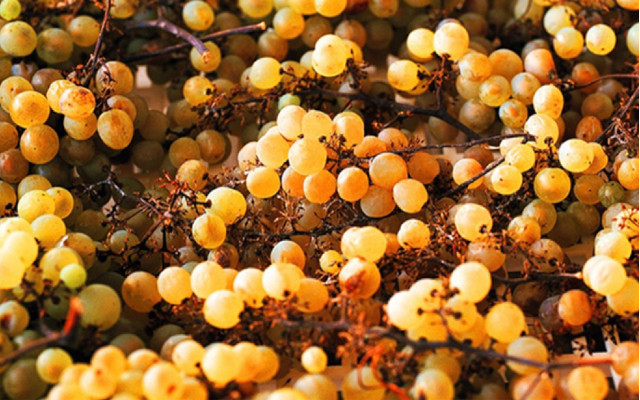
Second DOCG of Friuli Venezia Giulia, Picolit owes its rarity to the partial floral abortion which creates sparse bunches with few concentrated berries. Produced on approximately 42 hectares in the Eastern Hills of Udine (max yield 22 hl/ha), it stands out for the history of trade of Count Asquini (18th century), the Cialla sub-area (pure) and the fermentation guided by botrytis and native yeasts.
The Colli Orientali del Friuli Picolit DOCG it is a sweet or sweet white wine, produced with at least 85% Picolit grapes on the hills of the province of Udine, on the border with Slovenia. In the Cialla sub-area the Picolit must instead be pure (Picolit regulations, article 2). It is the second controlled and guaranteed denomination of origin in Friuli Venezia Giulia, after Ramandolo DOCG, with the first certified harvest in 2006 (Consorzio Friuli Colli Orientali e Ramandolo, n.d.).
It is also one of the smallest denominations in Italy. With the 2019 harvest the Consortium recorded 42 hectares claimed, 568 hectoliters vinified and approximately 55,000 bottles (Qualivita, 2020). Following is the vine and its poor fruit setting, the documented history, the rules of the specification, the territory, the profile of the wine and the market.
The vine of the few grapes
The Picolit owes its rarity to a characteristic of the bunch. During flowering, some of the flowers do not set, due to incomplete pollination: the bunch remains sparse, with a few small and sugar-rich berries (Dell'Alma et al., 2026). This phenomenon structurally limits production (Consorzio Friuli Colli Orientali and Ramandolo, n.d.). Already in 1790, Canon Andrea Zucchini derived the name from the small quantity of grapes (Picolit regulations, article 8).
Poor fruit set has a positive consequence on health of the grapes. The sparse grapes allow the air to circulate, ripen for a long time and are suitable for drying, on the vine or after harvesting (Picolit regulations, article 5). A study by the Universities of Milan, Brescia and Messina followed the spontaneous fermentation di un Picolit biologico nei Colli Orientali: nel mosto iniziale prevalevano lieviti non-Saccharomyces e Botrytis cinerea, che persisteva fino alle ultime fasi; da metà fermentazione dominava invece un gruppo di più specie di Saccharomyces (Dell’Alma et al., 2026).
From Count Asquini to Rocca Bernarda
Picolit's European fame is due to the count Fabio Asquini of Fagagna (Udine), author of a true treatise on wine over 250 years ago. From the 1762 Asquini avviò un commercio internazionale su larga scala, con migliaia di bottiglie spedite a Londra, Parigi, Amsterdam, in Russia, in Germania e in diverse città italiane, e forniture alla corte di Francia, al re di Sardegna e all’imperatore d’Austria. Agli inizi dell’Ottocento è documentata anche una spedizione verso gli Stati Uniti (disciplinare Picolit, articolo 8). Nel 1756 monsignor Giuseppe de Rinaldis scriveva da Castel Gandolfo lodando il ‘Piccolitto’ di Asquini; il vino compare negli scritti di Antonio Zanon (1767), F. M. Malvolti (1772) e, nell’Ottocento, nelle ampelografie di Agazzotti (1867) e Di Rovasenda (1877) (disciplinare Picolit, articolo 8).
Asquini's death was followed by a long decline. There rebirth it bears the name of the Perusini family of Rocca Bernarda di Ipplis, in Premariacco: Giacomo Perusini Antonini acquistò la tenuta nel 1905 e recuperò il Picolit tra i vigneti abbandonati, il figlio Gaetano ne completò il lavoro (Consorzio Friuli Colli Orientali e Ramandolo, n.d.). Nel 1959 Luigi Veronelli venne in Friuli per il Picolit della contessa Giuseppina Perusini; il giornalista Isi Benini lo definì ‘l’araba fenice del Friuli’ (disciplinare Picolit, articolo 8).
Formal recognition comes in two stages. Picolit enters the Colli Orientali del Friuli DOC with the Presidential Decree of 20 July 1970; there DOCG was established with Ministerial Decree of 30 March 2006 (Picolit disciplinary, introduction).
The specifications of Colli Orientali del Friuli Picolit DOCG
There production area includes, in whole or in part, nineteen municipalities in the central-eastern area of the province of Udine: Attimis, Buttrio, Cividale del Friuli, Corno di Rosazzo, Faedis, Magnano in Riviera, Manzano, Moimacco, Nimis, Povoletto, Premariacco, Prepotto, Reana del Rojale, Remanzacco, San Giovanni al Natisone, San Pietro al Natisone, Tarcento, Tricesimo and Torreano. There subarea Cialla it occupies the northern part of the municipality of Prepotto, on the border with Cividale del Friuli (Picolit regulations, article 3).
The Picolit must represent at least the 85% of grapes; the rest can come from other white grape varieties suitable in the region, excluding the aromatic Traminer (Picolit specification, article 2). The new plantings must have at least 3,500 vines per hectare and the maximum yield is 4 tons of grapes per hectare – one of the lowest among those foreseen by the specifications for protected denomination wines – with natural alcoholic strength minimum of 13% vol, 14% vol in Cialla (Picolit regulations, article 4).
There yield of grapes in wine cannot exceed 55%, equal to 22 hectoliters per hectare. THE'withering it is allowed on the plant, on trellises, in outdoor boxes or in rooms with controlled temperature, humidity and ventilation; any enrichment is prohibited. Vinification and aging are permitted wooden barrels, small in Cialla (Picolit regulations, article 5). The wine can be released for consumption from 1 September of the year following the harvest; the Cialla from 1 September of the second year. The mention Reserve is reserved for Cialla and requires at least four years of aging from 1 November of the year (Picolit regulations, article 5).
For consumption the wine must have a minimum total alcoholic strength of 15% vol, 16% vol for Cialla, total acidity of at least 4 g/l and non-reducing extract of at least 26 g/l (Picolit disciplinary, article 6). The indication of the vintage on the label is mandatory, the bottles cannot exceed 5 liters and must be closed with a cork (Picolit regulations, article 7).
Vinification and bottling must take place in the area, with historical exceptions for the province of Udine and the Collio municipalities (Picolit regulations, article 5). Control is the responsibility of CEVIQ, authorized by the Ministry of Agriculture (Picolit regulations, article 9; law 238/2016, art. 64).
| Parameter | Colli Orientali del Friuli Picolit DOCG | Picolit Cialla | Picolit Cialla Reserve
|
| Minimal picolit | 85% | 100% | 100% |
| Other vines | Suitable whites, excluding aromatic Traminer | Nobody | Nobody |
| Maximum grape yield | 4 t/ha | 4 t/ha | 4 t/ha |
| Grape/wine yield | 55% | 55% | 55% |
| Minimum natural content of the grapes | 13% vol | 14% vol | 14% vol |
| Minimum total wine strength | 15% vol | 16% vol | 16% vol |
| Wood | Admitted | Small barrels | Small barrels |
| Release for consumption | From 1 September of the following year | From 1 September of the second following year | After at least 4 years from November 1st of the vintage |
Fonte: disciplinare Picolit, articoli 2-7.
Picolit outside the DOCG
The vine also appears in other Friulian denominations. The Collio DOC includes the Picolit type, with at least 85% of the vine, maximum yield of 4 tons per hectare, minimum natural content of 13% vol and total of 14% vol (Collio regulations, articles 2, 4, 5 and 6). In October 2026, a 2020 Collio Picolit obtained the special award for meditation wine of the year in the Gambero Rosso Vini d'Italia 2027 guide (Pighin, 2026).
The modification of Friuli Colli Orientali DOC published in July 2025 then opens up a new use: the subarea Savorgnano describes a wine made from Friulano between 80 and 90% and Picolit between 10 and 20%. Picolit is also permitted in the Bianco and Dolce types of the DOC and in the Bianco and Rosso di Cialla (DM 7 July 2025, articles 1 and 2). The rare vine thus also finds space as a component of the local whites.
The hills of the ponca
The vineyards are located between 100 and 400 meters above sea level, often on terraces. The soils belong to the Flysch by Cormòns, an alternation of marl and sandstone which in Friulian is called 'ponca', predominantly marly and easily erodible. The average annual temperature is around 15 °C, between 18 and 19 °C in the vegetative period, with a thermal sum of 1,800-1,900 degree days (Picolit regulations, article 8; Consorzio Friuli Colli Orientali e Ramandolo, n.d.).
The profile of the wine
The specification describes a wine of color more or less intense golden yellow, with odor intense, sometimes raisin, fine and pleasant. On the palate it is lovable or sweet, warm and harmonious; Cialla has a more delicate aroma and a flavor described as delicate (Picolit regulations, article 6).
There maturation in small wood it usually lasts between 12 and 24 months (Dell'Alma et al., 2026).
Luigi Veronelli approached him, however prestige, to what the Château d'Yquem represents for France (Picolit regulations, article 8).
The Picolit numbers
The Picolit is a superlative niche within a larger district. The Friuli Colli Orientali and Ramandolo Consortium protects approximately 2,000 hectares and over 80,000 hectoliters of denomination wine, with approximately 200 members, three quarters of whom are bottlers; at least 30% of production is sold abroad, especially in Europe, the United States and Japan (Consorzio Friuli Colli Orientali e Ramandolo, n.d.).
With the 2019 harvest, Picolit DOCG had 42 hectares and approximately 55,000 bottles, compared to 1,911 hectares and 8 million bottles of Friuli Colli Orientali DOC (Qualivita, 2020). The figure gives the size of the scale: the Picolit occupies approximately 2% of the district area.
The maximum yield of 22 hectoliters per hectare (Picolit disciplinary, article 5) - please note - is well less than half that of the Brunello di Montalcino, set at 54.4 hectoliters (Brunello regulations, article 4). Each hectare therefore corresponds to a limited volume of wine which explains the price and the diffusion, however rare, in wine shops and high-end restaurants.
Frequently asked questions about the Picolit
Is Picolit a grape variety or a wine? Both: it is a white grape variety and the name of the DOCG Colli Orientali del Friuli Picolit (Picolit disciplinary, articles 1 and 2).
Why does Picolit produce little? The bunch attaches only a part of the flowers and remains sparse, with few berries (Dell'Alma et al., 2026). The specification also sets the yield at 4 tonnes per hectare (Picolit specification, article 4).
Has Picolit always been dried? No: drying is permitted, not mandatory (Picolit regulations, article 5).
Does Picolit Riserva exist? Only in the Cialla sub-area, with at least four years of aging (Picolit regulations, article 5).
Dario Dongo
Credit cover: Consorzio Friuli Colli Orientali and Ramandolo DOCG
References
European Union regulatory sources
Regulation (EU) No 1308/2013 of the European Parliament and of the Council of 17 December 2013 establishing a common organization of the markets in agricultural products and repealing Council Regulations (EEC) No 922/72, (EEC) No 234/79, (EC) No 1037/2001 and (EC) No 1234/2007. Consolidated text: 03/18/2026. http://data.europa.eu/eli/reg/2013/1308/2026-03-18
Regulation (EU) 2024/1143 of the European Parliament and of the Council of 11 April 2024 on geographical indications for wine, spirit drinks and agricultural products, as well as traditional specialties guaranteed and optional quality terms for agricultural products, amending Regulations (EU) No 1308/2013, (EU) 2019/787 and (EU) 2019/1753 and repealing Regulation (EU) No 1151/2012. Consolidated text: 03/18/2026. http://data.europa.eu/eli/reg/2024/1143/2026-03-18
Italian regulatory sources
Legge 12 dicembre 2016, n. 238, Disciplina organica della coltivazione della vite e della produzione e del commercio del vino. Normattiva. Ultima versione consolidata: 14/05/2026. https://www.normattiva.it/uri-res/N2Ls?urn:nir:stato:legge:2016-12-12;238
Production regulations
Production specifications for the DOCG 'Colli Orientali del Friuli Picolit', approved as DOC with Presidential Decree 20.7.1970 (GU no. 247 of 30.9.1970) and as DOCG with Ministerial Decree 30.3.2006 (GU no. 83 of 8.4.2006), last amendment Ministerial Decree 7.3.2014. https://aisitalia.it/Disciplinari/Friuli%20Venezia%20Giulia/DOCG/Colli%20Orientali%20del%20Friuli%20Picolit.pdf
Production regulations for the DOC 'Collio Goriziano or Collio', approved with Presidential Decree 24.5.1968 (GU no. 178 of 15.7.1968), last modification DM 7.3.2014. https://aisitalia.it/Disciplinari/Friuli%20Venezia%20Giulia/DOC/Collio%20Goriziano%20o%20Collio.pdf
Ministry of Agriculture, Food Sovereignty and Forestry. Ministerial Decree 7 July 2025, ordinary modification of the production specifications of the DOC 'Friuli Colli Orientali'. GU General series n. 173 of 28.7.2025. https://www.colliorientali.com/wp-content/uploads/2026/02/Friuli_Colli_Orientali_DOC__DM_7.07.25_Mod.Ordinaria_GU28.07.2025.pdf
Production regulations for the DOCG 'Brunello di Montalcino', last ordinary amendment published in OJEU C 225 of 5.7.2019. https://aisitalia.it/Disciplinari/Toscana/DOCG/Brunello%20di%20Montalcino.pdf
Scientific literature
Dell’Alma, M., Cesana, M., Kenny, P., Peron, G., Cafarella, C., Rigano, F., Mondello, L., Mangieri, N., Pizzi, S., Russo, P., Mora, D., & Gargari, G. (2026). Multi-omic characterization of microbial dynamics during spontaneous fermentation of sweet wine Picolit variety. Frontiers in Microbiology, 17, 1857803. https://doi.org/10.3389/fmicb.2026.1857803
Consortium sources
Consorzio Friuli Colli Orientali e Ramandolo. (n.d.). DOCG Colli Orientali del Friuli Picolit. https://www.colliorientali.com/le-denominazioni/picolit/
Qualivita. (2020, January 24). Friuli Colli Orientali Consortium: all harvest data collected in 2 thousand DOP hectares. https://www.qualivita.it/news/consorzio-friuli-colli-orientali-dop-raccolti-tutti-i-dati-della-vendemmia-in-2-mila-ettari-dop/
Sector press
Pighin. (2026, 26 ottobre). Pighin: Picolit Collio DOC 2020 named ‘Meditation Wine of the Year’ by Gambero Rosso and awarded Tre Bicchieri. Wine Industry Advisor. https://wineindustryadvisor.com/2026/10/26/pighin-picolit-collio-doc-2020-named-meditation-wine-of-the-year/

Dario Dongo, lawyer and journalist, PhD in international food law, founder of WIISE (FARE - GIFT – Food Times) and Égalité.


