

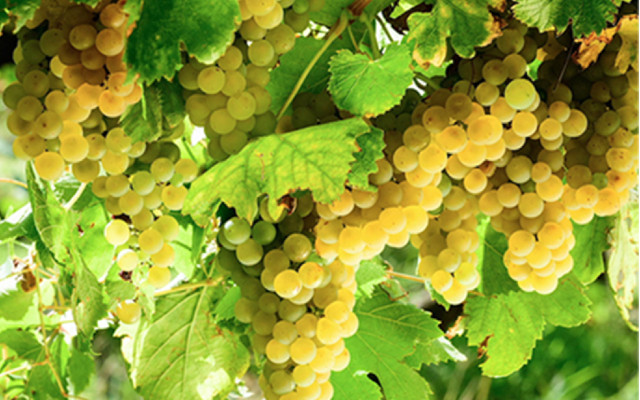
Eight municipalities in the Sabato valley, a vine mentioned by Latin authors, the sulfur mines of the nineteenth century. The rules of the Greco di Tufo DOCG after the 2020 changes, with Riserva and Spumante Riserva, and the numbers of a production close to 40,000 hectolitres.
The Greco di Tufo PDO is, with the Fiano di Avellino PDO and the red Taurasi DOCG, one of the three guaranteed denominations of Irpinia. It comes from grapes Greco in a restricted area of the province of Avellino, eight municipalities along the Sabato valley, and takes its name from Tufo, the municipality which is its historic centre. It is a white wine with good acidity and flavour, also produced in the Reserve and Classic method Spumante versions (Greco di Tufo specifications, articles 1, 2 and 3).
Irpinia is an important wine-growing province in Campania. According to the Irpinia Sannio Chamber of Commerce, the province of Avellino represents 24.7% of the regional vineyard area and 19.3% of production; denomination of origin (DOP) wines express approximately 31% of provincial production and, among these, whites represent 84.4% (Irpinia Sannio Chamber of Commerce, 2026). Following, the history of the denomination, the grape variety, the specifications, the market, the characteristics of the wines and the pairings.
DOCG recognition, Reserve and Sparkling Reserve mentions
Greco di Tufo was first recognized as DOC in 1970, then as DOCG in 2003. The specifications were modified in 2011, 2014 and 2020 (Greco di Tufo specifications, introduction). The ministerial decrees of October 2020 introduced the mentions Reserve for the white wine and Sparkling Reserve, approximately three years after the request from the Consortium for the protection of Irpinia wines (Guerriero, 2020).
Aminea Gemina, Pompeii and Tufo sulphur
The specification links the vine to the ancient one Aminea Gemina cited by Latin authors and recalls a fresco from Pompeii of the 1st century BC that mentions the 'Greek' wine (Greco di Tufo disciplinary, article 9). The link between today's Greek and the wines of antiquity remains a documentary tradition rather than a genetic fact.
More recent and better documented is the history of sulphur. In the nineteenth century the discovery of sulfur deposits at Tufo favoured the spread of the vine and the practice of sulphuring (Greco di Tufo regulation, article 9). The mines, owned by the Di Marzo family, remained active until the early 1970s; the Molino Giardino mill, started in 1870, processed the mineral (De Palma, 2015). The technical report to the 2020 modification proposal also recalls that the 1815 cadastre recorded in the area approximately 286 tomoli of vineyard, a surface slightly larger than today's (MIPAAF, 2020).
The Greco vine and its variability
The Grape variety, called Greco or white Greco, must be distinguished from the white Greco of Calabria, the basis of the Greco di Bianco DOC. A study by the University of Naples Federico II examined 17 Greco clones collected in various companies in the production area. The qualitative morphological characters were uniform and the quantitative ones of the bunch and berry were little variable, while the molecular markers SSR and REMAP revealed differences between the clones, more evident with the latter. The authors underline the importance of these data for the management and protection of clonal selections (Villano et al., 2023).
The Greco di Tufo PDO regulations
The Production zone includes the entire territory of Tufo, Altavilla Irpina, Chianche, Montefusco, Prata di Principato Ultra, Petruro Irpino, Santa Paolina and Torrioni, in Avellino province. The wine comes from at least 85% Greco, with white Coda di Volpe up to 15% (Greco di Tufo regulations, articles 2 and 3). Only well-exposed hillside vineyards are allowed, with the exclusion of humid and little sunny valley bottoms, in a range between 300 and 650 metres; the new plants must have espalier training methods and at least 2,500 vines per hectare (Greco di Tufo regulations, articles 4 and 9).
The maximum yield is 10 tons of grapes per hectare, with a minimum natural alcoholic strength of 11% vol and a wine yield of no more than 70%; the vinification must take place in the province of Avellino (Greco di Tufo regulations, articles 4 and 5). There Reserve requires at least 12 months of aging from November 1st of the year of harvest. The Spumante and Spumante Riserva are produced exclusively with classic method, with at least 18 and 36 months on the yeasts from the draft (Greco di Tufo regulations, article 5). The year on the label is mandatory, except for sparkling wines; still wines must use a level cap (Greco di Tufo regulations, articles 7 and 8).
| Type | Minimum ageing | Minimum total strength | Minimum total acidity | Minimum non-reducing extract |
| Greco di Tufo | No obligation | 11.5% vol | 5.0 g/l | 16.0 g/l |
| Greco di Tufo Riserva | 12 months from November 1st | 12% vol | 5.0 g/l | 17.0 g/l |
| Greco di Tufo Spumante | 18 months on the lees | 12% vol | 6.0 g/l | 15.0 g/l |
| Greco di Tufo Spumante Riserva | 36 months on the lees | 12% vol | 6.0 g/l | 16.0 g/l |
The Greco di Tufo market
No recent official data are available for this individual denomination. The technical report published by the ministry in 2020 indicated final production close to 40,000 hectolitres, equal to approximately 5.3 million 0.75 liter bottles, compared to a potential of approximately 60,000 hectoliters, with actual yields of 8-10 tons per hectare (MIPAAF, 2020).
The most recent picture concerns the province. In 2025, wine exports from the province of Avellino fell to 21.5 million euros (-6.4%), with a 30% drop towards the United States; there are 856 wine-growing companies in Irpinia (Irpinia Sannio Chamber of Commerce, 2026). The Consortium for the protection of Irpinia wines, chaired by Teresa Bruno, protects the Greco di Tufo DOCG together with the Fiano di Avellino DOCG, the Taurasi DOCG and the Irpinia DOC.
Wine characteristics
The regulations describe still wines with colour straw yellow and flavour dry and fresh; sparkling wines have fine and persistent foam, with dosage ranging from extra brut to extra dry (Greco di Tufo regulations, article 6).
The clayey, sandy or calcareous soils, rich in clay, magnesium and potassium, and the climate influenced by the woods and rainy autumns contribute, according to the specification, to the balance between acidity and structure of the wine (Greco di Tufo regulations, article 9).
The young versions are fresh and savoury, with notes of white-fleshed fruit and citrus; the Reserves and wines with a few years of bottle age develop more complex notes and an almond finish.
Food pairings
Young Greco di Tufo pairs with seafood appetisers, raw preparations, shellfish, grilled fish and fresh cheeses such as Mozzarella di Bufala Campana PDO. The Reserve supports baked fish, white meats, risottos and medium-aged cheeses. Classic method sparkling wine goes well with aperitifs, fried foods and shellfish.
Dario Dongo
Credit cover: Consorzio Tutela Vini d'Irpinia
References
Regulations and national acts
Production regulations for 'Greco di Tufo' DOCG wines, approved with Ministerial Decree 18.7.2003 (GU n. 180 of 5.8.2003), last modification by Ministerial Decree 13.10.2020 (GU n. 266 of 26.10.2020) and ordinary modification published in OJEU C 61 of 22.2.2021. https://aisitalia.it/Disciplinari/Campania/DOCG/Greco di Tufo.pdf
MIPAAF. (2020). Proposal for ordinary modification of the production specifications of the controlled and guaranteed designation of origin of 'Greco di Tufo' wines. Press release, GU General series n. 222 of 7.9.2020 (20A04749). https://unionalimentari.com/wp-content/uploads/2024/09/MIPAAF-produzione-produzione-vino-Greco-di-Tufo.pdf
Scientific literature
Villano, C., Corrado, G., Basile, B., Di Serio, E., Mataffo, A., Ferrara, E., & Aversano, R. (2023). Morphological and genetic clonal diversity within the 'Greco Bianco' grapevine (Vitis vinifera L.) variety. Plants, 12(3), 515. https://doi.org/10.3390/plants12030515
Institutional sources
Chamber of Commerce Irpinia Sannio. (2026, April 8). Press release on the wine sector, Vinitaly 2026. https://www.irpiniasannio.camcom.it/sites/default/files/contenuto_redazione/pagina_base/allegati/Comunicato%20Stampa%20settore%20vitivinicolo.pdf
Trade press
De Palma, F. (2015, June 13). A park with the industrial archeology of the Sabato Valley. Irpinia newspaper. https://www.giornalelirpinia.it/index.php/component/content/article/3-cultura/10416-un-parco-dallarcheologia-industriale-della-valle-del-sabato
Guerriero, F. (2020, October 31). Consortium for the Protection of Irpinia Wines, approval of disciplinary changes. Binews. https://www.binews.it/vini-sapori-dintorni/consorzio-tutela-vini-dirpinia-approvazione-modifiche-disciplinari/

Dario Dongo, lawyer and journalist, PhD in international food law, founder of WIISE (FARE - GIFT – Food Times) and Égalité.


