

The news of Coop Italy's landing on the global ecommerce champion last month went almost unnoticed. Alibaba, China and food Made in Italy. An opportunity for all, to accept the invitation of the amazing Jack Ma? (1) Some brief reflections to follow.
Communication in general and politics in particular tend to generalize, without making the appropriate distinctions in size and numbers. It is instead useful to face reality. To successfully tackle a market with dimensions and characteristics like that of the PRC, substantial resources (financial, human, time), accurate market analysis and medium-long term strategies are necessary. Which very few groups have, in the Italian landscape of food & drink.
A preliminary consideration serves to introduce the concept. The US giants dominating the digital market of the West, despite huge investments made, have so far failed to penetrate the Chinese market (see infographic on 2016 data).
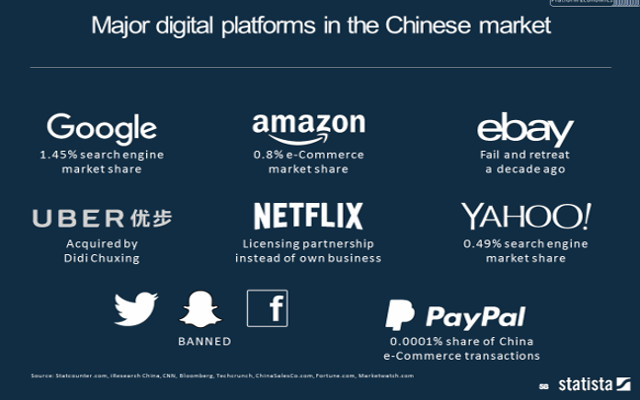
It could be argued that protectionism prevailing in the Chinese market is stronger in sectors with high added value and internally replicable. The services offered by the aforementioned US giants are indeed guarded by Chinese groups (Alibaba, Baidu, Tencent, Huawei) who effectively control and dominate the domestic market.
Italian food could have better chances, thanks to iconic brands and inimitable products. Provided however that such intangible values are backed by a level of organization, financial capability and investments accessible to very few. The venture could instead prove unsuccessful for SMEs, whose products risk being 'cloned' by international giants (with good memory of the global success of Parmesan under the Kraft brand) before reaching sales volumes and the cash flow necessary to reorganize large-scale productions.
Therefore, one must not underestimate the ability of local producers to emulate processes historically believed unrepeatable. Thanks also to the acquisition of know how and original technologies, as in the case of canned tomatoes. (2) Or the purchase of entire companies, such as the Salov oil mill of Lucca – owner of the ‘Filippo Berio’ brand – by the Chinese group Yimin in 2014. (3)
Volumes are decisive. With due proportions, China represents for the largest Italian operators what mass retail represents in Italy for artisans. The perspective is to significantly increase revenues without giving up their own identity and product quality. And if the commercial practices of European mass retail are unfair, those of Amazon go far beyond. Among other things, shipment of goods to the PRC and rental of warehouse space at the supplier's expense are required. Awaiting sale (preceded bycustoms clearance on demand), on which moreover there are no guarantees.
Thus the circle closes, to return to the starting point. Financial solidity, organization, investments are needed. Without forgetting the brand. Which must not only be registered but also made known – even before visible – in the most populous country in the world. Where to this day brand as Amazon or eBay have little meaning, an understatement. Otherwise, better look elsewhere.
We therefore wish the country system that Coop Italia may take on the role of Marco Polo of the 3rd millennium. And perhaps, that other operators of the Italian large-scale retail trade decide to follow it. A new route towards the Middle Kingdom must be opened, for Italian agri-food productions.
Dario Dongo and Fabio Ravera
Notes
(1) The intellectual stature of Jack Ma can be understood by listening to his memorable lesson of history and geopolitics, to the other world leaders, this year in Davos https://youtu.be/sC6IgkDg46E
(2) Cf. http://www.internazionale.it/reportage/stefano-liberti/2017/04/08/pomodoro-cina-italia
(3) Despite the rhetoric about the Italian-ness of Italian foods and the origin of their raw materials, the Spanish extra virgin olive oil under the Filippo Berio brand (Chinese-owned) represented Made in Italy at the last Los Angeles Times food and wine festival

Specialist in distribution models and Revenue Operations with over 25 years of projects in industrial sectors and different countries (12 years in the US). I work on lean organizations, Supply Chain inefficiencies, organizational and financial restructuring projects, Digitization and GDPR


