

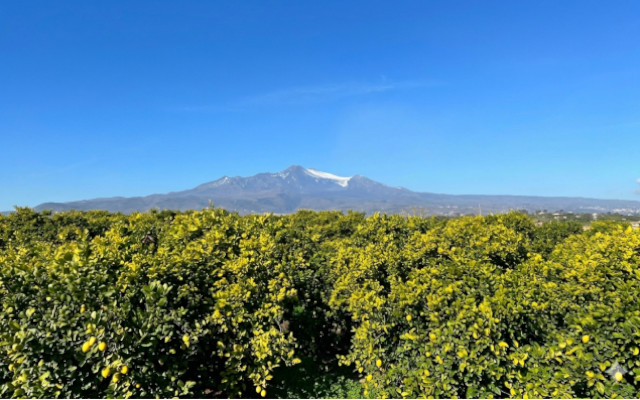
The Etna Lemon PGI is the lemon cultivated along the Ionian-Etna belt of the province of Catania, between the Alcantara River to the north and the northern border of the municipality of Catania. The protected geographical indication, registered by the European Union in October 2020, concerns two cultivars e three harvests per year, from autumn to summer. The specifications attribute the specificity to the volcanic soils, to the climate mitigated by the sea, to the high content of citral in the essential oils of the peel and to the technique of forcing, which allows the harvesting of verdelli in the summer months.
GIFT has already dedicated an in-depth study to the verdello and the two Sicilian PGIs that protect it. This sheet concerns the denomination as a whole: rules, territory, analysis, market, nutrition, and uses.
Production and market
In Italy The lemon occupies about 25 thousand hectares, with a production of 472,000 tons in 2023 (Istat, 2024). The Sicily concentrates about 70% of the national citrus production.
No data on certified PGI volumes are published: one year after registration, the producers' association estimated about 75 thousand tons annually as the potentially marketable production. The single Etna’s business network, based in Acireale, declares 150 hectares and about 5,000 tons per year, distributed throughout all seasons.
The domestic market rewards denominations. According to CSO Italy surveys in large-scale retail (February 2026), the 8% of volumes of lemons purchased by families are branded PGI and the protection marks appear in 6% of private label references. Large-scale retail intercepts almost 90% of domestic volumes, of which 54% in supermarkets, and 85% of shelf references are of national origin.
The exports of Italian lemons grew by over 40% in 2025, both in volume and value (Fruitimprese on Istat data), and in the first half of 2026 they recorded a further +17.04% in value.
From agrocotto to IGP, two centuries of Etnean lemon growing
The cultivation of lemon spreads on Etna at the end of the eighteenth century, driven by maritime trade from the ports of Riposto and Catania and by the demand for agrocotto, the concentrated juice used in shipping and Northern European countries against scurvy (regulation, article 6).
In 1841 the French traveler Viscount De Marcellus notes the granitas of Giarre, prepared with freshly picked lemons and Etna snow. In the 1869 Paolo Calì Fiorini, president of the Agricultural Committee of the district of Acireale, invites to plant lemons for their profitability. The entrepreneurs of Acireale respond with reclamation and ston removal works, first near the coast and then up to 300-400 meters altitude. Federico De Roberto, in ‘Viceré’ (1894), describes the excavations among the Mongibello lava in search of water for orange and lemon groves (regulation, article 6).
In the 1922 Giulio Savastano publishes in the Annals of the Royal Experimental Station of Citrus and Fruit Growing of Acireale a study on the cultivation biology of the lemon on the eastern Etnean slope, which already identifies an ‘Etnean lemon region’ basically coincident with the current IGP area.
The decline arrives in the last decades of the Twentieth century. At the beginning of the 1980s the lemon surface of the area was 9,500 hectares (Carrà, 1984, cited in the specification), while today the surface potentially claimable as a Protected Geographical Indication is estimated at 2,500-3,000 hectares. In the 2014 producers and packers constitute the Etna Lemon Association. Registration PGI arrives with the implementing regulation (EU) 2020/1533. The protection consortium, established in December 2021, obtained ministerial recognition in November 2023.
Specifications: territory, cultivars and three harvests
Production area and soils
The production area includes sixteen municipalities of the province of Catania: Aci Bonaccorsi, Aci Castello, Aci Catena, Aci Sant'Antonio, Acireale, Calatabiano, Castiglione di Sicilia, Fiumefreddo di Sicilia, Giarre, Mascali, Piedimonte Etneo, Riposto, Santa Venerina, San Gregorio di Catania, Valverde and Zafferana Etnea (disciplinary, article 3).
I soils sono di matrice vulcanica, permeabili, fertili e ricchi di sostanza organica. Il clima è mitigato dal mar Ionio. Nella nota che ha accompagnato la registrazione, la Commissione Europea ha richiamato anche la ‘particolare tecnica di coltivazione, che consente la produzione estiva’.
Cultivars, types and juice parameters
The PGI is reserved for Femminello and its clones and to the Monachello, della specie Citrus limon (L.) Burm. Ciascuna cultivar dà tre tipologie, che si distinguono per l’epoca di raccolta:
- Primofiore, winter lemon, harvested from September 15 for Femminello and October 15 for Monachello;
- Bianchetto o Maiolino, limone primaverile, raccolto dall’1 aprile;
- verdello, summer lemon, harvested from May 15.
The requirements of the juice are common to all types: acidity above 5.5%, total soluble solids over 7 degrees Brix, and essential oil yield above 0.3%. Juice yield ranges from over 25% for Monachello verdello to over 34% for Femminello primofiore. The minimum weight is 90 g for Femminello primofiore and 80 g for verdelli. Fresh fruit is sold in categories Extra and First, calibers from 3 to 6 (regulation, article 2).
Fruits destined for processing may have different category, size, shape, weight, and color, provided they comply with juice and essential oil parameters (regulation, article 2).
Forcing and verdelli
The forcing, or 'dry', suspends irrigation during the summer months and induces controlled water stress. The resumption of irrigation and fertilization causes a new flowering, from which the verdelli of the following summer are born. The regulation links this practice, evidenced for over two centuries, to the permeability of volcanic soils (regulation, article 6).
Cultivation, harvesting and labeling
Operating rules directly affect yield, peel quality, and product traceability:
- maximum density of 700 plants per hectare, up to 1,400 in the first six years in dynamic planting systems;
- maximum production of 60 t/ha for the entire campaign, including all flowering;
- harvesting with scissors, except for products intended for processing;
- ban on synthetic waxes and fungicides after harvesting, ensuring edible peel;
- bollino con il logo della IGP, due limoni e la scritta ‘Limone dell’Etna IGP‘, sul 100% dei frutti venduti sfusi;
- label 'Etna Lemon PGI intended for processing', with cultivar and batch, on packaging or transport documents for the industry (regulation, articles 5 and 8).
The designation allows both conventional and organic cultivation, now regulated by EU regulation 2018/848.
Citral, juice and minerals: what the analyses say
The distinctive feature claimed by the regulation is chemical. The essential oils of the Etna lemons, according to CREA-OFA analyses in Acireale, have an average content of citral (a mixture of geranial and neral aldehydes) of 3.61%, against 3.49% for Siracusa lemons and 3.29% for those from Bagheria. The same studies indicate in the verdelli of both cultivars the highest content of flavonoids (regulation, article 6).
A study by the University of Messina (Di Bella et al., 2026) compared Sicilian citrus fruits grown on volcanic soils (Etna and Stromboli) and non-volcanic (Marsala). Fruits from volcanic areas show higher concentrations of minerals such as potassium, phosphorus, iron and aluminum. Discriminant analysis correctly classified all samples by origin. These data, presented by the authors as a proof of concept on an orchard per area, suggest the potential of the elemental fingerprint as a tool for verifying the origin of lemons, also useful for PGI controls.
Nutritional profile
The food composition tables indicated by CREA — Food and Nutrition Research Center (2019) report the following nutritional values for fresh lemons (code 008030; edible portion 64%, serving 150 g).
| Per 100 g of edible portion | Value |
| Energy | 65 kJ / 16 kcal |
| Fat | 0 g |
| of which saturated fatty acids | 0 g |
| Carbohydrates | 2.5 g |
| of which sugars | 2.5 g |
| Fiber | 1.9 g |
| Proteins | 0.6 g |
| Salt | 0.005 g |
| Vitamin C | 50 mg (62.5% NRV) |
Gli operatori possono quindi utilizzare il nutrition claim ‘rich in vitamin C' in labeling and advertising of both fresh fruit and juice, pursuant to regulation (EC) no. 1924/06. Lemon juice, according to CREA tables (code 008040), provides only 10 kcal and as much as 43 mg of vitamin C per 100 ml (53.8% NRV).
Il regolamento (UE) n. 432/2012 a sua volta autorizza l’impiego dell’health claim ‘la vitamina C contribuisce alla normale funzione del sistema immunitario’ sui prodotti che ne costituiscono fonte.
Our team of DO (Food and Agriculture Requirements) supports operators, their representatives and consortia — including research ones — in enhancing foods also from a nutraceutical point of view.
Uses in cooking and processing
The Limone dell’Etna IGP regulation recalls the local uses of lemon as seasoning, flavoring and base for granitas, and the habit of drinking lemon juice in half a glass of water upon waking (regulation, article 6).
The lemon granita, today a summer breakfast of eastern Sicily with brioche, has in the recipe of the Cucchiaio d’Argento lemon juice and grated lemon zest, water, sugar. Among the ingredients the recipe indicates the ‘edible peel‘, a requirement that Limone dell’Etna IGP satisfies due to the ban on post-harvest treatments. In the kiosks of Catania the drink of seltzer, lemon and salt persists.
The ban on waxes and synthetic fungicides makes the peel usable in pastry, candied fruit e liqueurs, starting from limoncello. The processing industry can use juice, peels and essential oils, with the dedicated label that ensures traceability of the IGP raw material also in semi-finished products.
Guidelines for buyers and consumers
Some elements allow to recognize and appreciate the authentic product:
- the IGP label on each loose fruit and, on packages, the cultivar (Femminello or Monachello) and the category;
- the usable peel, guaranteed by the ban on post-harvest treatments, without the need for the label ‘edible peel’;
- The organic certification, allowed by the regulation, which guarantees the application of the highest standards of environmental and biodiversity protection;
- for the industry, the minimum parameters of the juice (acidity, Brix, essential oil yield) and the label ‘destined for processing’ on packaging or transport documents.
Conclusions
Il Limone dell’Etna IGP offre limoni italiani freschi dodici mesi l’anno, con verdelli disponibili in estate, scorza priva di trattamenti post-raccolta e parametri di succo e oli essenziali fissati per legge. Sono caratteristiche che interessano la ristorazione, la pasticceria, l’industria di succhi e liquori e la grande distribuzione, dove la quota IGP è in crescita. La filiera deve ancora rendere pubblici i volumi certificati, dato essenziale per i buyer internazionali.
Dario Dongo
Credit cover Consorzio di tutela del Limone dell’Etna IGP
References
European Union regulatory sources
Commission Implementing Regulation (EU) 2020/1533 of 15 October 2020 entering a name in the register of protected designations of origin and protected geographical indications (‘Limone dell’Etna’ (PGI)). OJ L 351, 22.10.2020, p. 1. http://data.europa.eu/eli/reg_impl/2020/1533/oj
Publication of an application for registration of a name pursuant to Article 50(2)(a) of Regulation (EU) No 1151/2012, ‘Limone dell’Etna’, EU No PGI-IT-02444. OJ C 204, 18.6.2020. https://eur-lex.europa.eu/legal-content/EN/TXT/?uri=CELEX:52020XC0618(11)
Regulation (EU) 2024/1143 on geographical indications for wine, spirit drinks and agricultural products, as well as traditional specialities guaranteed and optional quality terms for agricultural products. Consolidated text: 18/03/2026. http://data.europa.eu/eli/reg/2024/1143/2026-03-18
Regulation (EU) No 1169/2011 on the provision of food information to consumers. Consolidated text: 01/04/2025. http://data.europa.eu/eli/reg/2011/1169/2025-04-01
Regulation (EC) No 1924/2006 on nutrition and health claims made on foods. Consolidated text: 13/12/2014. http://data.europa.eu/eli/reg/2006/1924/2014-12-13
Commission Regulation (EU) No 432/2012 establishing a list of permitted health claims made on foods. Consolidated text: 20/08/2025. http://data.europa.eu/eli/reg/2012/432/2025-08-20
Regulation (EU) 2018/848 on organic production and labelling of organic products. Consolidated text: 25/03/2025. http://data.europa.eu/eli/reg/2018/848/2025-03-25
Italian institutional sources
CREA Centro di ricerca Alimenti e Nutrizione. (2019). Tabelle di composizione degli alimenti. Limoni, freschi (008030). https://www.alimentinutrizione.it/tabelle-nutrizionali/008030
CREA Centro di ricerca Alimenti e Nutrizione. (2019). Tabelle di composizione degli alimenti. Limoni, succo (008040). https://www.alimentinutrizione.it/tabelle-nutrizionali/008040
Istat. (2024). Annuario statistico italiano 2024, capitolo 13, Agricoltura, tavola 13.2. https://www.istat.it/storage/ASI/2024/capitoli/C13.pdf
Ministero delle politiche agricole alimentari, forestali e del turismo. (2018, 18 ottobre). Proposta di riconoscimento della indicazione geografica protetta ‘Limone dell’Etna’. Gazzetta Ufficiale della Repubblica Italiana, Serie generale (codice redazionale 18A06631). Official Gazette, 18.10.2018, 18A06631
Scientific studies
Di Bella, G., Nava, V., Potortì, A. G., Sturniolo, R., & Lo Turco, V. (2026). Multi-element analysis of Sicilian citrus fruits from volcanic and non-volcanic areas for geographical authentication and food safety assessment. Foods, 15(17), 3008. https://doi.org/10.3390/foods15173008
Market data and industry press
Askanews. (2026, 11 febbraio). Cresce il consumo di limoni a marchio IGP, è l’8% in GDO. https://www.radiostudio90italia.it/cresce-il-consumo-di-limoni-a-marchio-igp-e-l8-in-gdo/
Consorzio di tutela del Limone dell’Etna IGP. (s.d.). La storia e il Consorzio. https://limonedelletnaigp.it/il-consorzio/
FocuSicilia. (s.d.). Limone dell’Etna: da un anno IGP, pronto per il mercato. https://focusicilia.it/limone-delletna-da-un-anno-igp-pronto-per-il-mercato-il-migliore-al-mondo/
FreshPlaza. (2025). Il ‘Limone dell’Etna IGP’ amplia la presenza nella grande distribuzione organizzata. https://www.freshplaza.it/article/9701613/il-limone-dell-etna-igp-amplia-la-presenza-nella-grande-distribuzione-organizzata/
FreshPoint Magazine. (2026). Export ortofrutta da record nel 2025: +11% in valore e +8,1% in volume. https://www.freshpointmagazine.it/produzione-mercati/export/export-ortofrutta-italia-2025-dati-esportazioni-fruitimprese/
Rivista di Frutticoltura e Ortofloricoltura. (2026). Ortofrutta, per l’export italiano +4,4% nel primo semestre. Ma crescono costi e import. https://rivistafrutticoltura.edagricole.it/economia-politica/ortofrutta-per-lexport-italiano-44-nel-primo-semestre-ma-crescono-costi-e-import/
Recipes
Cucchiaio d’Argento. (s.d.). Granita al limone. https://www.cucchiaio.it/ricetta/granita-al-limone/

Dario Dongo, lawyer and journalist, PhD in international food law, founder of WIISE (FARE - GIFT – Food Times) and Égalité.


