

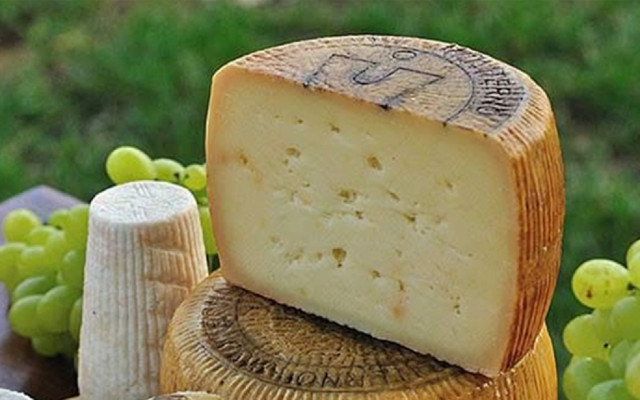
The canestrato is a family of cheeses united by an ancient gesture: the shaping of curd in a basket of rush or wicker, which imprints the characteristic weave on the rind and favors the purging of the whey. It is a sheep's cheese from the South and central Apennines, linked to the transhumance and spread from Abruzzo to Sicily.
Two of these Italian cheeses receive specific protection in European Union law, Canestrato Pugliese PDO and Canestrato di Moliterno PGI. Others - such as the Canestrato from Castel del Monte in Abruzzo and the Sicilian canestrati - are instead included in the lists of Traditional Agri-food Products, whose value pertains to the culture of the Italian regions.
The historical origins of canestrato
The 1st century A.D. and the treaty of Columella
In 1st century A.D. Lucius Junius Moderatus Columella describes in De re rustica a cheese-making technique that canestrato cheeses preserve to this day:
- It curd, once firmed, 'in fiscellas aut in calathos vel formas transferendus est', that is, it is transferred in baskets, small baskets or moulds, and weights are placed on it to release the whey (Columella, De re rustica, VII, 8);
- It salting with ground salt and the resting of the moulds on very clean boards, in a closed room sheltered from the wind. Columella also uses the term mulctra, the milking bucket: the same Latin root to which, eighteen centuries later, historian Giacomo Racioppi would trace back the name of Moliterno.
The Tavoliere and the Customs of sheep, 1447-1806
Puglian canestrato is born from the great transhumance which united the summer pastures of Abruzzo to the Tavoliere plains. In 1447 Alfonso I of Aragon established the Royal Customs of the movement of sheep, which organized for nearly four centuries the passage of flocks along the tratturi – the ancient grassy routes of transhumance – until the suppression decided by Joseph Bonaparte in 1806 (State Archive of Foggia, n.d.; Rainone, 2019).
I compact and aging-capable ewe's milk cheeses produced in Capitanata during the winter stay of the flocks in the plains are the ancestors of today's Canestrato Pugliese DOP. In 2019, transhumance was inscribed by UNESCO in the list of the Intangible Cultural Heritage of Humanity.
Moliterno and the fondacs, from the eighteenth to the twentieth century
The cheese production of Moliterno, in Val d'Agri, has been documented since from the Eighteenth Century. The PGI specification recalls Racioppi, a nineteenth-century historian from Molitera, who derived the toponym from Latin mulctrum, or 'place where milk is made, that is, where the herd is milked and the milk coagulates'. The Moliternese Franciscan Father Daniele Murno describes the mule caravans which, in winter and spring, descended towards the Ionian coast to collect fresh pecorino, with round trips lasting four to six days.
The wheels were then entrusted to cellars of the country for maturing. In 1906, a single producer, registered among the exporters of Basilicata, shipped around 130 tons of matured cheese, destined for other Italian regions and abroad, especially the Americas. There Gentile di Lucania sheep, main breed of the area, derived from crosses with merino rams started in the 15th century (specification, article 6).
Sicily and the gabella contracts of the fifteenth century
In Sicily the canestrato, also called 'cow', appears in the 15th century gabelle contracts among the products to be delivered each year to the gabellotto as rent for the large estate. The Palermo dairy price list of 1407 records it as 'tumazza', that of 1412 as 'cacio vacchino'. In 1562 it was included in the diet of the nuns of the monastery of San Castrenze in Monreale (ONAF, s.d.-b).
Canestrato Pugliese PDO
The Canestrato Pugliese PDO it has been recognized as a designation of origin in Italy since 1985 and registered as a PDO in 1996 (EC reg. 1107/96). The production area includes the entire province of Foggia and sixteen municipalities of the Murgia, originally all in the province of Bari, including Altamura, Andria, Gravina in Puglia, Santeramo in Colle and Spinazzola (regulation, article 3).
Raw milk and animal rennet
Canestrato Pugliese is one of nine Italian ovine PDO cheeses for which not è permitted any heat treatment of milk (Natrella et al., 2023). It is obtained exclusively from whole sheep milk of one or two daily milkings, from flocks fed with green or dried forages from the natural pastures of the area, supplemented with hay and exceptionally with simple concentrated feed. The milk coagulates between 38 and 45 °C with only animal rennet; salting is done dry or in brine, and aging lasts from two to ten months in cool and slightly ventilated rooms (specification, article 2).
A study by the University of Bari confirmed the value of this choice: the microbial flora native microbiota of raw milk accelerates proteolysis, while forms obtained from thermized milk lose part of their typical sensory characteristics (Natrella et al., 2023). The consumption of raw milk and raw milk dairy products – outside of aged cheeses alone – must in any case be avoided by vulnerable consumers (children, pregnant women, elderly people and immunocompromised individuals) to prevent the risk of foodborne illnesses linked to pathogenic bacteria such as Listeria m. and E. Coli STEC that only pasteurization can inactivate.
Shape, rind and paste of the finished product
It shape is cylindrical, with flat faces of 25-34 cm in diameter, height of 10-14 cm and weight of 7-14 kg. The rind, brown tending to yellow, more or less wrinkled, hard and thick, is treated with olive oil, possibly mixed with wine vinegar. There Pasta is straw-coloured more or less intense, compact, rather friable, fairly melting and not very elastic, with scarcely visible fat eyes. The flavour is peppery, characteristic and rather pronounced; the fat on the dry matter does not fall below 38%. The cheese is consumed at table and, after at least six months of ageing, also as a grating cheese (regulation, article 2).
Canestrato di Moliterno PGI
The Canestrato di Moliterno PGI has been registered since 2010 (Reg. EU 441/2010). An ordinary amendment in 2024 expanded the milk production area, which now includes municipalities in the provinces of Potenza and Matera, and added the Grigia Lucana and Rossa Mediterranea goat breeds to the permitted breeds (communication C/2024/3834).
Sheep-goat milk and lamb or kid rennet
The cheese is obtained from whole sheep milk for 70-90% and from whole goat milk for 10-30%, raw or thermized, from Gentile di Puglia, Gentile di Lucania, Leccese, Sarda, Comisana sheep and their crosses and from Garganica, Grigia Lucana, Maltese, Jonica, Camosciata, Rossa Mediterranea goats and their crosses. The rennet is obtained from the stomachs of suckling lambs or kids, dried, salted and ground. The milk coagulates at 36-40 °C in no more than 35 minutes; the curd, broken to rice grain size, is placed in reed baskets or other permitted materials, which leave streaks on the crust. This is followed by possible immersion in the serum at no more than 90°C for a maximum of three minutes dry salting up to ten days or in saturated brine for 10-12 hours per kilogram, and drying in the dairy for 30-40 days (regulation, article 5).
Ageing in the fondacs
It aging, minimum 60 days, takes place exclusively in cellars of Moliterno, environments at over 700 meters above sea level with walls at least 40 cm thick, at least two ventilation openings and at least two underground walls. There rind is treated with olive oil, alone or emulsified with wine vinegar, or with soot water, obtained by boiling the soot scraped from wood-burning chimneys: in this case the rind turns to slate black (regulation, article 5).
A study published in the Journal of Dairy Science compared wheels aged in cellars and in climate-controlled rooms. In the cellar, lacking artificial temperature and humidity control, maturation was faster, with greater casein degradation, more free amino acids and more volatile aromatic compounds, and the cheese developed a distinct sensory profile (Faccia et al., 2022).
Primitivo, Stagionato and Extra
It shape is cylindrical, with faces of 15-25 cm, sides of 10-15 cm and weight of 2-5.5 kg. The rind, inedible, ranges from the more or less intense yellow of the Primitivo (up to six months) to the brown of the Aged (from six to twelve months) and Extra (over twelve months). The paste is compact, with irregular eyes, white or slightly straw-colored in Primitivo and more or less intense straw-colored in other types. The flavour, sweet and delicate in young forms, becomes savory and spicy with maturation; the fat on the dry matter is at least 30%. Primitivo is a table cheese, Stagionato and Extra are also for grating (regulations, articles 2 and 8).
Canestrato di Castel del Monte, the cheese of Gran Sasso
On the Aquilan side of Gran Sasso, in the municipalities of Barisciano, Calascio, Castel del Monte and Villa Santa Lucia, the Canestrato di Castel del Monte, registered among the Traditional Agri-Food Products of Abruzzo and Slow Food Presidium. The similarity with the Apulian canestrato reveals the common origin in the transhumance that connected the Tavoliere to the pastures of Campo Imperatore (Abruzzo Region, in ONAF, s.d.-a). Even today, at the end of spring, shepherds take their flocks up to altitude with one vertical transhumance which ensures 8-10 months of grazing (Gambero Rosso, s.d.-a).
The cheese is obtained from raw whole sheep's milk sheep milk from Gentile di Puglia, Sopravissana, Comisana, Pagliarola, Sarda breeds or their crosses, heated to 38-40 °C and coagulated with animal rennet, preferably ovine or caprine. The curd, broken with thorn to the size of a corn kernel, remains for two days in moulds of rush, being turned over at least four times. After dry salting, the wheels dry for 25-30 days on reed racks at 10-15 °C and then age for four to ten months. The finished product is cylindrical, from about 1.5 to 6-7 kg, with a hard rind marked by the mould and compact paste, white cream when young and straw-coloured with aging (Abruzzo Region, in ONAF, s.d.-a). Producers adhere to a Consortium for valorization with its own regulations (Slow Food Foundation, s.d.).
Sicilian canestrati
The list of Traditional Agri-Food Products of the Region Sicily includes canestrato, produced throughout the island, and the Canestrato vacchino from Gratteri, in the Palermo area (Sicilian Region, 2024). Unlike the Apennine basket cheeses, these are cheeses made from cow's milk raw whole milk, sometimes mixed with sheep's or goat's milk according to the shepherd's availability. The milk, heated to about 35 °C, coagulates with calf rennet paste; the curd, reduced to rice grain size, is hand-pressed in rush baskets and scalded in hot whey. On request, black peppercorns or chilli peppers are added. The cheese is sold as fresh tuma, primosale (8-10 days), secondo sale (2-4 months) or aged (over four months), in 5-20 kg wheels with wrinkled rind (ONAF, s.d.-b).
A recent study on fresh Sicilian basket cheese documented rich microflora it is an aromatic profile dominated by free fatty acids, followed by esters, alcohols, ketones and aldehydes (Pisana et al., 2025).
The nutritional profile according to CREA
The food composition tables indicated by CREA — Research Centre for Food and Nutrition (2019) do not include a dedicated entry for canestrato. The entry closest to hard-paste sheep canestrato is Sicilian pecorino (code 166070), to which the tables refer the nutritional values reported below, per 100 g.
| Nutrient | Per 100 g |
| Energy | 1.787 kJ / 427 kcal |
| Fats | 33.6 g |
| of which saturated fatty acids | not reported |
| Carbohydrates | 2.4 g |
| of which sugars | 2.4 g |
| Fibre | 0 g |
| Proteins | 28.9 g |
| Salt | 1.13 g |
| Calcium | 1.162 mg (145% NRV) |
| Phosphorus | 798 mg (114% NRV) |
| Vitamin A | 573 µg (72% NRV) |
Note: the percentages refer to the nutritional reference values mentioned in Annex XIII to Regulation (EU) No 1169/2011.
Proteins provide 27% of the energy, and the cheese meets the conditions of use of the 'ad' indications high protein', 'high in Calcium', 'high in Phosphorus' and 'high in Vitamin A' (EC regulation 1924/2006, Annex). A 50 g portion provides approximately 214 kcal, 14.5 g of protein and 581 mg of calcium, equal to 73% of the daily reference value. The values vary with maturation and with the fat content, which the specification sets at least 38% of the dry substance for Canestrato Pugliese PDO and 30% for Canestrato di Moliterno PGI.
Uses in the kitchen and pairings
Young canestrato is a cheese for the board, the aged one is suitable for grating and cooking. The Canestrato Pugliese PDO aged is grated at the moment onto Puglian ragù and on orecchiette with ragù (ONAF, s.d.-c) and appears in the filling of the bombette, the capocollo rolls from the Itria Valley.
The Canestrato di Moliterno PGI Primitivo goes well with well-structured white wines and fresh fruit and vegetables, while Stagionato and Extra require intense and persistent reds, with the traditional pairing with Aglianico del Vulture PDO; grated, adds flavor to pasta with ragù and soups (ONAF, s.d.-d). In Basilicata aged pecorino also enters the rafanata, the deep baked omelette with eggs and horseradish. The Canestrato di Castel del Monte pairs with Abruzzo cured meats on the board, the Sicilian canestrato Pepato is the protagonist of the island's appetizers.
Conclusions
From Columella's chapter on fiscelle to the warehouses of Moliterno, from the sheep tracks of the Customs of Foggia to the fuscelle of Campo Imperatore and the Sicilian fascedde, the canestrato tells of two thousand years of pastoral culture. Canestrato Pugliese PDO and Canestrato di Moliterno PGI protect its best-known expressions, while Canestrato di Castel del Monte and Sicilian canestrati preserve its variety. To recognize them, three gestures are enough: reading the rind, reading the label, knowing the seasoning.
Dairy and cheese companies can contact FARE (Food and Agriculture Requirements) for the strategic planning of commercial information compliance, in the environmental and sustainability fields (supply chains, processes and products) and on nutrition & health claims, also with support for the development of corporate governance systems and operating procedures.
Dario Dongo
Credit cover Canestrato di Moliterno PGI Protection Consortium
References
European Union regulatory sources
Commission Regulation (EC) No 1107/96 of 12 June 1996 on the registration of geographical indications and designations of origin under the procedure laid down in Article 17 of Council Regulation (EEC) No 2081/92. OJ L 148, 21.6.1996. http://data.europa.eu/eli/reg/1996/1107/oj
Commission Regulation (EU) No 441/2010 of 21 May 2010 entering a name in the register of protected designations of origin and protected geographical indications [Canestrato di Moliterno (PGI)]. OJ L 126, 22.5.2010. http://data.europa.eu/eli/reg/2010/441/oj
Publication of a communication of approval of a standard amendment to a product specification for a name in the agricultural products sector: 'Canestrato di Moliterno' (PGI-IT-0487-AM01). OJ C, C/2024/3834, 18.6.2024. http://data.europa.eu/eli/C/2024/3834/oj
Regulation (EU) 2024/1143 of the European Parliament and of the Council of 11 April 2024 on geographical indications for wine, spirit drinks and agricultural products, as well as traditional specialities guaranteed and optional quality terms for agricultural products. Consolidated text: 18/03/2026. http://data.europa.eu/eli/reg/2024/1143/2026-03-18
Regulation (EU) 2018/848 of the European Parliament and of the Council of 30 May 2018 on organic production and labelling of organic products. Consolidated text: 25/03/2025. http://data.europa.eu/eli/reg/2018/848/2025-03-25
Regulation (EU) No 1169/2011 of the European Parliament and of the Council of 25 October 2011 on the provision of food information to consumers. Consolidated text: 01/04/2025. http://data.europa.eu/eli/reg/2011/1169/2025-04-01
Regulation (EC) No 1924/2006 of the European Parliament and of the Council of 20 December 2006 on nutrition and health claims made on foods. Consolidated text: 13/12/2014. http://data.europa.eu/eli/reg/2006/1924/2014-12-13
Italian regulatory and disciplinary sources
Decree of the President of the Republic 10 September 1985. Production regulations for the designation of origin of the 'Canestrato pugliese' cheese. GURI n. 112 of 16.5.1986. Text: https://www.onaf.it/uploads/public/formaggi/1461_1-dop-canestrato-pugliese-disciplinare-iniziale.pdf
Production specifications for the pecorino cheese with protected geographical indication 'Canestrato di Moliterno'. Basilicata Region. https://regione.basilicata.it/giuntacma//files/docs/DOCUMENT_FILE_3095664.pdf
MASAF decree 6 February 2026, n. 59360. Update of the national list of traditional agri-food products (26th revision). GURI n. 40 of 18.2.2026.
Sicily Region (2024). List of traditional agri-food products. https://www.regione.sicilia.it/sites/default/files/2024-04/ELENCO~1.pdf
Scientific studies
Faccia, M., Natrella, G., Gambacorta, G., & Trani, A. (2022). Cheese ripening in nonconventional conditions: A multiparameter study applied to Protected Geographical Indication Canestrato di Moliterno cheese. Journal of Dairy Science, 105(1), 140-153. https://doi.org/10.3168/jds.2021-20845
Natrella, G., Gambacorta, G., Squeo, G., & Faccia, M. (2023). Impact of milk thermization on the quality characteristics of P.D.O. 'Canestrato Pugliese' sheep hard cheese. Foods, 12(5), 1080. https://doi.org/10.3390/foods12051080
Pisana, C., Caccamo, M., Barbera, M., Marino, G., Serio, G., Franciosi, E., Settanni, L., Gaglio, R., & Caggia, C. (2025). Comprehensive characterization of the microbiological and quality attributes of traditional Sicilian Canestrato fresco cheese. Foods, 14(17), 3123. https://doi.org/10.3390/foods14173123
Nutritional sources
CREA – Food and Nutrition Research Centre (2019). Food Composition Tables. Pecorino siciliano, code 166070. https://www.alimentinutrizione.it/tabelle-nutrizionali/166070
Historical sources
State Archive of Foggia (n.d.). The routes of transhumance. https://archiviodistatofoggia.cultura.gov.it/fileadmin/risorse/materiale_archivio/eventi/documenti/le_vie_della_Transumanza.pdf
Columella, L. I. M. (1st century A.D.). De re rustica, book VII, 8. The Latin Library. https://www.thelatinlibrary.com/columella/columella.rr7.shtml
Rainone, M. (2019). Dixit. Linguistic commentary on the procedural writings of the late eighteenth century of the Court of the 'Regia Dogana della mena delle sheep' of Foggia [Doctoral thesis, Sapienza University of Rome]. https://iris.uniroma1.it/bitstream/11573/1321699/1/Tesi_dottorato_Rainone.pdf
Product sheets
Slow Food Foundation (n.d.). Castel del Monte Canestrato, Slow Food Presidium. https://www.fondazioneslowfood.com/en/slow-food-presidia/castel-del-monte-canestrato/
ONAF (n.d.-a). Incanestrato di Castel del Monte, Abruzzo Region sheet. https://www.onaf.it/uploads/public/formaggi/6634_incanestrato-di-castel-del-monte-varie-scheda-regione.pdf
ONAF (n.d.-b). Canestrato, PAT Sicily Region. https://www.onaf.it/uploads/public/15326_canestrato.pdf
ONAF (n.d.-c). Canestrato from Puglia. https://www.onaf.it/uploads/public/16938_canestrato-pugliese.pdf
ONAF (n.d.-d). Canestrato di Moliterno. https://www.onaf.it/uploads/public/11760_canestrato-di-moliterno.pdf
Gastronomic sources
Gambero Rosso (n.d.-a). Abruzzese sheep cheese, guide to the best. https://www.gamberorosso.it/notizie/formaggio-di-pecora-abruzzesi-guida-ai-migliori/

Dario Dongo, lawyer and journalist, PhD in international food law, founder of WIISE (FARE - GIFT – Food Times) and Égalité.


